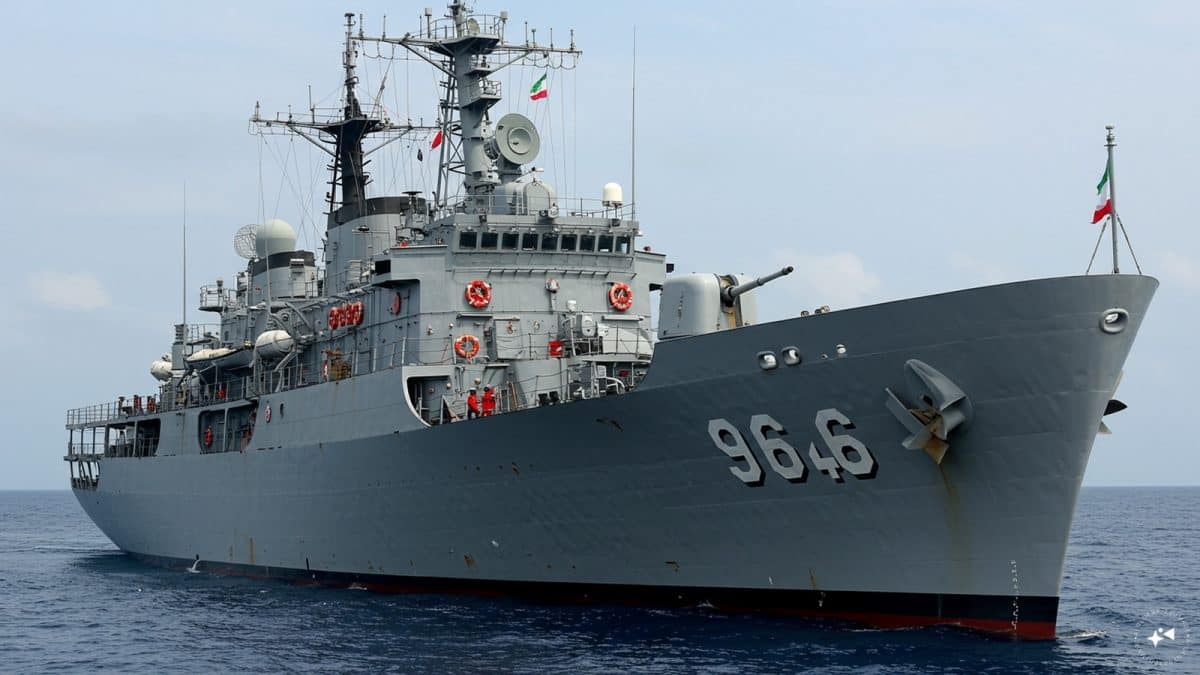
The evacuation of 208 sailors from the Iranian-flagged vessel MV Saviz by the Sri Lankan Navy (SLN) functions as a case study in the intersection of maritime humanitarian law and the escalating volatility of Indian Ocean "shadow war" dynamics. This operation was not merely a tactical extraction; it was a calibrated exercise in mitigating third-party risk during a period of peak kinetic friction between Iran and Israel. The SLN's decision to deploy its flagship, the P626 SLNS Gajabahu, to a position 460 nautical miles off the coast of Colombo reflects a specific risk-reward ratio: the necessity of maintaining "Search and Rescue" (SAR) credibility versus the danger of becoming collateral in a targeted missile or drone strike.
The Triple Constraint of the Saviz Extraction
The technical success of this mission is defined by three distinct operational constraints that dictated the Sri Lankan Navy's behavior. These variables provide the structural logic that simple news reporting often overlooks.
1. The Proximity-Threat Variable
The Saviz has been documented by maritime intelligence agencies as a forward-deployed logistics base and intelligence-gathering platform for the Iranian Revolutionary Guard Corps (IRGC). Its presence in the Red Sea and subsequently the Indian Ocean has historically drawn kinetic responses, most notably the April 2021 limpet mine attack. For the SLN, approaching such a vessel creates a "threat-by-association" profile. The SLNS Gajabahu had to maintain a standoff distance that allowed for small-boat transfers while remaining outside the immediate blast radius of a potential preemptive strike from regional adversaries.
2. The Legal Obligation vs. Political Exposure
Under the United Nations Convention on the Law of the Sea (UNCLOS), specifically Article 98, every coastal state must promote the establishment and maintenance of an adequate and effective search and rescue service. Sri Lanka’s Search and Rescue Region (SRR) is vast. Failing to respond to a distress call from a vessel of this size would degrade Sri Lanka's standing as a responsible maritime gatekeeper. However, the political exposure is high: providing aid to an IRGC-linked vessel can be interpreted by Western or Middle Eastern intelligence as tacit support. The SLN solved this by framing the intervention strictly as a "medical and humanitarian evacuation," stripping the act of any military or strategic cooperation labels.
3. Logistic Throughput and Triage
Transferring 208 personnel from a high-freeboard vessel to a naval frigate in open-sea conditions requires specific mechanical and organizational throughput.
- Sea State Variables: Wave heights in the Central Indian Ocean often exceed 2.5 meters, complicating the use of Rigid-Hull Inflatable Boats (RHIBs).
- Personnel Density: Moving 200+ individuals onto a single vessel creates an immediate strain on the host ship's life support systems, medical bays, and security protocols.
- Screening Protocols: The SLN was forced to implement a dual-track screening process: medical triage for immediate injuries and security vetting to ensure no unauthorized military hardware or hazardous materials accompanied the sailors onto the SLNS Gajabahu.
The Mechanics of Persistent Maritime Surveillance
The fear of a "US attack" or an Israeli "long-arm" strike on the Saviz is grounded in the evolution of asymmetric maritime warfare. The Saviz represents a "gray zone" asset—a merchant hull used for military utility. This classification changes the engagement rules.
The primary mechanism of risk for the Saviz—and by extension, its rescuers—is the use of Unmanned Aerial Vehicles (UAVs) and Precision Guided Munitions (PGMs). Unlike traditional naval engagements, these attacks are often low-signature and high-precision. The SLN’s deployment of the Gajabahu (a former US Coast Guard Hamilton-class cutter) is significant because of the ship's sensor suite. To safely secure the Iranian vessel, the SLN had to maintain a 360-degree electronic warfare (EW) watch to detect incoming "suicide" drones or loitering munitions that might have been launched the moment the vessel became stationary and vulnerable.
The Cost Function of Regional Neutrality
Every naval hour spent 460 nautical miles offshore incurs a significant operational cost. For a developing economy like Sri Lanka, this mission was an expensive assertion of sovereignty.
- Fuel Consumption: Operating a 3,250-ton vessel at high speeds to reach the distress site consumes thousands of liters of marine diesel per hour.
- Opportunity Cost: The Gajabahu is Sri Lanka’s primary deterrent against illegal, unreported, and unregulated (IUU) fishing and narcotics smuggling in its Exclusive Economic Zone (EEZ). Its absence creates a temporary security vacuum in domestic waters.
- Refurbishment Costs: Housing 208 foreign nationals requires rapid decontamination and replenishment of shipboard stores upon return to port.
The "return on investment" for Sri Lanka is not monetary but diplomatic. By successfully extracting the crew and securing the vessel without incident, Colombo signaled to Tehran that it is a reliable partner in the Indian Ocean, while signaling to Washington and New Delhi that it is adhering strictly to international maritime law rather than participating in regional power blocs.
Strategic Bottlenecks in Deep-Sea Rescue
The Saviz incident highlights three critical bottlenecks in current Indian Ocean security architectures:
- The Information Gap: The initial distress signal and the subsequent realization of the ship’s identity create a "latency period." During this time, the rescuing navy must decide if the vessel is a legitimate civilian casualty or a "trap" hull designed to lure assets into a vulnerable position.
- The Medical Capacity Ceiling: Most naval frigates are equipped to handle 10-15 trauma cases. Managing 200+ sailors requires a modular medical approach that most regional navies lack. The SLN likely utilized the Gajabahu’s large flight deck as a makeshift triage center, a tactic that increases exposure to elements and aerial observation.
- The Power Vacuum: The fact that a Sri Lankan vessel had to travel nearly 500 miles highlights the lack of persistent, multi-national SAR presence in the central Indian Ocean. This allows non-state actors and "shadow" vessels to operate with relative impunity until a crisis occurs.
The Shift Toward "Hard" Humanitarianism
This operation marks a shift from "soft" humanitarianism (disaster relief) to "hard" humanitarianism (extraction from active conflict zones or high-threat assets). The SLN demonstrated that to operate in the modern Indian Ocean, a navy must possess:
- High-Endurance Platforms: The Hamilton-class's ability to sustain operations in heavy seas was the deciding factor.
- Diplomatic Agility: The ability to communicate with the Iranian embassy while maintaining open lines with the US and Indian navies to prevent "blue-on-blue" or accidental escalations.
- Scalable Force Protection: The ability to pivot from a rescue mission to a defensive posture in seconds.
The strategic play for maritime commanders in this theater is now the "Standoff Rescue." Future operations will likely rely more heavily on unmanned surface vessels (USVs) to ferry personnel between the distressed ship and the naval mother ship, thereby reducing the risk to the high-value naval asset. The Saviz extraction will likely be the last of its kind where a flagship is placed in such direct proximity to a high-threat "gray zone" target.
The immediate requirement for regional maritime security forces is the development of a shared "White Shipping" database that tracks the cargo and true ownership of vessels like the Saviz before they enter an SRR. This would allow navies to pre-position specific force protection assets rather than reacting with a general-purpose frigate. Managing the fallout of the Saviz requires more than medical aid; it requires a hardened intelligence framework that treats every distress call as a potential multi-domain engagement.
Navies must now calculate the "Engagement Weight" of a rescue—where the weight is the sum of the crew's lives, the vessel's political baggage, and the kinetic threat from its enemies. In the case of the Saviz, the Sri Lankan Navy judged the weight manageable, but the margin of safety was razor-thin.