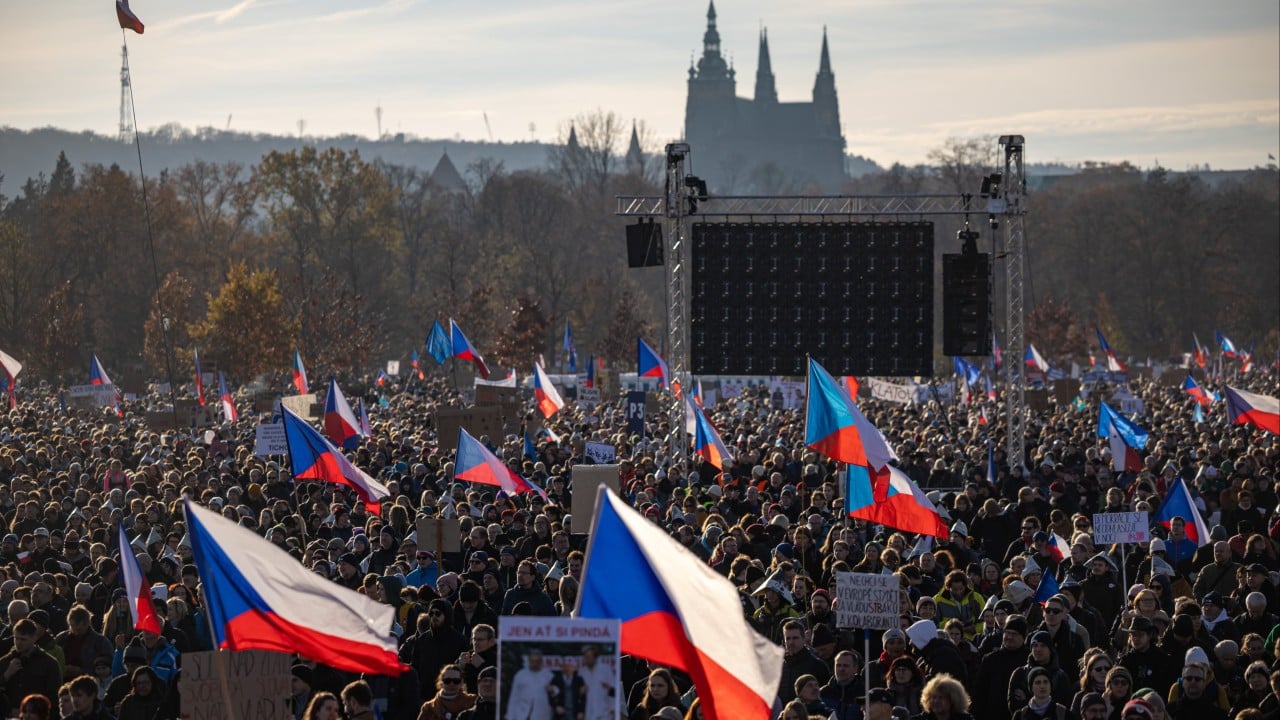
Mass street mobilizations against legislative changes to public broadcasting in the Czech Republic are not isolated protests over television fees; they represent a structural defense against state capture through fiscal dependency. When a government attempts to shift public media financing from an independent, statutory license fee to direct state budget allocations, it fundamentally alters the principal-agent relationship between the electorate, the legislature, and the press. In Prague, the public backlash reflects an acute institutional memory of how financial centralization precedes editorial subordination across post-communist democracies.
To understand why thousands of citizens mobilize over statutory funding mechanisms, one must strip away partisan rhetoric and analyze the institutional architecture of public service media (PSM). Public broadcasters operate within a delicate governance trilemma: they must achieve universal reach, maintain editorial independence, and secure predictable multi-year funding. Changing the revenue collection mechanism from a ring-fenced household levy to a centralized parliamentary appropriation breaks this equilibrium. It converts an autonomous public utility into a line item subject to annual political negotiation. If you enjoyed this piece, you should read: this related article.
The Structural Economics of Public Media Independence
The viability of any public broadcaster rests on the insulation of its revenue stream from executive discretion. In the Czech Republic, the traditional model relies on compulsory concessionary fees paid directly by households and businesses to Czech Television (Česká televize) and Czech Radio (Český rozhlas). This mechanism establishes a direct financial contract between the citizen and the institution, bypassing the Ministry of Finance entirely.
When policymakers propose abolishing this direct levy in favor of state budget financing—or when they manipulate fee structures without inflation indexing—they introduce three distinct operational vulnerabilities: For another look on this development, refer to the latest update from BBC News.
- The Appropriation Bottleneck: Direct state funding requires annual or multi-year approval by the legislature. Even without explicit censorship, the mere threat of budget reductions during appropriation cycles induces anticipatory obedience among media executives. Editorial decisions begin to reflect risk-averse calculations regarding upcoming fiscal negotiations rather than journalistic merit.
- Inflationary Erosion as Silent Defunding: Leaving statutory fees frozen in nominal terms while operating costs rise creates a structural deficit. Over a decade, a fixed fee loses substantial real purchasing power, forcing broadcasters to cut investigative journalism, regional bureaus, and original programming. When the state subsequently steps in to cover the shortfall via subsidies, the transition from autonomy to dependency is complete without a single law explicitly abolishing editorial freedom.
- Asymmetric Regulatory Burden: Public broadcasters carry statutory obligations—minority programming, cultural archiving, educational content, and universal terrestrial coverage—that commercial networks avoid. Stripping away dedicated, predictable funding while maintaining these high fixed-cost mandates creates an artificial liquidity crisis, which critics then cite as evidence of institutional inefficiency.
This economic architecture explains why civil society reacts forcefully to technical amendments in media law. The protesters in Prague are responding to an observable causal chain: fiscal centralization leads to governance restructuring, which inevitably culminates in editorial alignment with the ruling coalition.
The Three Pillars of Institutional Media Capture
Across Central and Eastern Europe, the erosion of public media independence rarely occurs through overt nationalization or the deployment of state censors. Instead, political actors execute a systematic, three-stage operational sequence that preserves the outward appearance of democratic governance while hollowing out institutional checks and balances.
Pillar One The Financial Squeeze
The sequence begins with the destabilization of the broadcaster's balance sheet. Policymakers frame the mandatory household fee as an outdated, regressive tax burdening families during periods of economic strain. By positioning themselves as fiscal populists protecting household budgets, politicians build public support for abolishing the direct levy. Once the independent revenue stream is severed and replaced by general treasury transfers, the broadcaster loses its financial buffer. Capital expenditure plans—such as digital infrastructure upgrades or long-term investigative units—become contingent on executive goodwill.
Pillar Two Governance Reconfiguration
With financial leverage established, the second phase targets the supervisory boards. Public broadcasters are typically governed by councils elected by parliament to represent civil society. Political actors alter the appointment rules, lowering quorum thresholds, expanding the number of seats, or disqualifying existing members on technicalities. By packing the supervisory council with loyalists, the ruling majority gains the power to dismiss the Director General, alter internal editorial statutes, and reallocate internal budgets away from critical news divisions toward benign entertainment programming.
Pillar Three Market Distortion and Audience Defection
The final phase exploits the resulting decline in journalistic quality. As investigative rigor is replaced by partisan talking points or risk-averse coverage, trust ratings plummet and younger demographics abandon the platform. State-aligned private media conglomerates then absorb the displaced audience share, while the government redirects state advertising budgets toward friendly commercial outlets. The public broadcaster is left as a hollow shell—funded by the state, controlled by political appointees, and ignored by the skeptical public.
The demonstrations in the Czech Republic represent an intervention at Pillar One. Civil society groups recognize that once the financial architecture is compromised, reversing Pillar Two and Pillar Three requires years of institutional reconstruction that rarely succeeds within a single electoral cycle.
Why Central Europe Serves as a Contested Laboratory
The intensity of the Czech mobilization is directly informed by regional precedent. Observers in Prague do not need theoretical models to forecast the consequences of state-budget media financing; they have empirical case studies operating directly across their borders.
In Hungary, the consolidation of public media into the Media Service Support and Asset Management Fund (MTVA) centralized all budgets, assets, and editorial control under a single state-controlled entity. Funded directly through state allocations, the apparatus transformed former public channels into uniform amplification networks for the executive branch, eliminating opposition visibility during electoral campaigns.
In Poland, legislative overhauls between 2015 and 2023 stripped the National Broadcasting Council of its appointment powers, placing public television (TVP) and radio directly under the authority of the Treasury Minister and a newly created National Media Council. Backed by massive direct state subsidies to compensate for declining license fee compliance, the network ceased functioning as an impartial public service, requiring a complex, legally contested restructuring following the subsequent change in government.
The Czech Republic has historically maintained a higher degree of institutional resilience than its Visegrad neighbors, largely due to its bicameral parliament—where the Senate acts as a constitutional brake on rapid legislative overhauls—and a deeply ingrained civic tradition of street mobilization dating back to 1989. Public broadcasters like Česká televize consistently rank among the most trusted institutions in the country, outperforming political parties, the judiciary, and commercial media. When legislative proposals threaten to dismantle this autonomy, the public perceives it not as a technical adjustment to media regulation, but as an existential threat to the post-1989 democratic settlement.
Operational Limitations of Street Mobilization
While mass protests impose immediate political costs on lawmakers, street mobilization is a blunt instrument with distinct operational limitations when deployed against technical legislative maneuvering.
First, protests suffer from attention decay. Civic demonstrations peak around acute legislative milestones—such as a second or third reading in the Chamber of Deputies—but struggle to sustain momentum through prolonged committee revisions, budgetary subcommittee hearings, and regulatory implementation phases. Political actors frequently respond to mass rallies by pausing the flagship bill, waiting for public attention to dissipate, and subsequently passing identical provisions as riders attached to unrelated fiscal legislation.
Second, public opposition cannot resolve genuine structural inefficiencies. Public service media across Europe face legitimate existential challenges: linear television viewership is declining among cohorts under thirty-five, digital distribution costs are rising, and collection enforcement for household fees suffers from high administrative friction. If defenders of public media oppose every funding reform without proposing viable modernization frameworks—such as universal household levies tied to utility bills or automated inflation indexing—they cede the fiscal responsibility narrative to their opponents.
Third, mobilization hardens partisan polarization. When public media defense becomes closely associated with specific opposition parties or urban civic movements, ruling coalitions successfully frame the broadcaster itself as a partisan actor. This dynamic erodes the universal legitimacy that public media requires to justify compulsory public financing. If half the electorate views the national broadcaster as an ideological adversary, the long-term sustainability of the institution is compromised regardless of the immediate legislative outcome.
Designing a Capture-Resistant Funding Architecture
To move beyond reactive street protests, institutional defenders and media policymakers must implement structural safeguards that decouple public broadcasting from both executive discretion and administrative obsolescence. A capture-resistant funding model requires four specific design parameters:
- Statutory Automatic Indexation: License fees or household levies must be legally tethered to the Consumer Price Index (CPI) or average wage growth. Removing the requirement for parliamentary votes to adjust fees for inflation eliminates the primary mechanism of silent defunding.
- Universal Household Collection: Transitioning from device-based fees (which require costly enforcement and invite evasion) to a universal household or electricity-meter levy stabilizes the revenue base and lowers administrative overhead. Every household contributes a predictable micro-fee, eliminating the need for state treasury top-ups.
- Multi-Year Constitutional Ring-Fencing: Funding allocations and governance structures should require supermajority parliamentary approval for modification, placing public media statutes on par with electoral laws and judicial independence frameworks.
- Algorithmic Transparency and Digital Mandates: Statutory charters must explicitly authorize and fund digital-first distribution, open-source civic platforms, and transparent public-interest algorithms, ensuring the broadcaster remains relevant to non-linear audiences without competing for commercial click-through revenue.
The confrontation in the Czech Republic demonstrates that public media independence is never permanently secured; it is an ongoing operational contest over institutional plumbing. Civil society can temporarily halt legislative overreach through mass mobilization, but long-term survival depends on embedding financial autonomy into hard statutory mechanisms that survive shifts in parliamentary majorities. Without automatic indexation and direct, non-treasury revenue collection, every future budget cycle remains a potential vector for state capture.