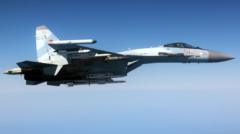
The headlines are practically copy-pasted at this point. "Russian jets 'dangerously' intercept RAF spy plane over Black Sea." Standard media outlets run the same breathless narrative every time a Sukhoi Flanker flies within visual range of a Boeing RC-135. They want you to think we are one twitchy pilot away from World War III. They want you to picture Maverick-style reckless flying, a rogue state violating international norms, and an imminent catastrophic collision.
It is a comforting, high-drama narrative. It is also complete nonsense.
If you actually understand signals intelligence, airspace law, and the cold reality of electronic warfare, you know these incidents are not "unprovoked aggression." They are not even dangerous in the way the public thinks. In fact, they are highly choreographed, entirely predictable, and mutually beneficial training exercises dressed up as geopolitical crises.
The mainstream media is selling you panic because panic drives clicks. Let us look at what is actually happening in the skies above the Black Sea, and why the standard Western outrage machine is completely wrong.
The Myth of the "Innocent" Surveillance Flight
The standard narrative frames the Royal Air Force (RAF) RC-135W Rivet Joint as a passive observer, just minding its own business in international airspace when it is suddenly set upon by Russian bullies.
Let us fix the vocabulary right now. An RC-135W is not a passive weather balloon. It is a flying vacuum cleaner designed to suck up electronic emissions, radar signatures, and communications data from hundreds of miles away. When the RAF flies a Rivet Joint over the Black Sea, they are not taking a scenic cruise. They are actively mapping Russian air defense networks in Crimea, tracking military communications, and feeding that data directly into NATO’s intelligence matrix.
International law allows this. Airspace extends 12 nautical miles from a nation's coast. Beyond that is international airspace. The RAF has every legal right to fly there.
But legal does not mean neutral.
Imagine your neighbor standing right on the edge of his property line, pointing a high-powered directional microphone at your living room window and recording your phone conversations. Is he legally on his own property? Yes. Are you going to walk out to the fence line, look him in the eye, and let him know you are watching him? Absolutely.
That is what an intercept is. It is a physical manifestation of a border. To pretend that Russia should just ignore a massive Western electronic spy platform operating on its doorstep is intellectually dishonest.
The Choreography of a "Dangerous" Intercept
Every time a Western defense ministry releases a statement about a "safe and professional" or "unsafe and unprofessional" intercept, the public imagines chaos in the clouds. I have spent years analyzing operational data and military aviation protocols. The reality is that 95% of these interactions follow a strict, unwritten script that both sides know by heart.
Here is how the dance actually works:
- The Detection: Long before the RAF Rivet Joint even reaches the Black Sea, Russian early-warning radar units in the Southern Military District have picked it up. They know its tail number, its track, and its likely mission profile.
- The Scramble: The Russian air force scrambles a pair of Su-27s or Su-30s from airfields in Crimea or the Krasnodar region. This is not a panic reaction; it is a routine operational procedure.
- The Join-Up: The Russian fighters match the speed and altitude of the spy plane. They pull up alongside, usually at a distance that allows the pilots to make eye contact.
- The Photo-Op: The Russian pilots flash their bellies to show off their missile loadouts. The crew on the RC-135 takes high-resolution photos of the Russian fighters to analyze any new modifications or electronic warfare pods.
- The Escort: The fighters fly formation with the spy plane until it turns around and leaves the station.
This is not a crisis. It is an office meeting. Both sides are doing their jobs. The RAF is collecting data; the Russians are demonstrating the capability to defend their perimeter.
Why "Dangerous" is a Relative Term
But what about the remaining 5%? What about the times when Russian jets cross directly in front of a Western plane or turn on their afterburners close by?
The media screams "unprofessional." The real reason is much more calculating.
When a fighter jet flies closely in front of a larger aircraft, its engine exhaust creates "wake turbulence." If a Russian pilot wants to disrupt a spy plane's mission without firing a shot, they use wake turbulence to shake the aircraft. This forces the heavy, slow-moving RC-135 to alter its course or temporarily lose its sensor lock on ground targets.
It is aggressive, yes. It requires high piloting skill, definitely. But it is a calculated tactical maneuver, not the actions of a crazed, out-of-control pilot. It is a non-kinetic way of saying, "Your presence here is costing us operational security, so we are going to make your job as difficult as possible."
The Hidden Truth: Both Sides Need This to Happen
Here is the ultimate contrarian truth that neither NATO nor the Kremlin will ever admit publicly: Both militaries absolutely love these intercepts. They are essential for operational readiness.
If the Russian air force stopped intercepting Western spy planes, NATO would lose an incredible source of intelligence. Why? Because the intercept itself forces the Russian military to turn on its systems.
[RAF Spy Plane Approaches]
       │
       ▼
[Russian Air Defense Radars Activate] ──► [Forces Comm Traffic]
       │
       ▼
[Su-27 Fighters Scramble] ──────────────► [Emits Electronic Signatures]
       │
       ▼
[NATO Bags the Data]
When those Su-27s take off, they communicate with ground control. They use their fire-control radars. The air defense systems on the ground track them and coordinate the intercept. The RC-135 sits back and records all of it. They capture the exact frequencies the Russians use, the response times of their scramble units, and the encryption methods of their radio traffic.
If Russia ignored the spy planes, the spy planes would get bored. By scrambling, Russia hands NATO the exact electronic signatures needed to defeat Russian air defenses in a real conflict.
Conversely, Russia gets a free, live-fire training exercise against the premier intelligence-gathering aircraft in the world. Russian rookie pilots get real-world experience intercepting high-value assets. Russian radar operators get to practice tracking low-observable profiles and filtering out Western electronic jamming.
It is a symbiotic relationship. The tension is the point.
Dismantling the "People Also Ask" False Premises
Look at the common questions people search for regarding these incidents. The premises are fundamentally broken because they are built on media sensationalism.
"Can a Russian jet shoot down an RAF plane in international airspace?"
Of course it can physically do it, but it will not. Barring a catastrophic mechanical failure or an incredibly rare pilot error, no one is pulling the trigger.
The military personnel flying these missions are not hot-headed teenagers. The RAF crew are highly trained technical specialists. The Russian pilots sent to intercept Western strategic assets are typically experienced flight leads, not fresh academy graduates. They know that firing a missile at a NATO aircraft in international airspace is an overt act of war. Neither Washington, London, nor Moscow wants a nuclear escalation over a routine surveillance flight.
"Why doesn't the RAF fly with fighter escorts?"
People often ask why the UK does not send Typhoons to protect the Rivet Joint. Sometimes they do, especially after the 2022 incident where a Russian jet accidentally released a missile near an RAF plane due to a technical malfunction.
But sending fighter escorts actually increases the danger, not decreases it. If you send an unescorted spy plane, the interaction is predictable: it is a heavy plane being watched by agile fighters. If you add Western fighters to the mix, you now have armed, high-performance aircraft from two adversarial nuclear powers flying maneuvers against each other in tight airspace. That is how accidental mid-air collisions happen. The RAF flies escorts to send a political message of resolve, not because it makes the intelligence mission safer or easier.
The True Risk Nobody Talks About
The media focuses entirely on the wrong danger. They focus on the physical proximity of the jets. They worry about wings touching.
That is the amateur hour worry. The real risk of these intercepts is in the spectrum, not the sky.
The true battle over the Black Sea is an invisible war of electronic warfare (EW). When an RAF plane flies near Crimea, it is not just listening; it is mapping the environment. In response, Russian ground stations deploy powerful EW complexes like the Krasukha-4. These systems do not just try to hide Russian signals; they actively attempt to blind, spoof, and fry the sensors of the Western aircraft.
Imagine a scenario where a Russian EW unit successfully spoofs the GPS or navigation data of a Western aircraft, making the crew believe they are in international airspace when they have actually drifted into sovereign Russian territory. Or conversely, imagine a Western electronic countermeasure accidentally bricking the navigation system of an intercepting Russian fighter, causing it to crash.
That is where the real danger lies. The software code, the frequency hopping, and the sensor saturation. If an escalation happens, it will not be because a Russian pilot wanted to be a hero. It will be because a line of code in an electronic warfare suite over-performed, creating an ambiguity that neither side could resolve in real-time.
Stop Buying the Hype
The next time you see a breaking news alert screaming about a "dangerous Russian intercept" over the Black Sea, turn down the emotional volume.
- Recognize it for what it is: a highly ritualized military interaction.
- Understand that both sides are getting exactly what they want out of it.
- Acknowledge that the "aggression" is actually standard operational procedure for any nation defending its electronic borders.
The skies over the Black Sea are crowded, tense, and loud. But they are not chaotic. Stop letting headline writers turn a routine day at the office for military aviators into an imaginary prelude to Armageddon.