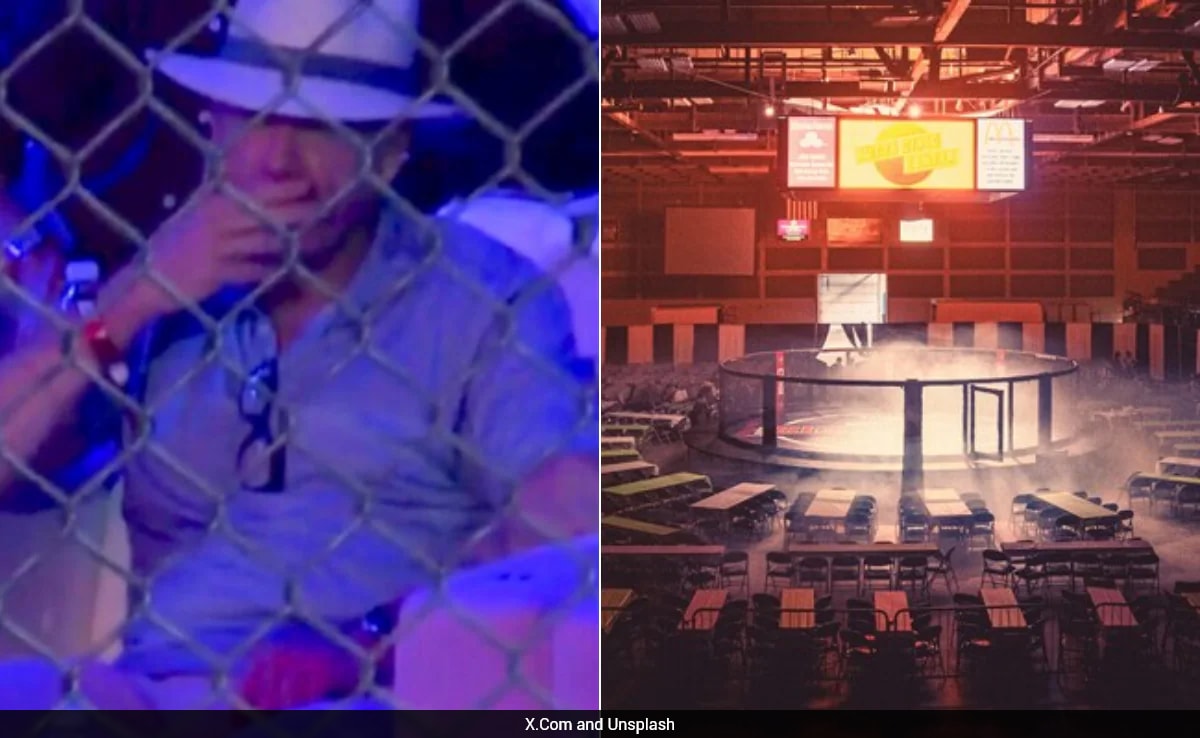
The air inside the Coca-Cola Arena in Dubai doesn’t move like the air outside. Outside, the desert wind is a physical weight, thick with salt and the smell of the Persian Gulf. Inside, it is filtered, chilled to a precise, expensive crispness, and vibrating with the bass of walkout music. It is a place where gravity feels optional and money feels infinite.
On this particular night, the octagon was a stage for combat, but the real theater was unfolding in the VIP sections.
If you scanned the front rows, you saw the usual suspects of high-society violence: influencers in tailored linen, retired athletes with scar tissue around their eyes, and the scions of local dynasties. But if you looked closer—past the flashing lights and the sweat spraying off a mid-tier lightweight—you would have seen something that shouldn’t exist. You would have seen the world’s most hunted men breathing the same chilled air as the people sworn to catch them.
They weren't hiding. They were cheering.
The Invisible Front Row
International law enforcement agencies spend billions of dollars on "Red Notices." These are digital sirens, electronic screams sent across borders to notify every port, every airport, and every beat cop that a specific human being is a threat to the global order. We are told these men live in "the shadows." We picture them in damp basements in Eastern Europe or fortified compounds in the jungle, eating canned rations and staring at grainy CCTV monitors.
The reality is much more comfortable. The reality is a velvet-roped enclosure at an MMA event.
Among the crowd sat figures linked to the Kinahan Organized Crime Group, a name that carries a $15 million bounty from the U.S. government. To the DEA, they are a narco-terrorist organization responsible for a trail of bodies stretching from Dublin to Spain. To the fans at the arena, they were just guys in expensive t-shirts, nodding along to the rhythm of the fights.
There is a specific kind of cognitive dissonance that happens when you see a face from a "Most Wanted" poster under a spotlight. It breaks the social contract. We agree to follow the rules because we believe the rules are being enforced. When a man with a global warrant for his arrest can buy a ticket to a sporting event and sit in the open, the law doesn't just look weak. It looks like a suggestion.
The Architecture of a Safe Haven
Dubai is a city built on the idea that the future can be purchased. It is a miracle of engineering and a masterpiece of branding. But for the world’s elite fugitives, it represents something more practical: a diplomatic fortress.
The city operates on a logic of "don't ask, don't tell," provided you have enough liquidity to justify the silence. It isn't that the local authorities are necessarily in league with these bosses. It’s that the bureaucracy of international extradition is a slow, grinding machine, and in Dubai, that machine often hits a patch of very expensive sand.
Consider the logistics of being a ghost. You need more than just a fake passport. You need a life. You need schools for your children, gyms for your workouts, and entertainment for your Saturday nights. You need to be able to walk into an arena without a hood over your head.
When these crime bosses appear at a televised MMA event, it isn't an accident. It’s a flex. It is a public signal to their rivals, their subordinates, and the detectives back home that they are untouchable. It is a way of saying, I am not running. I am spectating.
The Blood and the Business
The connection between combat sports and organized crime isn't new, but it has evolved into something sophisticated. In the old days, it was a back-alley bookie and a fixed fight. Today, it’s about "management companies" and "sportswashing."
Combat sports offer a unique utility for the fugitive. It is an industry built on toughness, on the "outlaw" persona, and on a constant influx of cash. It’s a world where questions about where the money comes from are often drowned out by the roar of the crowd. For a crime boss, owning or influencing a fighter provides a veneer of legitimacy. You aren't a drug trafficker; you are a "promoter." You aren't a money launderer; you are a "consultant" for an athlete.
The fighters themselves are often caught in the middle. Many come from impoverished backgrounds, driven by a desperation that makes them easy to exploit. When a man offers you a six-figure contract and a private jet to a training camp in the UAE, you don’t ask to see his tax returns. You sign. You fight. You become a pawn in a much larger game of geopolitical chess.
But what does it feel like for the victim of a gangland shooting in a Dublin suburb to see the man who ordered the hit laughing on a 4K broadcast?
It feels like the world is upside down. It feels like the "Most Wanted" list is just a directory for the front row.
The Myth of the Global Police
We like to believe in the "Long Arm of the Law." We grew up on movies where the fugitive is eventually cornered on a rooftop or caught at a border crossing by a diligent agent.
That arm is shorter than we think.
The reality of global policing is a mess of paperwork, political favors, and jurisdictional nightmares. If a country doesn't have a robust extradition treaty with another, or if the fugitive has invested enough in the local economy to be seen as an "asset," the Red Notice becomes a piece of digital junk mail.
The detectives in the U.K., Ireland, and the U.S. aren't oblivious. They see the same social media posts we see. They see the tags in the VIP lounges. They see the gym photos. They are forced to watch the men they’ve spent decades hunting live lives of leisure. It is a slow-motion taunt.
This isn't just about crime. It’s about the erosion of the idea that borders mean anything. For the person with a hundred dollars in their pocket, a border is a wall. For the person with a hundred million, a border is a revolving door.
The Lights Fade, the Shadows Remain
As the main event concludes and the arena begins to empty, the spectators filter out into the warm Dubai night. The influencers head to after-parties. The fighters head to the hospital. And the men on the posters? They walk to their armored SUVs, parked in the VIP lot, and disappear back into the glittering skyline.
They aren't going to a hideout. They are going home to luxury apartments with floor-to-ceiling windows.
We are left with a haunting realization. The "underworld" isn't under anything. It is right here, sitting next to us, buying the same popcorn and cheering for the same knockout. The most successful criminals don't live in the dark; they live where the lights are so bright they blind you.
The next time you watch a mega-event from a gilded city, look past the athlete. Look at the faces in the shadows of the strobe lights. You might see a ghost. And the ghost might be smiling.
Would you like me to look into the specific extradition treaties currently complicating these international investigations?