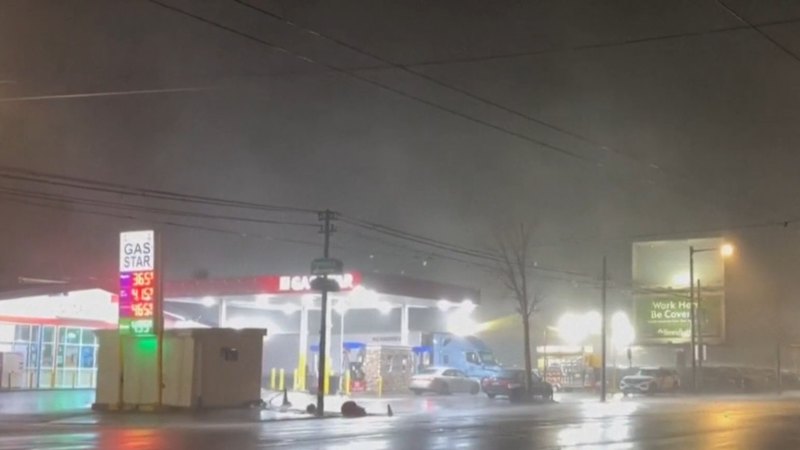
The wind didn't howl at first. It hissed. It was the sound of a billion frozen needles sandblasting the siding of houses from the Great Lakes down to the Appalachian spine. By the time the sun dipped below the horizon on Tuesday, the gray veil had dropped completely, turning the familiar geography of the American East and Midwest into a monochromatic void.
This wasn't just another winter storm. It was a atmospheric siege. In other updates, take a look at: The Sabotage of the Sultans.
Think of a single mother in Indianapolis—let’s call her Sarah. She isn’t looking at a Doppler radar or tracking a "low-pressure system." She is looking at the digital clock on her stove, watching the numbers flicker and die as a power line two miles away snaps under the weight of an inch of radial ice. In that instant, the abstract data of a national news cycle becomes the visceral reality of a cold house, a dark kitchen, and the sudden, sharp realization that the world has become very small and very dangerous.
The Weight of a Frozen Atmosphere
Meteorologists spent the week warning of a "bomb cyclone," a term that sounds like hyperbole until you feel the pressure drop in your inner ear. The technical reality is a matter of physics: a massive collision between a frigid Arctic air mass and a plume of moisture-rich air surging up from the Gulf of Mexico. When these two titans meet, the result is a vertical battleground. NBC News has analyzed this fascinating issue in extensive detail.
But for those on the ground, the science is secondary to the weight. An inch of ice on a standard power line adds nearly 500 pounds of load per span. It is a slow-motion collapse. Across Ohio, Pennsylvania, and New York, the sound of the night was the rhythmic crack-thump of ancient oak limbs giving up the ghost. They don’t just break; they explode under the tension, sending shrapnel across driveways and through roof shingles.
The statistics are staggering, yet they fail to capture the stillness. While news tickers scroll through "500,000 without power" and "3,000 flights canceled," they don't mention the eerie silence of a neighborhood where every engine has stopped. No cars move. The salt trucks are losing the war. The interstate, usually a vein of constant commerce and light, has become a graveyard of jackknifed semis and abandoned sedans.
The Invisible Stakes of a Hard Freeze
In the Midwest, we like to pride ourselves on our resilience. We own heavy coats. We have generators. We know how to fish-tail out of a slide. But this storm targeted the vulnerabilities we usually ignore. It targeted the supply chains that bring fresh milk to the corner store and the fragile electrical grid that keeps the elderly warm in high-rise apartments.
Consider the logistics of a single loaf of bread. To get to a shelf in a suburban Philadelphia grocery store, it requires a clear path for a driver, a functioning fuel pump, and a store with enough juice to keep the lights on. When the ice cements the loading dock doors shut, the "just-in-time" economy grinds to a halt. We are all, it turns out, about three days of heavy snow away from a very different kind of existence.
The storm moved like a slow, heavy curtain. In Chicago, the wind chill plummeted to -20 degrees, a temperature where exposed skin begins to die in minutes. Further east, in the Hudson Valley, the problem wasn't the cold, but the water. Heavy, wet snow—the kind that breaks hearts and backs—piled up at a rate of two inches per hour.
The Anatomy of a Whiteout
Visibility is a gift we take for granted. When the "whiteout" conditions hit the Tug Hill Plateau in New York, the concept of a horizon disappeared. Drivers described it as being trapped inside a gallon of milk. There is no up, no down, no road edge. Just a swirling, blinding nothingness.
This is where the human element becomes heroic. It’s the lineman in West Virginia climbing a pole in 40-mile-per-hour gusts, his gloved hands fumbling with frozen hardware while the wind tries to rip him into the dark. It’s the nurse in Detroit who walked four blocks through waist-deep drifts because her car couldn't clear the alley, all to make sure a midnight shift was covered.
We often talk about these storms as "disasters," but they are also mirrors. They reflect the quality of our infrastructure and the depth of our community ties. In the suburbs of Columbus, neighbors who haven't spoken since the summer found themselves sharing kerosene heaters and checking on the man at the end of the block who lives alone. The storm strips away the digital distractions and leaves us with the most basic human questions: Are you warm? Are you fed? Can I help?
The Long Thaw and the Aftermath
By the time the system began to pull toward the Atlantic, it left behind a transformed continent. The "Great Lakes Effect" added a final, cruel punctuation mark, dumping another foot of powder on cities already struggling to breathe.
The economic cost will be measured in the billions—insurance claims for fallen trees, lost wages for hourly workers, and the massive bill for salt and overtime. But the emotional cost is harder to quantify. It’s the exhaustion in the eyes of the snowplow drivers who haven't slept in thirty-six hours. It’s the anxiety of the homeowner watching a crack form in the ceiling under the weight of a snow-loaded roof.
The sky eventually cleared to a piercing, frozen blue. The sun came out, but it offered no warmth, only a glint off the ice that forced everyone to squint. The world looked beautiful, like a postcard from a dead planet.
We forget, in our climate-controlled lives, that we live at the mercy of a very thin layer of gases and the chaotic whims of a rotating sphere. We build our cities and lay our wires and assume the "on" switch will always work. Then a Tuesday comes along where the atmosphere decides to remind us of our place.
The hum of the refrigerator returning to life is the most beautiful song in the world when you haven't heard it for three days. It signals the return of the modern world, the end of the siege. But as the ice begins to drip from the eaves and the shovels are leaned against the garage walls, there is a lingering chill. It’s the knowledge that the clouds are already gathering somewhere else, heavy with the next reminder of how fragile our warmth truly is.
Below the eaves, a single icicle, three feet long and thick as a man's wrist, catches the fading light of the afternoon, hanging like a glass sword over the threshold of a home that is finally, slowly, beginning to get warm again.