Political theater makes for great clicks, but terrible investment thesis.
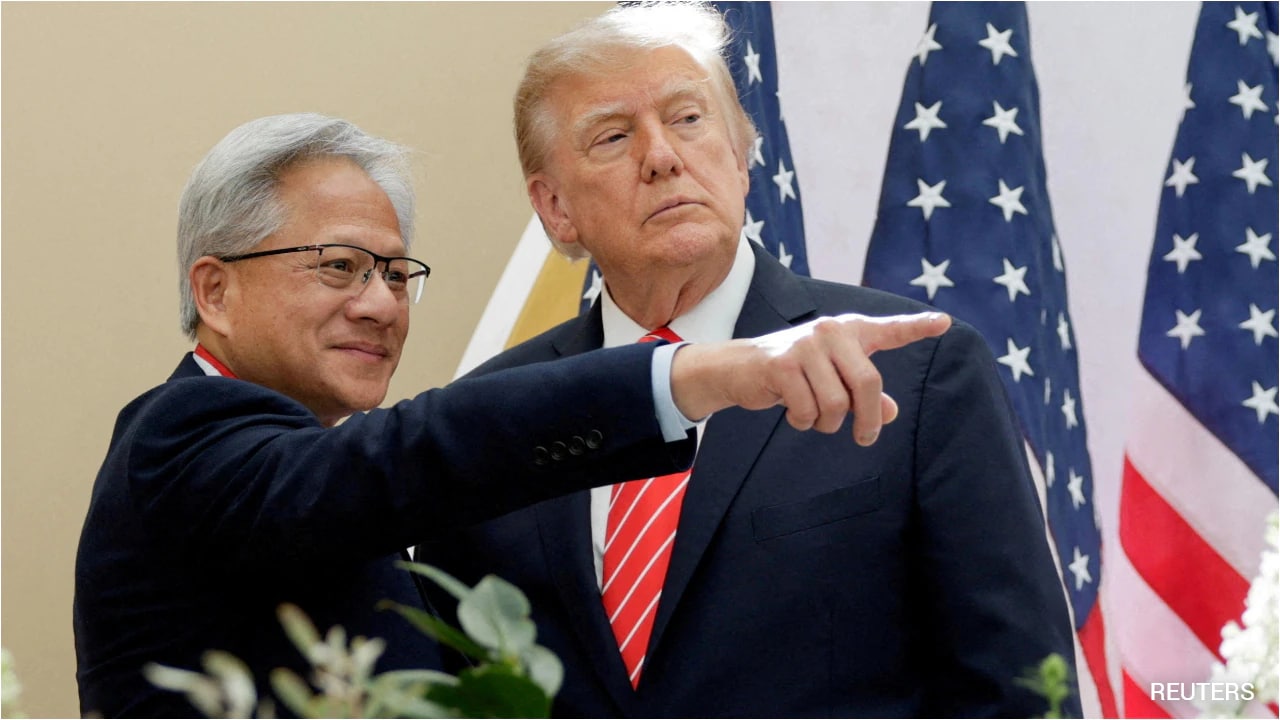
When headlines blare that Nvidia is not considering a "return" for Jensen Huang—or re-evaluating his role—despite vocal backing from Donald Trump, financial commentators treat it like a boardroom soap opera. They frame the story around personalities, political endorsements, and executive succession rumors.
They are looking at the wrong board.
If you think Nvidia’s trajectory depends on White House endorsements or the media's obsession with CEO succession chatter, you fundamentally misunderstand how enterprise hardware monopolies actually operate. The lazy consensus in tech journalism reduces a three-trillion-dollar infrastructure juggernaut to a clash of egos between Silicon Valley and Washington. It assumes that political favoritism dictates semiconductor supply chains, or that corporate governance at the apex of the AI boom reacts to cable news talking points.
It does not. Never has.
I have spent two decades watching institutional investors and enterprise buyers torch millions of dollars chasing political narratives in the semiconductor sector. Every election cycle, analysts scramble to map which chipmaker is "in favor" with the incoming administration. They build spreadsheets around tariffs, export controls, and public endorsements. Meanwhile, the actual purchasing decisions happen three layers deeper in the stack, dictated by compiler lock-in, thermal design power, and multi-year hyperscaler capital expenditure commitments that neither a president nor a board rumor can unwind overnight.
The Myth of the Political Kingmaker in Silicon
Let us dismantle the premise behind the headline first. Why would anyone believe political support—even from a figure as influential as Donald Trump—could alter Nvidia’s internal executive calculus?
The misconception stems from confusing regulatory friction with architectural dominance.
Yes, the White House controls export licenses. Yes, the Department of Commerce dictates whether a watered-down H20 or B20 chip can cross the border into Shenzhen. And yes, tariffs on Taiwanese foundry output (TSMC) can compress gross margins by a few hundred basis points. Those are real operational headwinds.
What they are not is a lever that moves a corporate board on executive leadership.
Nvidia’s board of directors—filled with seasoned operators like Harvey Jones, Mark Stevens, and Tench Coxe—does not govern by polling Washington sentiment. Jensen Huang is not a hired-gun CEO brought in to appease regulators; he is a co-founder who has led the company continuously since 1993. Talk of his "return" or "reconsideration" usually stems from garbled aggregation of unrelated executive rumors, misunderstood export-ban negotiations, or sensationalized speculation about succession planning. Treating it as a serious boardroom inflection point insults the intelligence of anyone who has ever read a proxy statement.
Why Washington Cannot Dictate the Compute Stack
Imagine a scenario where the federal government actively campaigns to reshape the leadership or strategic direction of a dominant infrastructure provider. Even if a president explicitly backs or criticizes an executive, enterprise demand does not flinch. Why? Because hyperscalers—Microsoft, Meta, Alphabet, Amazon—are not buying Nvidia GPUs out of political goodwill. They are buying them because of CUDA (Compute Unified Device Architecture).
To understand why political noise is irrelevant here, you have to understand the switching costs:
- The Software Moat: Over four million developers write directly to CUDA libraries. Moving a frontier model training run to a competing architecture like AMD’s ROCm or custom ASICs (like Google’s TPUs or Amazon’s Trainium) requires rewriting kernels, debugging numerical precision drift, and accepting lower utilization rates during transition.
- Networking Integration: Nvidia does not just sell chips; it sells the data center as the unit of computing. Between NVLink, InfiniBand, and Spectrum-X Ethernet, the company controls the interconnects that prevent thousands of GPUs from sitting idle while waiting for data.
- Supply Chain Pre-emption: Nvidia locks up advanced packaging capacity (specifically TSMC’s CoWoS—Chip-on-Wafer-on-Substrate) years in advance. No political endorsement can conjure cleanroom capacity out of thin air.
When commentators obsess over Trump’s remarks regarding Huang or Nvidia’s corporate posture, they mistake the press conference for the factory floor.
What Everyone Gets Wrong About Nvidia Governance
Whenever a rumor circulates about Nvidia’s leadership or board decisions, retail investors immediately ask the wrong questions. Let us look at the actual questions dominating search bars right now—and expose why their premises are broken.
"Is Jensen Huang leaving or stepping back from Nvidia?"
No. The question itself reveals a failure to read basic corporate filings. Huang has been CEO for over three decades, making him the longest-tenured chief executive in the S&P 500 tech sector. Unlike founder-CEOs who step aside into "Executive Chairman" roles to focus on philanthropy or side projects, Huang maintains a famously flat organizational structure with dozens of direct reports. He has eliminated traditional middle-management layers specifically to keep his hands directly on product roadmaps—from Blackwell to Rubin and beyond. Any headline implying a "return" is either recycling ancient succession speculation or hallucinating a departure that never happened.
"Does Trump’s support help Nvidia bypass export restrictions?"
This is where the nuance gets uncomfortable for both political camps. Political backing does not equal deregulation for national security assets.
In Washington, restricting advanced AI compute to geopolitical rivals is one of the few issues with genuine bipartisan consensus. Even an administration inclined toward deregulation and bilateral dealmaking views high-bandwidth memory (HBM) and sub-3-nanometer logic chips through a defense lens. Support from Trump—or any president—might smooth over domestic permitting for U.S.-based data centers or soften broad tariff rhetoric, but it will not reopen the floodgates for unrestricted sales of flagship Blackwell or Hopper accelerators to restricted entities. Nvidia knows this. They have already written off billions in potential Chinese data center revenue and reallocated that supply to sovereign AI initiatives in Europe, the Middle East, and Japan.
"Could political pressure force Nvidia to manufacture chips in the US?"
It is already happening, and politics only accelerated what risk management demanded. TSMC’s fabrication plants in Arizona (Fab 21) are ramping up, and Nvidia is already committing to domestic wafer runs and stateside packaging partnerships with firms like Amkor. However, relying entirely on U.S. fabs anytime before 2030 is a fantasy. Cutting-edge lithography and advanced packaging ecosystems in Hsinchu and Tainan took forty years to build. No executive order compresses four decades of supply chain density into a four-year presidential term.
The Real Threat to Nvidia Is Not Political—It Is Architectural
If you want to understand what actually keeps Nvidia’s leadership awake at night, stop watching political pundits and start reading hyperscaler earnings transcripts.
The existential risk to Nvidia has nothing to do with who sits in the Oval Office or what rumors swirl around executive succession. It comes from the people writing the $50 billion checks.
Right now, roughly 40% to 50% of Nvidia’s data center revenue comes from a handful of cloud titans. Those exact customers are aggressively funding their own escape hatches.
- Inference Economics vs. Training Dominance: Training massive foundation models requires the brute-force interconnect speed and FP8/FP4 precision where Nvidia is untouchable. Inference—running those models in production to answer user prompts—is a completely different economic game. Once a model’s weights are frozen, custom silicon like AWS Inferentia, Google’s TPU v5e/Trillium, or Meta’s MTIA can deliver vastly superior performance-per-watt at a fraction of Nvidia’s 75% gross margin markup.
- The Open-Source Compiler Push: Projects like OpenAI’s Triton, PyTorch 2.0, and the Unified Acceleration (UXL) Foundation are specifically engineered to abstract away the hardware layer. If developers can write high-level Python code that compiles efficiently onto AMD, Intel, or custom ASICs without touching CUDA C++, Nvidia’s software moat shrinks overnight.
- Power and Thermal Walls: Data centers are no longer constrained by floor space or capital; they are constrained by gigawatts. Liquid cooling, 800-volt DC power architectures, and substation bottlenecks are dictating deployment schedules. If a rival chip architecture delivers 30% better tokens-per-watt under strict power caps, CIOs will endure the pain of migrating off CUDA.
Notice what is missing from that list? Cable news narratives. Political endorsements. Boardroom gossip.
Stop Trading Headlines and Start Auditing Infrastructure
If you are allocating capital, building enterprise AI strategy, or analyzing the semiconductor sector, you need to purge political theater from your decision matrix. Here is how sophisticated operators actually evaluate Nvidia’s position:
- Track Hyperscaler CapEx Guidance, Not Political Soundbites: Watch the quarterly capital expenditure numbers from Microsoft, Alphabet, Meta, and Amazon. As long as their combined annual CapEx exceeds $250 billion and remains heavily weighted toward server infrastructure, Nvidia’s order book is insulated from political static.
- Monitor Gross Margin Compression as the True Canary: Nvidia’s pricing power shows up in one number: gross margin. Holding mid-70% margins in a hardware business is historically anomalous. When custom ASICs or AMD’s Instinct MI300/MI350 series begin taking real share, you will not see it in a press release—you will see it when Nvidia’s gross margin slips below 70%.
- Watch Sovereign AI Deals: When U.S. export rules tightened, Nvidia pivoted to selling "Sovereign AI" clouds to national governments in France, India, Saudi Arabia, and Singapore. These state-backed buyers are less price-sensitive than hyperscalers and less likely to build their own custom chips, making them the ultimate hedge against both U.S. trade friction and Big Tech vertical integration.
The Downside of Ignoring the Noise
To be completely candid, ignoring political narratives entirely carries one specific risk: short-term volatility.
Algorithmic trading desks scrape headlines in milliseconds. A poorly worded rumor about Nvidia’s leadership, an offhand tariff threat during a rally, or a leaked memo from the Bureau of Industry and Security can trigger a 5% to 8% intraday swing in a $3 trillion stock—wiping out $200 billion in market cap before lunch. If you are trading short-dated options or operating on high leverage, political noise can liquidate you long before architectural fundamentals prove you right.
For everyone else—long-term investors, enterprise architects, and technology leaders—that volatility is just a discount window created by people who confuse news cycles with engineering reality.
The semiconductor industry runs on physics, lithography wavelengths, and software lock-in, not political favors. Until someone breaks CUDA’s grip on developer workflows or solves the advanced packaging bottleneck without TSMC, every headline about politicians backing or opposing Nvidia’s leadership is just static. Turn off the commentary and watch the silicon.