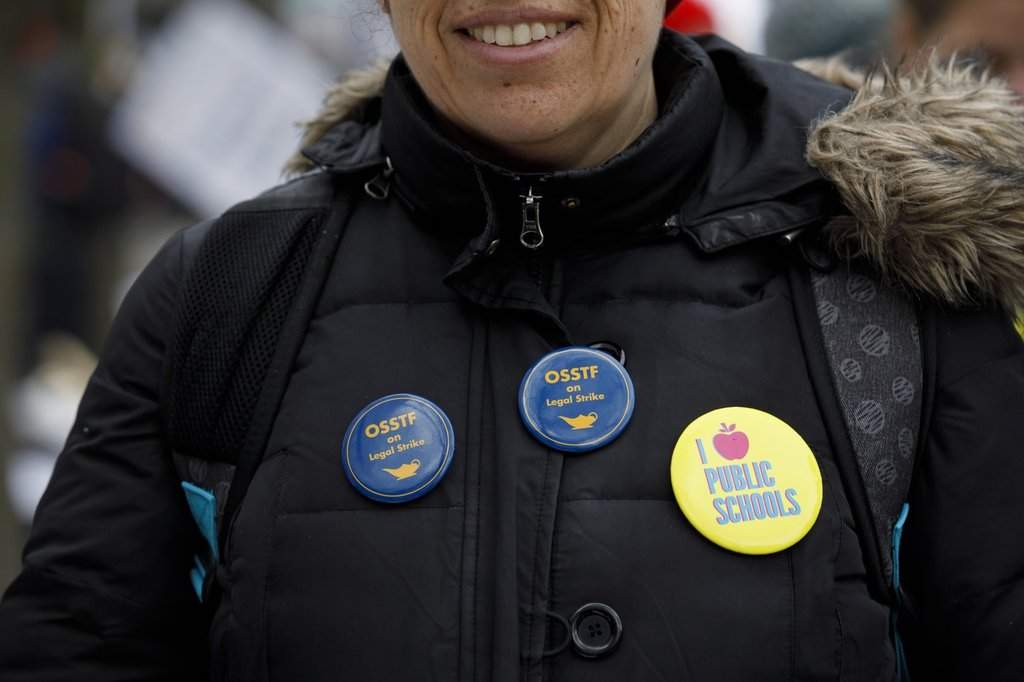
Ninety-six percent. That is the headline number currently ricocheting through every newsroom in Canada. The Ontario Secondary School Teachers' Federation (OSSTF) just handed its bargaining team an overwhelming strike mandate, and the mainstream press is treating it like a dramatic, high-stakes showdown between righteous educators and a stubborn provincial government.
Stop buying the theater.
The standard media narrative frames a 96% strike vote as an imminent educational apocalypse—a binary war over wages, class sizes, and hallway safety. Both sides are playing their assigned roles to perfection. The union leaders puff their chests and declare an unprecedented show of solidarity. The Ministry of Education wrings its hands about disrupted learning and threatens back-to-work legislation. Parents panic, scrambling to figure out childcare and university application timelines.
Everyone is looking at the 96% figure and asking the wrong question. They are asking when the picket lines go up. They should be asking why a union needs a near-unanimous strike vote just to stay relevant in a bargaining structure that has been legally rigged against actual work stoppages for over a decade.
The Illusion of the 96% Mandate
Let’s pull back the curtain on public-sector labor mechanics in Ontario. In the private sector, a 96% strike vote means a factory shuts down on Monday morning and inventory stops shipping. In Ontario’s public education system, a strike mandate is not a trigger; it is a mandatory procedural hoop.
Under the School Boards Collective Bargaining Act (SBCBA), bargaining is split into a clunky, two-tier system: central tables (where the province and the provincial union fight over money and class caps) and local tables (where individual school boards and local bargaining units haggle over working conditions). Before a union can even legally initiate a "work-to-rule" campaign—where teachers stop doing unpaid extracurriculars, skip staff meetings, and refuse to cover absent colleagues—they must first secure a strike mandate from their membership.
Think about that. You cannot even legally decline to coach the junior varsity basketball team as a bargaining tactic without first voting to walk off the job entirely.
When union executives rally their members to vote "yes," they do not pitch it as "pack your thermoses, we are hitting the pavement next week." They pitch it as "give us the ammunition we need so the government takes us seriously at the table." Every single member knows this. Voting "no" in an OSSTF strike authorization vote is the equivalent of telling your own negotiator to show up to a knife fight empty-handed.
Therefore, a 96% result does not measure impending militancy. It measures basic union literacy. Over the last twenty years of Ontario education bargaining—spanning both Liberal and Conservative governments—strike mandates routinely clear the 90% threshold. Treating 96% as some historic, earth-shattering anomaly is lazy journalism. It mistakes routine procedural posturing for a powder keg.
Follow the Real Leverage (Hint: It Isn't Picket Lines)
Having sat across from public-sector bargaining teams and watched millions of taxpayer dollars evaporate into procedural gridlock, I can tell you a hard truth: nobody in Queen's Park actually fears a full-blown teachers' strike anymore.
Why? Because in Ontario, the government holds the ultimate trump card, and they have shown a bipartisan willingness to play it.
Look at the historical record. When the Elementary Teachers' Federation of Ontario (ETFO) or OSSTF pushes a strike past the point of political tolerance, the provincial legislature simply passes back-to-work legislation—or, as we saw during the 2022 clash with CUPE education workers, threatens to invoke the Notwithstanding Clause of the Canadian Charter of Rights and Freedoms. Even when the courts later rule those laws unconstitutional—and Ontario taxpayers end up footing hundreds of millions of dollars in Charter damages years down the line—the immediate strike is broken. The kids go back to school. The political crisis ends.
The real battle is not over who blinks first on a picket line. The real battle is over binding arbitration and cost-of-living indexing.
Here is what the mainstream articles completely gloss over:
- The Inflation Catch-Up Trap: For years, Ontario public-sector wages were capped at 1% annually under Bill 124. When the Ontario Court of Appeal struck down Bill 124 as unconstitutional, it blew a massive hole in the provincial treasury. Teachers received retroactive pay awards, yes, but the baseline cost of living in the Greater Toronto Area and across southern Ontario outpaced those adjustments. The current bargaining round is not about getting rich; it is about whether base salaries will permanently lag behind inflation.
- The Violence and Staffing Crisis: Media coverage loves talking about salaries because numbers are easy to put in a graphic. What they miss is the collapse of in-school support. When educational assistants (EAs), child and youth workers, and specialized behavioral staff are underfunded, violent incidents in classrooms spike. Secondary teachers are increasingly acting as triage nurses and security guards rather than instructors. You cannot fix classroom safety with a 2.5% wage bump, yet the central bargaining table inevitably trades away working conditions to fund salary increases.
- The Arbitration Gamble: Notice how often recent Ontario teacher disputes end up in voluntary or imposed binding interest arbitration. When a dispute goes to an arbitrator, the third-party adjudicator looks at "replication"—what the two sides would have agreed to if free collective bargaining had worked. By securing a 96% mandate, the OSSTF isn't trying to shut down schools; they are trying to prove to a future arbitrator that their membership's grievances are severe enough to warrant an aggressive award.
Dismantling the "People Also Ask" Myths
Whenever a strike vote hits the news cycle, search engines flood with panicked queries from parents and taxpayers. Let’s strip away the PR spin from both the Ministry and the union and answer the questions people are actually asking.
Are Ontario schools closing tomorrow?
No. Not even close. Under Ontario labor law, a strike vote does not trigger a walkout. The union must first request a "no-board" report from the Ministry of Labour. Once that report is issued, a mandatory 17-day cooling-off period begins. Even after those 17 days expire, the union must give five full days' written notice before taking any job action. Furthermore, unions rarely jump straight to a full withdrawal of services. They escalate through administrative work-to-rule phases first because a full strike costs the union millions in strike pay and rapidly erodes public sympathy.
Do teachers actually want to strike?
Almost none of them. A full strike means teachers give up their regular paychecks—which average roughly $350 to $500 per day before taxes depending on grid placement—in exchange for meager union strike pay, typically around $50 to $75 a day. Nobody with a mortgage in Ontario wants to take an 85% pay cut in the middle of winter. They vote "yes" because the alternative is accepting whatever contract the government dictates without pushback.
Is this just about teachers demanding more money?
If you think this is purely about greed, look at teacher retention and recruitment data across the province. Ontario used to have a massive surplus of teachers; graduates waited years on supply lists just to get a partial contract. Today, school boards are routinely issuing Temporary Letters of Approval—allowing uncertified individuals who haven't even finished teachers' college to run classrooms—because they cannot find qualified replacements for sick days. You do not experience a labor shortage in a profession that is overpaid and underworked.
Will this ruin high school graduations and university admissions?
During the 2019–2020 rotating strikes, this was the number one fear among parents of Grade 12 students. The reality? Ontario universities and colleges adjust their admissions processing automatically during provincial labor disruptions. Guidance counselors still process Ontario Universities' Application Centre (OUAC) transmissions even during most work-to-rule phases, or boards deploy non-unionized principals and vice-principals to upload grades. The stress is real, and extracurriculars suffer enormously, but universities do not penalize applicants for provincial labor disputes.
The Counter-Intuitive Reality: Both Sides Need This Crisis
To truly understand why Ontario ends up in this exact same standoff every three to four years, you have to stop viewing the government and the union as mortal enemies and start viewing them as co-dependent actors in a broken system.
Consider a thought experiment. Imagine a scenario where the Ontario government quietly sat down with the OSSTF six months before the contract expired, opened the books, indexed wages cleanly to the Consumer Price Index, funded dedicated behavioral specialists for every high school, and signed a four-year deal with zero drama.
It would be political suicide for both leadership teams.
For a provincial government—regardless of party—standing tough against public-sector unions plays exceptionally well with fiscal conservatives and frustrated taxpayers who feel squeezed by rising costs. If the government settles too easily, they look weak and fiscally reckless. They need the union to look militant so they can position themselves as the sole defenders of the taxpayer's wallet.
Conversely, for union leadership, a quiet, friction-free settlement breeds suspicion among the rank and file. Members pay hefty union dues—often exceeding $1,000 a year per teacher. If the bargaining team signs a deal without a fight, members inevitably ask: "Could we have gotten more if we had pushed harder?" Union executives need a dramatic confrontation—complete with a 96% strike vote, fiery press conferences, and government pushback—to prove to their members that they extracted every possible dime from the province.
The system is designed to produce conflict. The School Boards Collective Bargaining Act deliberately strips local school boards of real financial autonomy—since funding is dictated centrally by Queen's Park via the Grants for Student Needs (GSN)—while forcing local units to bargain separately anyway. It is a bureaucratic maze engineered to delay resolution until maximum political theater has been achieved.
The Downside of Calling the Bluff
Now, let’s be brutally honest about the risk in this contrarian view. Just because a 96% strike vote is largely procedural posturing does not mean the system cannot accidentally catch fire.
When both sides rely on brinkmanship to satisfy their respective bases, miscalculation becomes lethal. If the provincial cabinet misreads the 96% vote as routine bluster and imposes an insulting, sub-inflation offer, union leaders can quickly lose control of their own membership. Rank-and-file frustration over classroom violence and administrative bloat is currently at a multi-decade high. If the leadership tries to sell a mediocre compromise, the members can vote it down—which immediately forces a real, protracted walkout that neither side actually wanted.
We saw a version of this dynamic in 2012 with Bill 115, and again in 2022 with the CUPE walkout. When political hubris collides with genuine workplace burnout, procedural theater turns into closed schools overnight.
How Parents and Educators Should Actually Play This
If you are a parent, a student, or an educator watching this unfold, stop letting breathless breaking-news banners dictate your stress levels. Operate on mechanics, not headlines.
- Ignore the Strike Vote; Watch the "No-Board" Date. Nothing physical changes in a school until the Ministry of Labour issues a no-board report and the 17-day clock starts ticking. Until that specific filing happens, any talk of picket lines is pure noise.
- Prepare for Administrative Work-to-Rule, Not Lockouts. The first real impact you will feel is the disappearance of standardized test prep (EQAO), provincial report card comments (boards often end up issuing marks without written comments), and voluntary extracurricular clubs. If you have a student relying on spring sports or arts programs for university portfolios, start building backup plans outside the school system now.
- Track the Comparable Settlements. Watch what happens with the other major Ontario education unions—ETFO (elementary), OECTA (Catholic), and AEFO (French)—as well as public-sector nurses and civil servants. Under Ontario’s "me-too" bargaining culture, no single education union will accept a baseline wage package lower than what another union just secured. The first major union to sign a deal sets the floor for everyone else.
- Separate Local Grief from Central Money. If you are an educator voting in upcoming ratification rounds, read the fine print separating central gains from local realities. A 3% raise means nothing if your local board quietly trades away prep time, supervision caps, or special education staffing ratios to pay for it.
The 96% headline did its job. It grabbed your attention, spiked blood pressure across the province, and gave both Queen's Park and the union press office exactly the soundbites they wanted for the evening news.
Now turn off the noise and watch the calendar, because in Ontario education bargaining, the real deals are never signed on a picket line—they are signed at 3:00 AM in a windowless hotel conference room after the cameras go home.