Most headlines treat every gunfight in Port-au-Prince like random street chaos. They're wrong. When heavy fighting erupts in Haiti as armed forces battle gangs to regain control of a key corridor, it isn't just another bad news cycle—it's a calculated war over economic oxygen.
Whoever controls the asphalt controls the country. It really is that simple. For a different look, consider: this related article.
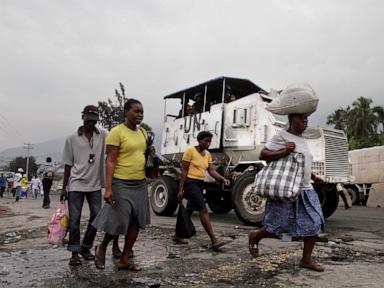
If you've followed the security situation in Haiti over the last few years, you already know the Haitian National Police (PNH), the Armed Forces of Haiti (FAd'H), and international security personnel have been locked in brutal urban combat against heavily armed coalitions like Viv Ansanm. What rarely makes it past the breaking news banner is why specific stretches of highway turn into warzones overnight. We aren't talking about symbolic territory here. We're talking about the arteries that carry fuel, food, medical supplies, and clean water to millions of trapped civilians.
Why Key Corridors Matter More Than Government Buildings
Think about how a modern city survives. You can surround a palace or burn down a courthouse, and daily life might limp along for a few weeks. Cut off the main transit corridor connecting a port or an agricultural region to the capital, and the entire economy flatlines in days. Related coverage on the subject has been shared by TIME.
In Haiti, armed coalitions figured this out a long time ago. By setting up fortified checkpoints, digging trenches across highways, and stationing snipers on rooftops overlooking main transit routes, gang alliances transformed major thoroughfares into lucrative tollbooths and chokepoints.
When state security forces launch an offensive to retake one of these corridors, the fighting turns fierce immediately because the stakes are existential for both sides. For the government and allied security forces, losing the road means losing the ability to govern or supply basic humanitarian aid. For the gangs, losing the corridor means losing millions of dollars in extortion revenue and surrendering their biggest piece of political leverage.
The Economics of Asphalt and Extortion
People often assume armed groups in Port-au-Prince survive purely on ransoms from kidnappings. Kidnapping gets the media attention, sure, because it's terrifying and personal. Yet highway extortion is the real cash cow.
Every shipping container leaving the port, every fuel tanker heading toward distribution depots, and every battered tap-tap bus carrying market vendors pays a tax to pass through gang-controlled territory. According to reporting by the United Nations Office on Drugs and Crime (UNODC) and the Global Initiative Against Transnational Organized Crime, illegal checkpoints along Haiti's main transit routes have systematically driven up the cost of basic goods across the entire nation.
When a truck driver has to pay thousands of dollars just to move rice or diesel a few miles down the road, those costs get passed straight to families already struggling to afford a single meal. That's why a battle over a stretch of road isn't just a tactical police operation. It's an attempt to break an economic stranglehold.
What Actually Happens During a Corridor Offensive
If you've ever watched raw footage from neighborhoods near Port-au-Prince's major transit arteries during a joint security operation, the first thing you notice isn't the gunfire—it's the terrain. Fighting in dense, unplanned urban sprawl favors the defender every single time.
Gangs don't fight like conventional armies. They don't wear uniforms, they don't hold static front lines in open fields, and they don't care about collateral damage. When armored vehicles from the Haitian National Police or allied units push into a contested corridor, they face a predictable, deadly playbook:
- Improvised barricades: Burned-out semi-trucks, shipping containers filled with rubble, and deep trenches dug with stolen heavy machinery block armored personnel carriers from advancing quickly.
- Elevated firing positions: Gunmen use cinderblock roofs and half-built concrete structures as natural bunkers, firing down on street-level patrols with high-caliber rifles.
- Rapid dispersion: The moment heavy armored units breach a barricade, fighters melt into narrow pedestrian alleyways where vehicles can't follow, only to circle back hours later.
- Civilian shields: Because these corridors run straight through densely populated commercial and residential districts, security forces have to weigh every burst of suppressive fire against the certainty of civilian casualties.
Honestly, clearing a corridor is the easy part. Anyone with enough armored vehicles and ammunition can push through a street for an afternoon. Holding it once the sun goes down is where past operations have repeatedly fallen apart.
The Trap of Short-Term Victories
Here's the hard truth that security analysts have been pointing out for years. Clearing gangs out of a key corridor means nothing if there isn't a permanent, fortified police presence left behind to keep them out.
Too often in Haiti's recent history, specialized police units have fought grueling, multi-day battles to reopen a highway, posed for cameras near a cleared barricade, and then withdrawn to base because they lacked the manpower or logistical support to garrison the area 24/7. Within forty-eight hours, gang fighters walk right back onto the street, rebuild the roadblocks, and punish local residents suspected of cooperating with authorities.
This cycle doesn't just waste lives and ammunition. It destroys public trust. If you're a shop owner or a bus driver living along a contested road, you're not going to cheer for an offensive if you know the gangs will be back by Tuesday night with a vengeance.
Why Equipment Alone Won't Fix This
Whenever heavy fighting breaks out, the immediate conversation turns to hardware. Does the Haitian National Police have enough armored vehicles? Do they have drones, night-vision optics, and heavy machine guns?
Hardware matters. You can't send officers in unarmored pickup trucks against shooters armed with .50-caliber rifles. International partners, including the United States and Canada, have delivered dozens of mine-resistant ambush-protected vehicles and tactical gear to bolster Haitian forces.
Still, hardware doesn't solve intelligence gaps or logistics. Without real-time aerial surveillance to spot ambushes before convoys enter narrow streets, armored trucks become targets. Without secure supply lines to rotate exhausted officers out of forward operating bases, even the best-equipped units burn out. And without cutting off the illicit weapons pipeline—most of which flows illegally from the United States via hidden compartments in maritime cargo, as documented repeatedly by UN expert panels—gangs simply replace whatever weapons security forces seize.
The Human Toll Caught in the Crossfire
When reports mention "heavy fighting" along a key corridor, the casualty numbers rarely tell the full story. The real damage spreads outward like shockwaves through a city already pushed to the brink.
First, movement stops completely. Hospitals along or near contested routes suddenly can't receive oxygen tanks, blood supplies, or surgical staff. Patients who need dialysis or emergency trauma care get turned away because ambulances can't cross active firing zones. Organizations like Médecins Sans Frontières (Doctors Without Borders) have had to repeatedly suspend or relocate operations in Port-au-Prince because ambulances and staff were caught in crossfire or targeted directly along main roads.
Second, displacement explodes. According to the International Organization for Migration (IOM), hundreds of thousands of Haitians have been forced from their homes by gang violence, with massive spikes occurring every time a major corridor erupts into sustained combat. Families flee with whatever they can carry in plastic bags, crowding into schools, churches, and makeshift camps that lack basic sanitation.
Third, food insecurity worsens almost instantly. Haiti relies heavily on imported staples arriving through Port-au-Prince's ports, alongside domestic produce trucked in from rural regions like the Artibonite Valley. When fighting shuts down the corridors connecting those farms and ports to urban markets, food rots in trucks while prices skyrocket inside the city.
How to Read News About Haiti's Security Operations Critically
If you want to understand whether an ongoing battle over a corridor actually signals a turning point—or just another temporary flare-up—stop looking at dramatic headlines and start tracking three concrete indicators over the weeks following the fighting:
- Sustained commercial traffic: Don't look at whether police vehicles can drive down the road. Watch whether independent fuel tankers, public transport buses, and food trucks resume regular daily trips without paying gang tolls.
- Forward base construction: Check whether security forces establish permanent, fortified substations along the cleared route rather than conducting hit-and-run patrols.
- Market price stabilization: In Port-au-Prince, the price of a gallon of fuel or a sack of rice tells you more about who truly controls the roads than any official press release ever will.
Keep your eye on those three metrics whenever fighting flares up along Haiti's transit arteries. Until armed forces can secure a corridor, fortify it permanently, and keep commercial goods flowing safely week after week, the battle for Port-au-Prince's lifelines is far from over.