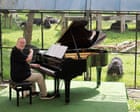
Progressive rock royalty rolls into a Vietnamese sanctuary, sets up a grand piano under a humid canopy, and plays solemn chords for one hundred and fifty rescued moon bears. The footage sweeps social media within hours. Headlines praise the transcendent power of music across species barriers. Donors feel warm. NGOs secure their quarterly funding bump.
It makes for world-class PR. It also completely misses the reality of wildlife rehabilitation. Building on this topic, you can find more in: Why The Oscar Rise of Nagaland Cinema Changes Everything You Thought You Knew About Indian Films.
For decades, the standard playbook for animal welfare has relied on anthropomorphic sentimentality. We want wild carnivores to appreciate human art because it flatters our egos. We project our emotional processing mechanisms onto a species whose neurological architecture evolved to hunt, forage, and violently defend territory against rival males.
Let us strip away the feel-good varnish and look at what actually happens when a concert pianist sits down in front of Asiatic black bears. Observers at GQ have shared their thoughts on this trend.
The Anthropomorphism Trap
I have spent years analyzing conservation economics and the behavioral responses of captive apex mammals. Every time a celebrity lands at a sanctuary with an acoustic instrument or a guitar, the internet loses its mind over acoustic enrichment.
Let us define enrichment properly. Environmental enrichment in zoology is not about making animals feel human emotions. It is about encouraging natural behavioral repertoires. It means foraging challenges, olfactory stimulation, spatial complexity, and unpredictable stimuli that mimic the ecological pressures of a harsh forest.
Does a 70-year-old British keyboardist playing classical melodies encourage natural foraging? No. Does it simulate the scent trail of a potential mate or the territorial threat of a rival? Not even close.
What it does is create a localized noise pollution event for an animal with acute auditory sensitivity. Bears possess hearing ranges that easily outstrip human capabilities. Pounding out resonant piano frequencies across a concrete and mesh enclosure does not soothe an Asiatic black bear. It confuses them. It forces them to process high-amplitude vibrations that they cannot contextualize, escape, or fight.
Yet the narrative persists because the public demands redemption arcs. We want the victims of the cruel bile extraction industry to find peace through Mozart. It is a clean, comforting lie.
The Economics of Feel Good Philanthropy
Behind every viral sanctuary concert sits a massive fundraising apparatus. Modern conservation runs on attention economy metrics. When a legacy rock star flies halfway across the world to play for rescued bears, the clickthrough rates spike. Donations surge. The sanctuary pays off its veterinary debts for another six months.
That is the pragmatic defense. Realists will argue that if playing Chopin to a captive bear keeps the lights on and buys antibiotics for a mutilated paw, the means justify the end.
I reject that compromise.
When we fund conservation through theatrical stunts, we distort public understanding of what conservation actually requires. Real conservation is boring. It is concrete quarantine protocols, expensive specialized surgical tools, massive tracts of protected land, armed anti-poaching patrols, and political battles against entrenched traditional medicine markets.
None of those things fit into a 60-second Instagram reel. None of them allow a wealthy Western audience to feel personally absolved of ecological guilt by double-tapping a video of a bear staring blankly at a Steinway.
By framing animal rescue as an emotional drama solved by artistic communion, we infantilize the issue. We teach the public that wild animals are simply furry humans who appreciate culture, rather than resilient, dangerous, highly specialized survivors of horrific industrial abuse.
What True Rehabilitation Demands
Ask any seasoned zookeeper or wildlife rehabilitator what a scarred moon bear needs after being freed from a bile crush cage. They will not ask for a grand piano.
They will ask for complex earthworks that force the animal to dig for grubs. They will ask for dense vegetation that blocks the relentless stare of tourists holding smartphones. They will ask for vast, multi-acre enclosures where bears can establish natural dominance hierarchies and rediscover the impulse to roam.
Most importantly, they will ask for a path to true release, or at least a life lived entirely on the animal's terms, free from human performance.
When we haul musical instruments into sanctuaries, we make the sanctuary about us. We make it a stage for human benevolence. The bears do not care about the artistic merit of the arrangement. They care about shade, food security, and the absence of human interference.
Stop looking for poetry in a cage. Give them space, give them silence, and get out of the way.