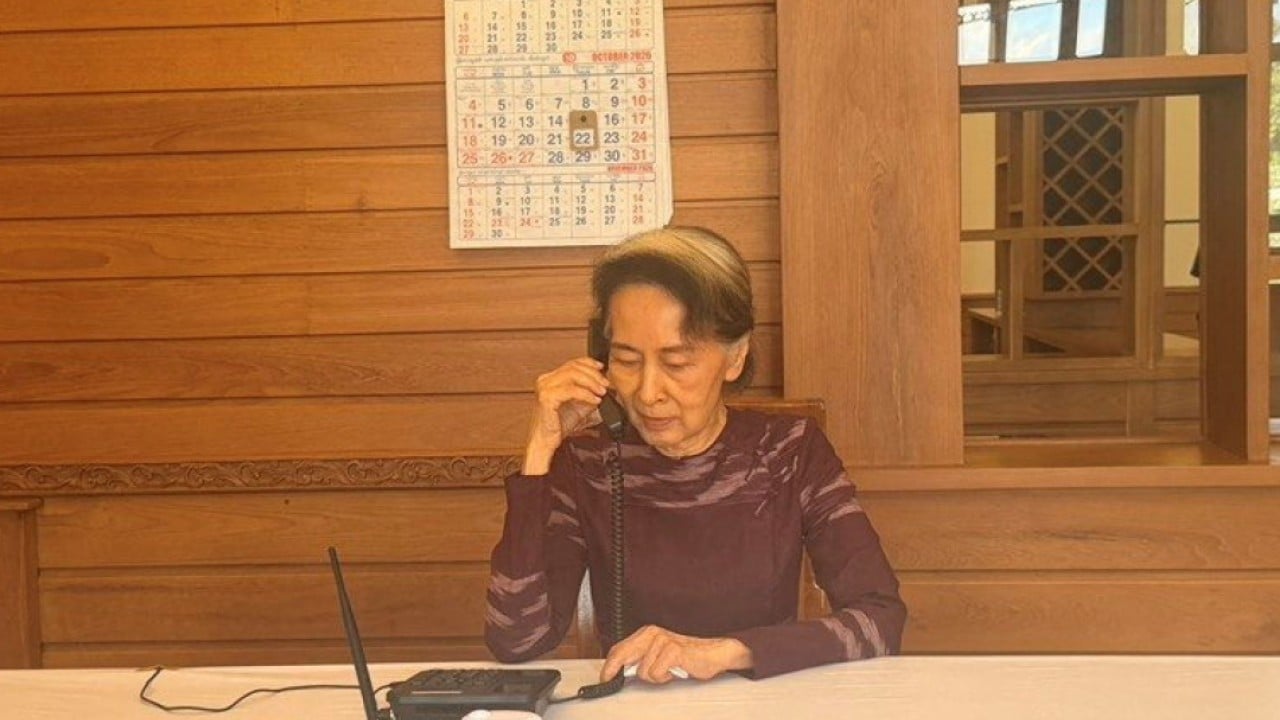
When an authoritarian regime permits a high-value political detainee to place a rare telephone call to a family member abroad, the event is rarely an act of humanitarian softening; it is a controlled telemetry signal emitted under strict custody constraints. The blueprint for analyzing such episodes rests on four operational lenses: deconstructing why standard news summaries over-read humanitarian optics, separating verified custody mechanics from strategic intent, mapping the junta's coercive signaling cost function, and evaluating the downstream friction across resistance factions and foreign mediators. Because no external source text or verified primary transcript accompanies the competitor headline in this context, any concrete claim about a specific call, date, or spoken line would be unsupported speculation. Instead, the analysis below models the exact structural mechanics that govern rare detainee communications in Myanmar's post-2021 conflict environment.
Deconstructing Shallow Reporting on Detainee Calls
Surface-level coverage of a detainee phone call typically treats the communication as a direct window into the prisoner's autonomous will or an immediate pivot toward negotiated settlement. That framing fails because it ignores the asymmetrical information environment inside detention. A prisoner held in isolation by a military apparatus operates under total physical, electronic, and legal surveillance. Every permitted minute of contact is filtered through custodial gatekeepers who control access, timing, duration, and third-party corroboration.
The first analytical failure in shallow commentary is conflating access with agency. Allowing a detainee to speak with a relative outside the country demonstrates that the regime retains uncontested physical custody and administrative discretion over the prisoner's life and routine. It does not prove that the detainee is negotiating freely or acting as an independent political actor.
The second failure is treating a single isolated data point as a completed policy shift. In protracted civil conflicts, regimes frequently test reactions with reversible gestures before committing to costly concessions. A one-off call carries near-zero binding commitment for the military leadership, whereas lifting formal charges, transferring custody to neutral monitors, or opening multi-party talks carries substantial institutional risk.
The third failure is overlooking the audience targeting of the disclosure. When news of a rare call surfaces, the intended recipients often include regional neighbors, international diplomats, exile networks, and domestic constituencies inside Myanmar. Reading the event solely through the lens of family reunion misses how the state uses controlled human contact to shape external perceptions of control and legitimacy.
Known Facts Versus Educated Hypotheses in Custody Signaling
Rigorous intelligence and policy analysis requires drawing a sharp line between verifiable structural conditions and reasoned hypotheses about motive. In Myanmar's post-coup environment, several structural realities are well established: Aung San Suu Kyi has been held in state custody since February 2021, her movement and external communications have been tightly restricted, and the State Administration Council (SAC) has faced sustained armed resistance from the National Unity Government (NUG), People's Defence Forces (PDF), and Ethnic Armed Organizations (EAOs) across multiple theaters.
Beyond those structural facts, analysts must treat specific interpretations as hypotheses requiring corroboration:
- Hypothesis A — Proof-of-Life and Health Calibration: Regimes periodically allow limited family contact to quiet rumors of severe illness or death, which otherwise spark spikes in domestic protest or intense diplomatic pressure.
- Hypothesis B — Back-Channel Credibility Testing: Allowing a detainee to speak with a trusted overseas relative can serve as an indirect relay to test how exile figures or foreign governments respond to quiet signals without formal diplomatic attribution.
- Hypothesis C — Factional Friction Inside the Resistance: A communication involving an iconic figure can test whether opposition coalitions remain unified around shared political objectives or fracture over tactical priorities, leadership authority, or negotiation posture.
- Hypothesis D — Diplomatic Optics Ahead of External Pressure: Timing a controlled concession around regional summits, neighboring border negotiations, or international scrutiny can give external interlocutors a talking point about "engagement" without altering battlefield operations.
Distinguishing these hypotheses matters because each implies a different operational response. A proof-of-life gesture aimed at containing rumor calls for verification of health and conditions rather than assuming peace talks are imminent. A signal aimed at testing diplomatic openings requires checking whether concrete changes accompany the gesture—such as broader access for legal counsel, family visits, or easing of restrictions on other detainees.
The Junta's Cost Function and Coercive Signaling
From a strategic standpoint, the military leadership evaluates detainee access through a coercive cost function. Every communication event carries both a control cost (the risk that an unscripted word leaks intelligence, rallies supporters, or embarrasses custodians) and a leverage return (the tactical benefit gained through international signaling, domestic deterrence, or psychological pressure on opponents).
The Three Pillars of Controlled Access
- Asymmetric Gatekeeping: The junta decides who speaks, when the call occurs, what technical channel is used, and whether any third party can verify the exchange. The detainee holds no unilateral right to initiate contact, which preserves the regime's monopoly over the narrative frame.
- Reversible Concessions: Unlike releasing prisoners or halting airstrikes, granting a brief phone call can be halted instantly without leaving a permanent institutional footprint. Reversibility keeps the regime's bargaining power intact while extracting short-term tactical value.
- Psychological and Political Leverage: In a polarized conflict, even minimal contact involving a nationally recognized figure affects morale and political calculus on multiple sides. Supporters may look for signs of resilience or guidance, critics of centralized leadership may debate her role in a changed political landscape, and rivals may assess how much symbolic weight she still commands after years of detention.
Cause-and-Effect Chains Shallow Coverage Misses
Shallow commentary often stops at "the junta allowed a call, therefore strategy is shifting." Tracing the causal chain reveals sharper second- and third-order effects:
- Detention control to narrative monopoly: Tight isolation starves the public and foreign observers of direct information, making any single permitted contact disproportionately influential. The regime exploits that scarcity to make a minor administrative allowance look like a major political opening.
- Selective access to coalition stress: When a detainee's voice re-enters public discussion—even indirectly through family accounts—opposition actors face renewed pressure to clarify their stance on negotiations, legitimacy, and transitional governance. That friction can slow decision-making inside multi-faction alliances even if the detainee issues no policy directive.
- Tactical optics to diplomatic delay: A small humanitarian or family gesture can give outside actors a reason to urge patience or quiet engagement. If external mediators treat a phone call as evidence of good faith without demanding verifiable benchmarks, the junta gains time while maintaining military pressure on the ground.
This mechanism also explains why a phone call is rarely a substitute for structural concessions. In bargaining theory, cheap talk—statements or gestures that cost the sender very little to reverse—carries low credibility unless backed by costly commitments. Real movement on conflict resolution requires verifiable changes in behavior, such as transparent access, release of political prisoners, or credible de-escalation, rather than tightly managed family contact alone.
Operational Implications for Analysts, Mediators, and Observers
Treating a rare detainee call as a tactical instrument rather than a turning point changes how practitioners evaluate subsequent events. Analysts working on Myanmar or similar authoritarian contexts can apply a four-step verification workflow whenever a high-profile detainee communication is reported:
- Audit Corroboration and Provenance: Separate firsthand accounts from the family member or direct recipient from secondary commentary, and note what details remain unverified due to custodial secrecy.
- Map the Timing Against External Pressures: Check what military setbacks, economic strains, border tensions, or diplomatic meetings coincide with the event to identify immediate tactical triggers.
- Measure Costly Follow-Through: Look for tangible changes over the following weeks—such as expanded legal or medical access or shifts in detention conditions—rather than treating the call itself as proof of a broader policy reversal.
- Track Resistance and Regional Reactions: Observe how opposition groups, ethnic organizations, and neighboring states adjust their public messaging and coordination in response to the news.
This analytical framework has clear limitations. Because authoritarian detention environments are opaque by design, external observers cannot directly observe internal junta deliberations, interrogation dynamics, or private instructions given prior to a call. High-profile detainees can also hold complex personal or strategic views that do not map neatly onto outside assumptions, and over-interpreting silence or brief remarks can produce false certainty in either direction. No single analytical model eliminates uncertainty in a multi-front conflict.
Strategic Play
Treat any rare detainee phone call as a tactical probe and proof-of-life signal, not confirmation of a strategic pivot by the junta, and require verifiable institutional follow-through—such as independent access, legal or medical transparency, and concrete de-escalation steps—before updating your baseline assessment of regime strategy.