Standing ovations are a terrible way to measure truth.
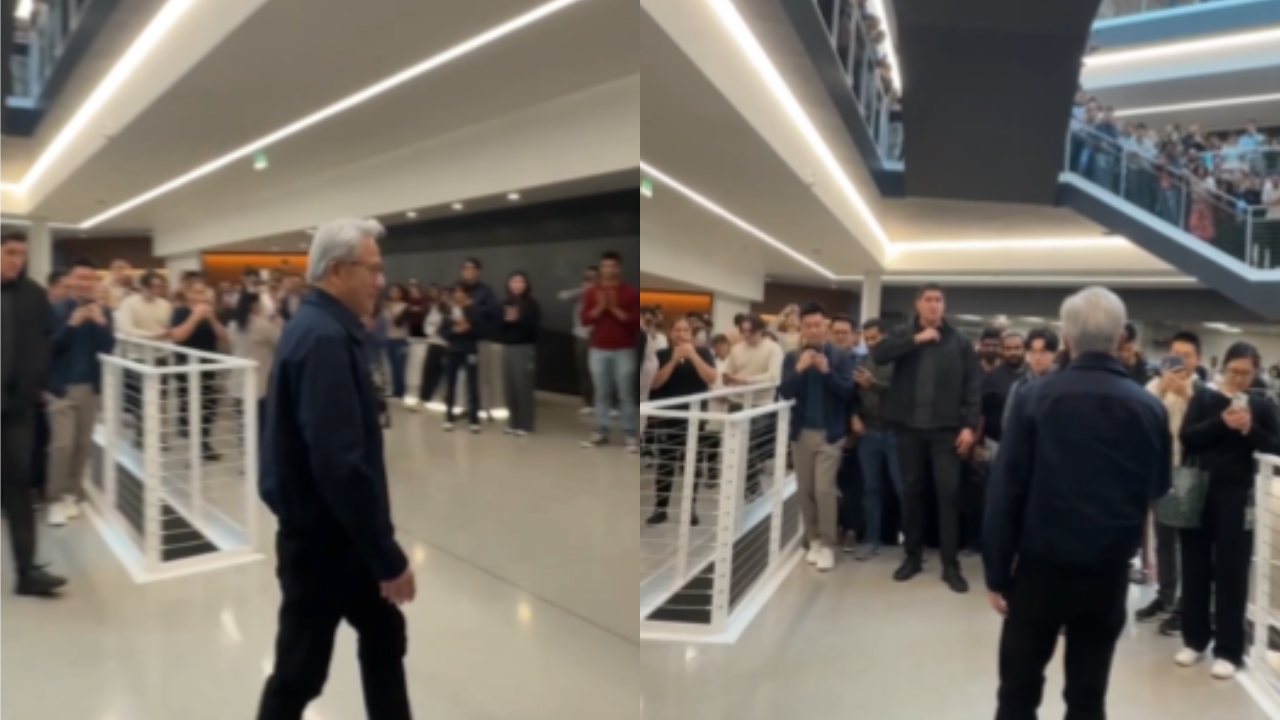
They are loud. They are warm. They wash over a room like a sudden summer rain, drowning out every whisper of doubt, every spreadsheet anomaly, every sleepless night that preceded the moment the doors swung open. When Jensen Huang walked back into Nvidia’s Santa Clara headquarters to a wall of thunderous applause and cheers, promising with a wry, practiced grin that he was going to be a "better CEO the second time around," the cameras captured triumph. They captured a tech titan returning to his kingdom, leather jacket gleaming under the atrium lights, greeted like a conquering hero.
I have stood in rooms like that before. Not in Santa Clara, and never at the helm of a multi-trillion-dollar colossus, but in corporate atriums where the air smells faintly of burnt espresso, expensive carpet adhesive, and collective relief. When a leader steps away—even briefly, even for a victory lap, a high-stakes diplomatic tour, or a strategic sabbatical—the organization holds its breath. Upon their return, the applause is rarely just about affection.
It is an exhale.
To understand why a room full of the sharpest engineers on earth erupted when one man walked through the front doors, you have to strip away the stock tickers and the breathless financial headlines. You have to look at the invisible weight resting on the shoulders of a company that accidentally became the load-bearing wall of the modern global economy.
The Anatomy of a Second Act
Why would the longest-serving chief executive in the semiconductor industry—a man who co-founded Nvidia in a Denny’s booth in 1993 and steered it from a scrappy graphics-card maker to the beating heart of the artificial intelligence boom—joke about needing a "second time around"?
It sounds like self-deprecation. It is actually a confession.
Consider a hypothetical engineer—let’s call her Maya—sitting three rows back in that Santa Clara atrium. Five years ago, Maya was optimizing rendering pipelines so teenagers could see sharper shadows in video games. Her life had a predictable cadence. Product cycles moved at a human pace. If a chip architecture slipped by a quarter, a few gaming forums complained, a few analysts adjusted their price targets, and life went on.
Today, Maya’s work dictates whether sovereign nations can train their own language models, whether pharmaceutical startups can simulate protein folding before their venture capital runs out, and whether the retirement accounts of millions of teachers and firefighters go up or down on a Tuesday afternoon.
When Jensen Huang walked out of that building for his recent stretch of relentless global appearances—navigating supply chain bottlenecks in Taiwan, testifying before policymakers, and evangelizing compute infrastructure across continents—the company he left behind was fundamentally different from the one he had run for three decades. And when he walked back in, he was stepping into a role that no human being has ever truly rehearsed for.
Running a fast-growing company is one skill. Running an infrastructure monopoly that the entire world is simultaneously dependent on and terrified of is another beast entirely.
The phrase "better CEO the second time around" lands with such force because every founder who survives long enough eventually realizes their original playbook has expired. The scrappy, paranoid survivalism that saved Nvidia from bankruptcy in the mid-1990s—when Huang famously told his staff that the company was "thirty days from going out of business"—doesn't work when you are the incumbent giant. You cannot pretend to be the underdog when your market capitalization rivals the GDP of G7 nations.
The Weight of the Leather Jacket
We love symbols because symbols are simple. The black leather jacket. The silver hair. The effortless command of a keynote stage without a teleprompter. Media coverage reduces Jensen Huang to a caricature of Silicon Valley cool, a rockstar CEO who signs autographs on people's chests and delivers billion-dollar product roadmaps like stand-up routines.
That caricature misses the exhausting reality of what it takes to hold a hyper-scaling organization together.
Think of an orchestra playing a symphony at double speed while the sheet music is still being printed. That is Nvidia right now. Competitors are pouring tens of billions of dollars into custom silicon to break free from Nvidia’s software ecosystem, CUDA. Cloud giants—Nvidia’s largest customers—are quietly building their own rival chips in-house. Regulators from Washington to Brussels are sharpening their antitrust pencils. Meanwhile, physics itself is pushing back, as cramming more transistors onto a sliver of silicon runs headfirst into the stubborn laws of thermodynamics and power grid limitations.
When the conductor steps off the podium, even for a short while, the musicians keep playing, because they are professionals. They hit their notes. The quarterly numbers still dazzle.
Yet an unmistakable tension creeps into the room. Without the central gravitational pull of the founder, middle management begins to hedge. Teams start optimizing for internal consensus rather than existential speed. Small political fractures—the silent killers of every great tech empire—begin to form beneath the floorboards.
I remember watching a legendary executive return to a struggling industrial firm after a six-month medical leave in the early 2010s. The welcome-back town hall looked remarkably similar to the footage from Santa Clara: banners, cheers, misty eyes. Within forty-eight hours, the cheering stopped, and the real work began. He walked the factory floor not to bask in the warmth of the welcome, but to listen to the hum of the machinery and find out where the friction had built up while he was gone.
Huang’s return to headquarters carries that exact electricity. The cheers in the lobby were real, born of genuine loyalty and shared wealth—Nvidia’s meteoric rise has turned thousands of rank-and-file employees into multi-millionaires. Still, beneath the celebration lies a cold, hard truth: the hardest part of this journey hasn't even started.
Why Founder-Led Companies Fear the Mirror
To grasp why Wall Street and Silicon Valley obsess over every move Huang makes, you have to look at the graveyard of tech titans who failed their second acts.
History is merciless to founders who stay too long without evolving. Look at the cautionary tales etched into the valley's collective memory. When a company transitions from an insurgent disruptor to an entrenched titan, the founder’s greatest strengths often metastasize into fatal blind spots. The relentless attention to detail turns into suffocating micromanagement. The refusal to listen to naysayers curdles into deafness toward legitimate market warnings.
Huang has built a reputation for flat organizational structures—reportedly maintaining dozens of direct reports to eliminate bureaucratic filters—and for sending terse, late-night emails demanding clarity on complex engineering bottlenecks. That intensity forged Nvidia’s culture. It created a company capable of pivoting from gaming GPUs to parallel computing and artificial intelligence years before anyone else saw the wave coming.
Now, however, the scale is staggering. You cannot personally inspect every weld on a ship the size of a city.
When Huang quipped about being a better CEO the second time around, he was acknowledging the transition from builder to steward. A builder obsesses over the product; a steward obsesses over the institution. A builder fights for market share; a steward manages an ecosystem where a single misstep can trigger a global supply shock.
Let’s be honest about the uncertainty here. Nobody—not the analysts on CNBC, not the engineers in Santa Clara, and almost certainly not Huang himself—knows for sure whether a single executive can successfully reinvent his leadership style at the exact moment his company reaches peak historical velocity. The history of business suggests the odds are stacked against it. Human beings are creatures of habit, especially habits that have made them wildly successful.
The Invisible Stakes in the Atrium
Watch the video of that welcome-back moment closely, and look past the man at the center of the frame. Look at the faces in the crowd.
You see young software architects who joined two years ago, exhausted from eighty-hour weeks spent debugging distributed training clusters. You see veterans who survived the lean years when Nvidia’s stock languished in the single digits and critics dismissed artificial intelligence as an academic pipedream. You see operations managers who spent the last year begging foundries for packaging capacity and navigating export controls that changed overnight.
They aren't cheering because they think the war is won. They are cheering because they know the battle is escalating, and they want their general back at the front.
Let’s use an analogy to ground what is actually happening inside those walls. Imagine a deep-sea submersible descending into the Mariana Trench. At three thousand feet, the hull creaks, and the crew feels proud of their engineering. At ten thousand feet, the pressure outside is so immense that a single hairline fracture—one loose bolt, one miscalibrated sensor—means instant implosion.
Nvidia has descended past ten thousand feet. The pressure isn't coming from failure; it is coming from success. Every major technology company on earth is now incentivized to reduce its dependence on Nvidia. Every sovereign government wants a piece of its supply chain. Every investor expects miracles every ninety days, treating a mere "beat" on earnings as a disappointment if the guidance doesn't shatter records.
At that depth, leadership isn't about giving inspiring speeches. It is about reading the pressure gauges in complete silence while everyone else is looking to you for reassurance.
What "Better" Actually Demands
If Jensen Huang is genuinely going to be a better CEO in this next chapter, what does that look like in practice? It won't look like the highlight reels. It will happen in quiet conference rooms, away from the cameras, through four brutal shifts in how the company operates.
First, it requires ruthless prioritization. When you have practically unlimited capital and endless demand, the greatest danger isn't starvation; it is indigestion. Nvidia can afford to fund every moonshot, buy every promising startup, and chase every adjacent market from robotics to drug discovery to sovereign cloud infrastructure. A better CEO says "no" to good ideas so the organization doesn't fracture under the weight of its own ambition.
Second, it demands diplomatic fluency. For thirty years, Huang’s primary audience was developers and gamers—people who spoke the language of teraflops, shaders, and latency. Today, his primary audience includes heads of state, energy ministers, and central bankers. Data centers consume gigawatts of electricity; AI chips have become instruments of national security. The second-time CEO has to navigate geopolitics with the same precision he brings to silicon architecture, knowing that a stray remark in a press conference can trigger regulatory retaliation halfway across the globe.
Third, it means resisting the seduction of your own myth. When the world tells you every single day that you are a visionary genius, the feedback loops inside your own company begin to break down. People stop bringing you bad news. They soften the edges of delays. They tell you what they think you want to hear. Overcoming that requires actively manufacturing dissent—rewarding the engineer who stands up in a meeting and says, "Jensen, this architecture is flawed, and here is why."
Finally, it requires preparing for a world where he isn't there at all. Succession is the taboo topic of every founder-led empire, the quiet elephant sitting in the corner of the boardroom. Yet the ultimate test of a second-act CEO isn't how brilliantly they shine in the spotlight; it is whether the machine they built can keep humming long after they take off the jacket and walk out the door for good.
The Echo After the Room Clears
The applause in Santa Clara lasted only a few minutes.
Eventually, the clapping faded into a low murmur. Badges were scanned at security turnstiles. Elevators whisked engineers back up to their floors, where glowing monitors waited with lines of uncompiled code, thermal simulation models, and supply chain manifests stretching well into the end of the decade.
Outside the glass walls of the headquarters, the California sun beat down on the manicured lawns, indifferent to market caps and keynotes. Inside, a man in a black leather jacket walked toward his office, carrying the expectations of an entire industry on his back, acutely aware that yesterday’s applause buys zero forgiveness for tomorrow’s mistakes.