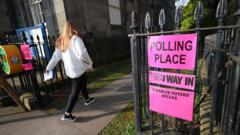
Polling stations across Scotland are seeing a steady stream of voters today as the nation decides the makeup of its seventh Parliament since 1999. While headline numbers suggest the Scottish National Party (SNP) remains on track to be the largest party with roughly 35% of the constituency vote, the underlying reality is far more volatile. This election is not merely a choice between parties; it is a fundamental stress test for the devolution settlement itself. For the first time in two decades, the predictable binary of independence versus union is being disrupted by a surging Reform UK and a Scottish Labour party fighting for survival.
The 2026 Holyrood election finds a Scottish electorate that is simultaneously exhausted and deeply divided. Decades of dominance by a single political movement are meeting the hard reality of a stagnant economy and an NHS that has struggled to recover from the shocks of the early 2020s. Voters are being asked to choose between an SNP-Green coalition seeking a fifth term and a fragmented opposition that cannot agree on whether to fix the current system or dismantle the constitutional status quo entirely.
The Death of the Two Party Monopoly
For years, Scottish politics was a simple tug-of-war. You were either with the SNP for independence or with the Conservatives to protect the union. That architecture has collapsed. The emergence of Reform UK as a genuine electoral force in Scotland—polling as high as 18% in some final surveys—has fractured the unionist vote in a way that helps the SNP maintain seats even as their own support dips.
In previous cycles, the Scottish Conservatives were the undisputed home for "No" voters. Today, that vote is split three ways between the Tories, a resurgent Reform, and a Labour party that is hemorrhaging support to both sides. This fragmentation means the SNP could win a significant number of first-past-the-post constituencies with much lower shares of the vote than in 2021. It is a mathematical quirk of the Additional Member System (AMS) that may keep the incumbents in Bute House, even if the "will of the people" feels less decisive than ever.
Fiscal Reality Versus Manifesto Promises
Behind the campaign slogans about "100 days of action" lies a looming financial crisis that no party is willing to fully acknowledge. The Institute for Fiscal Studies has been blunt: the next Scottish Government will inherit a budget under immense pressure. Scotland’s tax powers have expanded, but so have its liabilities.
- Income Tax Divergence: The gap between what high earners pay in Scotland compared to England has reached a historic peak.
- The Funding Gap: Public spending in Scotland remains significantly higher per head than in England, but the "Barnett squeeze" and a lack of real-term growth mean the money is running out.
- The NHS Burden: With 3% recurrent savings required annually just to keep the health service afloat, the next administration faces the politically toxic task of potential service cuts or further tax hikes.
The SNP’s pitch involves a price cap on essential food items and expanded childcare. Labour promises an industrial strategy. Yet, neither has explained how these will be funded in an environment where real earnings have grown by a dismal 0.13% per year over the last parliamentary term. This is the "fiscal honesty gap" that the winner will have to bridge the moment the cameras leave the count.
The Independence Paradox
Independence remains the elephant in the room, yet it has become strangely detached from the daily concerns of the electorate. Support for a "Yes" vote hovers around the 50% mark, but the path to a referendum is more blocked than ever. The Supreme Court's earlier rulings have made it clear that Holyrood cannot act unilaterally.
The SNP’s strategy of treating this election as a "de facto" mandate has lost its edge. Instead, they are pivoting toward a demand for a Section 30 order on day one of the new parliament. It is a familiar dance. However, the Scottish Greens are pushing the envelope further, demanding the devolution of all powers including energy and foreign affairs—essentially independence by stealth. If the SNP falls short of a majority and requires Green support to govern, the price of that coalition will be a much more aggressive stance toward Westminster.
The Reform Wildcard
The most significant "how" in this election is how Reform UK managed to penetrate the Scottish consciousness. They have successfully targeted "left-behind" voters in former industrial heartlands and rural areas who feel the central belt-centric policies of the SNP and the "woke" priorities of the Greens have ignored them. By focusing on the cost of living and a total rejection of the net-zero timeline, they have created a populist alternative that bypasses the traditional constitutional divide.
A System Under Strain
We are witnessing the limits of the 1997 devolution dream. The original goal was a consensus-based parliament that avoided the "winner takes all" mentality of Westminster. Instead, the proportional representation system has led to a decade of entrenched minority or coalition governments that spend more time on constitutional signaling than on legislative reform.
The results flowing in tomorrow will likely show a parliament that is even more fragmented. If the SNP and Greens together hold a majority, the push for independence will be renewed with theatrical intensity. If they fail, Scotland enters an era of legislative paralysis where no single bloc can pass a budget without making concessions that alienate their base.
Voters today aren't just picking an MSP; they are deciding if the current model of Scottish governance is sustainable. The queues at the polling stations are long, but the patience for the old arguments is remarkably short. Scotland is waiting for something to break.
The count begins at 10:00 PM. By dawn, we will know if the nation has chosen a difficult path toward renewal or four more years of the same constitutional stalemate. Regardless of the winner, the fiscal reckoning is no longer a future problem—it starts tomorrow morning.