Noise is easy.
In the modern football universe, sound design dictates everything. It lives in the booming stadium speakers, the hyper-filtered hype packages splashed across social media feeds, and the endless digital scrolling of twenty-somethings chasing validation through blue checks and notifications. Every young athlete enters the professional arena surrounded by a megaphone. They broadcast their thoughts, curate their brands, and trade in public proclamations before they have ever taken a meaningful snap against grown men.
Then there is David Bailey.
He does not have social media. While his peers spend their Tuesday nights refreshing timelines and measuring their worth in impressions, the rookie edge defender sits in quiet rooms, studying structural blocking schemes, logging film hours, and archiving movement patterns of elite pass rushers in his head. When his phone rings with texts from family members marveling at his ascent, he answers with a quiet nod. When veterans try to poke fun at him in the locker room to see if he will crack a smile or lose his composure, he simply blinks back with an unreadable, business-like calm.
He is twenty-three years old. He looks like he belongs in a boardroom, until the ball is snapped.
To understand what happened under the gray, rain-slicked skies of MetLife Stadium, you have to look past the box score. You have to trace the invisible geometry of the line of scrimmage, where a game of inches transforms into a matter of sheer survival.
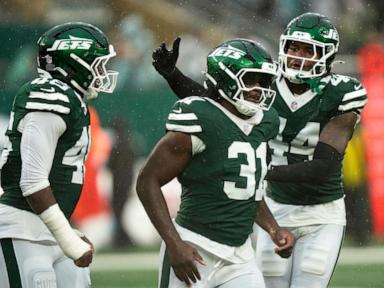
The elements were miserable that afternoon. A steady, driving rain turned the turf into a testing ground of traction and fatigue. The offense struggled to find rhythm. But the defense lived in a different register. At the center of that storm stood Bailey, wearing number 31, a young man carrying the heavy, unspoken expectations of a second-overall draft choice.
On his very first professional snaps against the Cleveland Browns, the tactical adjustments came instantly. Cleveland did not test him gently; they met him with immediate double-teams. They threw bodies at his chest, trying to erase his leverage before he could breathe. It did not matter. By the time the afternoon mud had settled, Bailey had compiled three sacks, nine total pressures, four quarterback hits, and an invisible gravity that warped the opposing team's entire play-calling architecture.
Head coach Aaron Glenn stood in the center of the post-game locker room, surrounded by the steaming exhaustion of a hard-fought victory. He looked at his players, raised his voice over the collective heartbeat of the room, and gave his young edge rusher a title that immediately caught fire across the league.
"That f--ing flamethrower," Glenn called him.
The moniker stuck because it captured the violent paradox of Bailey’s game. Out of uniform, he is a ghost in the machine—even-keeled, softly spoken, entirely detached from the digital theater of modern sports. But between the white lines, he converts that internal stillness into explosive kinetic fury. His first step is not merely fast; it is a mathematical anomaly. Next Gen Stats clocked his maximum acceleration at speeds exceeding twenty miles per hour, allowing him to bend the edge with a terrifying elasticity. He dips his shoulder beneath the massive frame of a three-hundred-pound tackle, turns an impossible corner, and arrives at the quarterback's back like an uninvited thought.
History remembers the rookie outliers who arrive with this kind of raw disruption. Names like Hugh Douglas, who terrorized backfields in 1995, or icons like Von Miller and Elvis Dumervil. Bailey joined elite historical company when he racked up seven and a half sacks and an unprecedented streak of forced fumbles through his first eight professional games, standing alone as the only player since the turn of the century to jar the ball loose five times in that span.
Yet numbers fail to capture the psychological weight he imposes on opposing offenses.
Consider what happens inside the mind of a veteran quarterback when the protection breaks down not because of a blown coverage, but because a rookie simply wants it more. During a high-stakes matchup in Kansas City, Bailey broke through the line with blinding acceleration, trapping Patrick Mahomes in the pocket before violently stripping the ball away. It was a sequence of pure destruction executed in less than thirty seconds. There was no celebration, no theatrical chest-thumping directed at the cameras. He simply secured the fumble, pointed to his teammates, and went back to work.
That relentless motor comes from somewhere deeper than athletic genetics. Raised in Southern California by immigrant parents—his father from Jamaica and his mother from Ghana—Bailey grew up absorbing an immigrant work ethic where shortcuts simply do not exist. That unyielding foundation carried him through dominant stints at Mater Dei High School, through the academic trenches of Stanford, and into the high-octane proving grounds of Texas Tech where he earned unanimous All-American honors and Big 12 Defensive Lineman of the Year recognition.
When the Jets drafted him second overall, analysts wondered if the transition to the professional level would blunt his edge. They worried the bright lights of New York might overwhelm a quiet kid from the West Coast. They mistook his silence for hesitation.
They did not understand that the quietest players are often the most dangerous.
The NFL is a theater of ego. Every week, players posture for the cameras, chase personal highlights, and seek the warmth of public approval. But true dominance requires a monastic dedication. It requires a willingness to submerge oneself in the unglamorous details: watching film until the eyes burn, studying stance variations, correcting hand placement by millimeters, and refusing to be distracted by the noise of the outside world.
When Bailey walks off the field after another multi-sack performance, he does not look for his phone. He does not check his mentions. He looks toward the next assignment.
For a franchise that has spent years searching for its defensive identity, finding a cornerstone piece who treats excellence as an absolute baseline rather than a brand-building exercise changes everything. The defense now possesses an anchor, a young predator who plays with the calculated coldness of a veteran and the raw, unbridled engine of a rookie who refuses to hit a wall.
The flamethrower is burning through the league. And the rest of football is only just beginning to feel the heat.