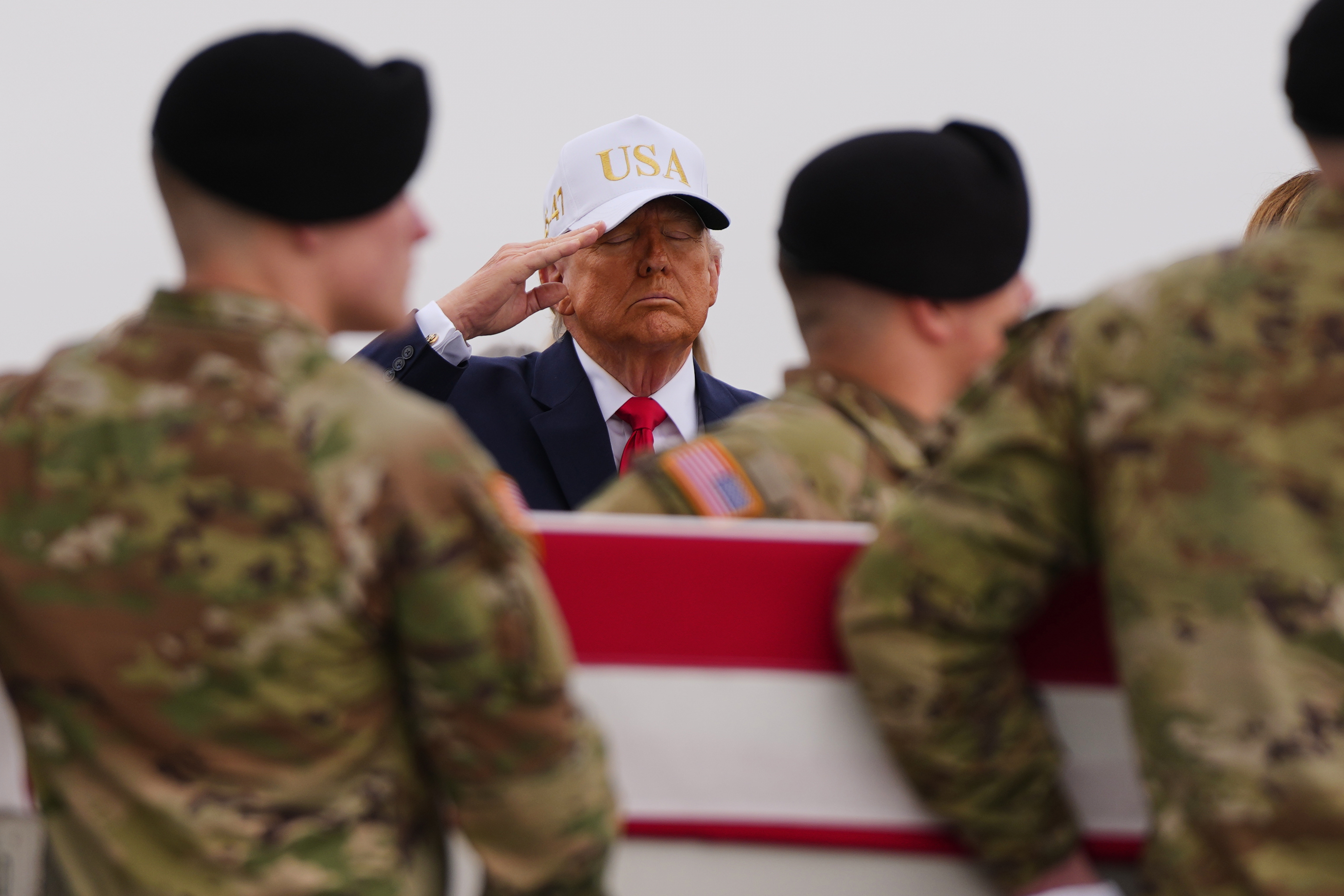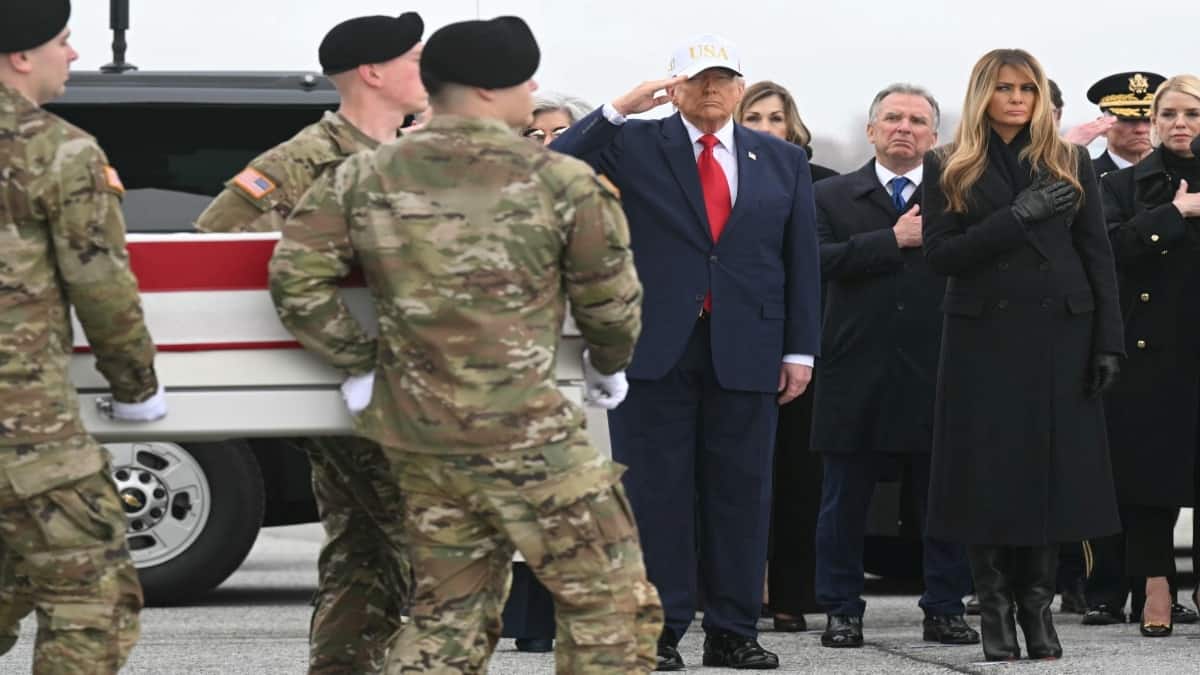
Donald Trump stood on the tarmac at Dover Air Force Base, the wind whipping against a white "USA" cap that felt more like a campaign signal than a traditional shroud of mourning. He was there to witness the "dignified transfer" of the first American service members killed in a direct, hot conflict with Iran—a moment that shifted the geopolitical weight of his administration from rhetorical threats to the heavy reality of body bags. This wasn't a standard military ceremony. It was the physical manifestation of a gamble that many in the Pentagon had warned would eventually come due.
The arrival of these fallen troops marks a grim milestone in a conflict that has simmered for decades but recently boiled over into a localized, lethal war. For the families watching the flag-draped transfer cases slide out of the C-17, the politics of the headwear mattered less than the void left behind. But for the rest of the world, and especially for the intelligence community, the imagery at Dover served as a stark admission that the "maximum pressure" campaign has reached a point of no return. We are no longer talking about proxy skirmishes in the Levant. We are talking about a state-on-state kinetic reality.
The Strategy Behind the Scenery
The presence of a Commander-in-Chief at Dover is always a calculated move. It is meant to show a leader sharing the burden of his decisions. However, the choice to wear a partisan-coded hat during a ceremony defined by somber, non-partisan ritual has sparked immediate friction within the veterans' community. The "USA" cap, often seen at rallies, creates a jarring contrast with the strict military dress code of the Honor Guard. It suggests a presidency that views even the most tragic duties of the office through the lens of a personal brand.
Beyond the optics, the "why" of this specific loss is what haunts the halls of the State Department. These troops weren't killed by a roadside IED planted by a nameless insurgent. They were targeted by sophisticated Iranian-manufactured ballistic missiles. This distinction is vital. It indicates a level of technical capability and intent from Tehran that bypasses the old rules of "plausible deniability."
The Intelligence Gap and the Warning Signs
For months, back-channel warnings from Swiss intermediaries and regional partners like Oman suggested that Tehran’s patience had evaporated. The administration’s decision to tighten the noose on Iranian oil exports to zero was the catalyst. In the intelligence world, we call this "cornering the rat." When a regime feels its survival is threatened, it stops caring about the nuances of international law. It strikes at the most visible symbol of its oppressor.
The Pentagon’s internal memos, some of which have begun to leak through the cracks of a fractured National Security Council, show that the defensive posture in the region was inadequate for a direct missile strike. We were prepared for drone swarms and small-boat harassment. We were not prepared for a coordinated saturation of our regional hubs. The failure to intercept the incoming fire that led to these deaths isn't just a tactical lapse; it’s a failure of strategic imagination.
The Economic Shrapnel of a Hot War
Wars are won on logistics and lost on the balance sheet. While the focus at Dover was on the human cost, the markets are already reacting to the realization that the Persian Gulf is now a shooting gallery. If Iran continues to target U.S. personnel, the U.S. will be forced to target Iranian infrastructure. This isn't just about the price of a gallon of gas in the Midwest. It’s about the insurance premiums for every tanker passing through the Strait of Hormuz.
When shipping lanes become war zones, the global supply chain doesn't just slow down—it breaks. The "just-in-time" delivery model that sustains modern commerce cannot handle a 400% increase in maritime insurance rates. We are looking at a scenario where the cost of defending the interests that led to this conflict exceeds the value of the interests themselves.
- Insurance Spikes: Commercial vessels are already being rerouted around the Cape of Good Hope.
- Energy Volatility: Brent crude is mocking the administration’s claims of stability.
- Military Spending: The "pivot to Asia" is officially dead as billions are redirected back into the Middle Eastern theater.
The Internal Friction of the Joint Chiefs
There is a quiet, simmering anger within the high-ranking circles of the military. They are the ones who have to explain to a 22-year-old widow why her husband is in a box because of a policy that lacked a clear "off-ramp." The military is an instrument of policy, but it expects that policy to have a coherent end state.
Currently, the end state with Iran is a moving target. Is it regime change? Is it a new nuclear deal? Is it simply containment through attrition? Without a clear answer, the military is being used as a shield for a diplomatic vacuum. The troops at Dover are the price of that ambiguity. They are the collateral of a strategy that prioritizes "looking tough" over the boring, difficult work of sustainable statecraft.
A Departure from Tradition
Traditionally, the dignified transfer is a silent affair. No speeches are given. The only sound is the rhythmic clicking of boots on metal and the snapping of the flag in the wind. By bringing the aesthetic of a political movement to this silence, the administration risks turning a sacred military rite into a campaign backdrop.
This isn't a minor gripe from the "etiquette police." It's a fundamental shift in how the American public perceives the use of force. If the sacrifice of service members is tied to a specific political identity, the national consensus required to sustain a long-term conflict begins to crumble. You cannot fight a war with only half the country behind you.
The Tehran Perspective
We often fail to look at the scoreboard from the other side. For the hardliners in the Islamic Revolutionary Guard Corps (IRGC), the images from Dover are a victory. They have proven they can reach out and touch American forces. They have shown their domestic audience that the "Great Satan" is not invincible.
They are playing a different game than we are. While Washington worries about the next election cycle, Tehran is thinking in decades and centuries. They are willing to endure immense economic pain to achieve a single symbolic blow like the one we saw the results of this week. This fundamental misalignment in "pain tolerance" is why the current strategy is failing. We are trying to bankrupt a regime that views bankruptcy as a holy sacrifice.
The Equipment Problem
The hardware being used in this conflict is aging. While we talk about high-tech warfare, the reality on the ground is often soldiers operating systems that were designed in the 1980s. The missile defense systems that failed to protect these troops are sophisticated, but they were overwhelmed by sheer volume.
The U.S. military is currently spread too thin. We have assets in Eastern Europe, the South China Sea, and now a re-ignited front in the Middle East. This "strategic overstretch" means that when a crisis hits, we are reacting with whatever is nearby, rather than the optimal force. These deaths are a reminder that even the world’s most powerful military has a breaking point.
What This Means for the Next Six Months
The next half-year will be defined by a cycle of retaliation. The "USA" cap at Dover signals that the President is doubling down. He is not in a mood for de-escalation. He sees the fallen as a reason to strike harder, rather than a reason to rethink the path that led here.
We should expect:
- Increased Cyber Attacks: Iran will not limit its response to missiles; expect hits on domestic U.S. infrastructure.
- Targeted Assassinations: Both sides have now set a precedent for taking out high-level targets.
- Proxy Surge: Expect increased activity from Hezbollah and various militias in Iraq to further stretch U.S. resources.
The dignified transfer at Dover was a moment of silence in a world that is getting progressively louder. The flags were folded, the families were comforted, and the President flew back to Washington. But the underlying mechanics of this war remain unchanged and unaddressed. We are spending our most precious resource—human life—on a strategy that seems to have no clear exit and no measurable definition of victory.
The "USA" hat might look like a sign of strength to a base of supporters, but to the rest of the world, it looks like a lack of gravity. It looks like a leader who hasn't yet grasped that the blood on the tarmac is real, permanent, and entirely his responsibility. The time for slogans has passed. The time for a coherent, realistic foreign policy that doesn't rely on the hope that the other side will simply give up is long overdue.
Check the deployment orders for the 82nd Airborne tonight if you want to know where this is really going.