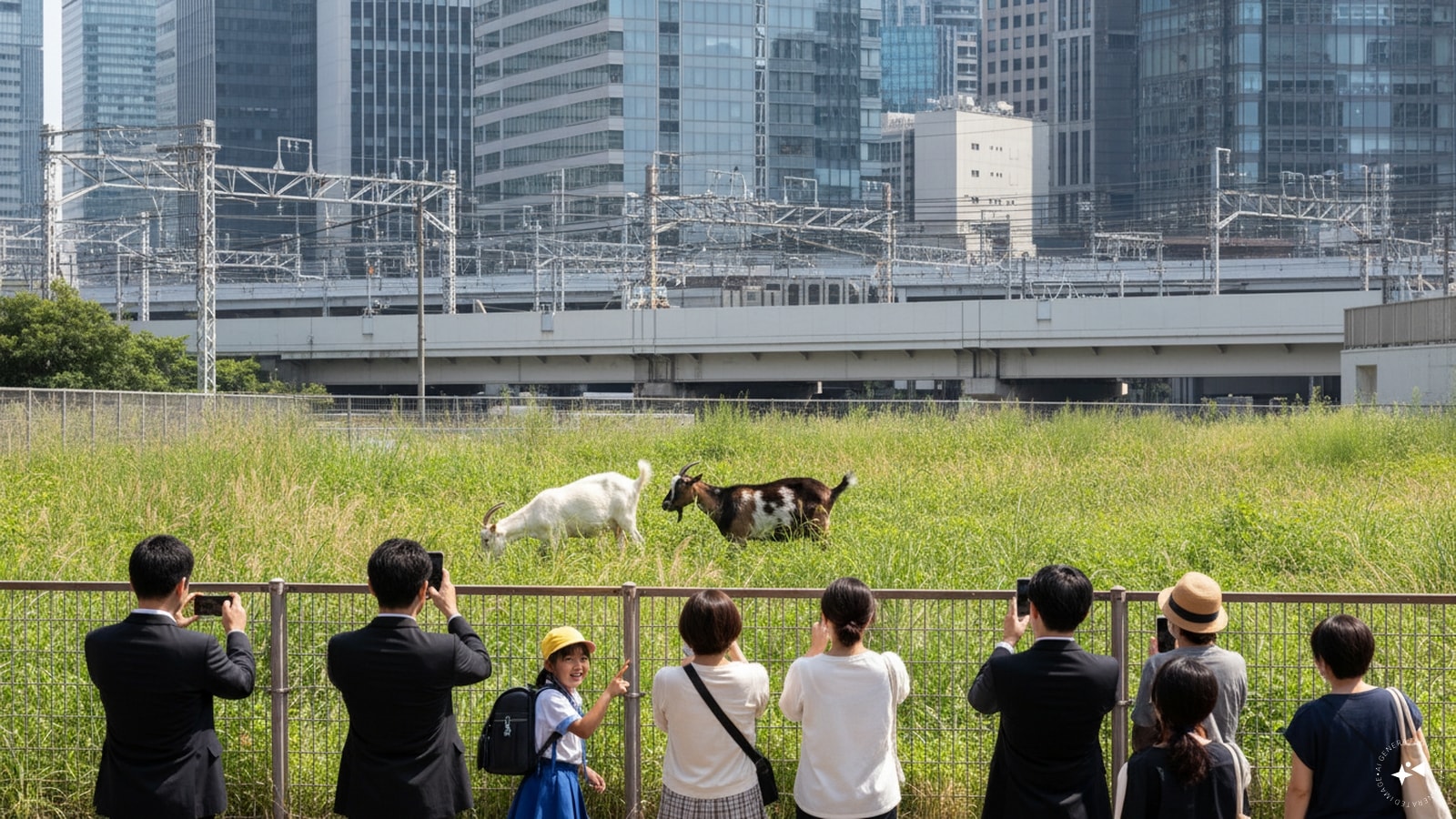
Every few months, the internet collectively loses its mind over a fluff piece about Japanese transit authorities hiring goats to eat weeds along train tracks.
Look at the headlines. Read the lazy journalism. They frame it as a heartwarming, accidental viral sensation. The standard narrative goes something like this: pragmatic railway engineers hire four-legged lawnmowers to trim the grass, and oops, the fluffy little guys accidentally steal the spotlight from the bullet trains! Commuters smile! Everyone wins!
That narrative is completely backwards.
If you have spent any time inside corporate communications, infrastructure asset management, or municipal PR, you know that nothing a major Japanese rail operator does is an accident. Those goats did not "steal" the spotlight. They were weaponized to capture it.
The mainstream coverage treats this as an adorable quirk of Japanese culture. In reality, it is a cold, calculated masterclass in risk mitigation, public relations laundering, and behavioral psychology disguised as a petting zoo.
The Myth of the Accidental Viral Sensation
Let’s dismantle the primary delusion right out of the gate. Major transit operators like Keio Corporation or JR East do not casually toss livestock next to high-voltage third rails and multi-ton steel locomotives on a whim.
Railway corridors are among the most heavily regulated, liability-obsessed environments on earth. Before a single hoof touches ballast gravel, teams of actuaries, safety inspectors, veterinarians, and legal counsel have spent months running risk assessments. When a transit authority puts goats on an embankment, they know exactly what the press will do.
The press is predictable. Give a journalist a spreadsheet about herbicide runoff reduction and trackside erosion control, and they will ignore you. Give a journalist a photo of a baby goat wearing a tiny safety vest next to a commuter platform, and they will write your brand story for free across twelve time zones.
I have sat in boardrooms where executives burned through millions of dollars trying to buy the kind of positive sentiment that four goats generate for the price of a few bales of hay and a temporary chain-link fence. Calling this an "accidental spotlight" insults the intelligence of the PR strategists who engineered it.
What Ruminants Actually Do to Infrastructure
To understand why this works—and why the cute framing obscures the real engineering—you have to look at the mechanics of targeted grazing (also known as prescriptive grazing).
Most people think goats just eat grass. They don't. Cattle and sheep are grazers; they prefer low-lying grasses and clover. Goats are browsers. Their biological machinery is built to stand on their hind legs, reach high, and strip woody shrubs, invasive vines, and broadleaf weeds like kudzu—the exact aggressively growing flora that destroys railway embankments and fouls overhead catenary wires.
Here is the real operational problem railway engineers face:
- Mechanical mowing fails on slopes. Steep trackside embankments are death traps for heavy machinery and human crews using string trimmers. Rollovers happen. Flying gravel shatters train windows.
- Chemical herbicides destroy the soil. If you spray glyphosate or heavy industrial weedkillers on an embankment, you kill the plant all the way to the root. Once those roots rot away, the soil loses its structural binding. The next heavy monsoon washes the embankment right onto the tracks, causing a derailment.
- Goats prune without killing the root matrix. By stripping the foliage from the top down, goats starve the plant of photosynthesis without immediately destroying the subterranean root web holding the dirt together.
Furthermore, cloven hooves actually aerate compacted slope soil while pressing seeds into the earth, encouraging low-growing, erosion-resistant turf to take over once the woody brush is cleared. And because a goat’s digestive tract features a multi-chambered stomach with intense microbial fermentation, the vast majority of weed seeds they ingest are rendered completely sterile before they hit the ground as fertilizer.
The PR Laundering Machine
So the engineering checks out. Goats are legitimate biological maintenance tools, a fact well-documented by agricultural extension programs from UC Davis to Kyoto University.
Why, then, do I call it a corporate distraction? Because of when and where these programs get deployed.
Imagine a scenario where a major urban transit agency needs to raise commuter fares, announce a multi-year construction delay, or deflect criticism over overcrowded rush-hour trains. How do you soften the public’s emotional baseline before delivering bad news? You deploy affective priming.
By stationing goats at visible, high-foot-traffic commuter hubs—like the Keio Sagamihara Line stations in Tama New Town—the railway alters the commuter's neurological response to the brand. Instead of associating the station with fluorescent lights, screeching brakes, and soul-crushing delays, the commuter experiences a hit of oxytocin while watching a goat chew on a dandelion.
The public thinks they are witnessing a charming eco-initiative. The railway knows they are buying cheap insurance against future public outrage.
The Brutal Economics Nobody Mentions
If goats are so brilliant, why aren't they lining every mile of track from Tokyo to Osaka? Because if you look past the PR halo, biological weed control is an absolute logistical nightmare at scale.
Let’s look at the operational realities that fluffy travel blogs conveniently leave out:
- The throughput is pathetic. A crew of three workers with commercial brush cutters can clear a mile of trackside right-of-way in a single afternoon. A small herd of goats takes weeks to clear a fraction of an acre. You cannot scale ruminants to meet tight seasonal maintenance windows.
- Liability is a ticking time bomb. A goat does not understand timetable schedules. If a fence fails and a 120-pound animal wanders onto an active express track, you aren't looking at a cute viral photo anymore. You are looking at an emergency brake application, a catastrophic derailment risk, and a PR disaster that wipes out a decade of goodwill in ten seconds.
- Veterinary and welfare overhead. Goats are escape artists with fragile digestive systems. If a well-meaning commuter tosses a toxic ornamental plant, a plastic wrapper, or sugary pastry over the fence, the goat bloats and dies. Transit operators have to pay for constant monitoring, shelter, water hauling, and security cameras just to protect the animals from the very public that loves them.
- The "Toxic Weed" Problem. Tracks are notorious corridors for invasive species brought in on freight cars, many of which are poisonous to livestock. You actually have to send human crews in before the goats arrive to clear out toxic plants like nightshade or oleander. You are literally paying humans to weed the area so you can bring in goats to weed the area.
Answering the Questions You Should Actually Be Asking
When people read about Tokyo’s railway goats, they usually ask naive questions. Let’s look at the real issues hiding behind the viral curiosity.
Is hiring goats actually cheaper than traditional landscaping?
No. Not even close when you factor in total cost of ownership. While you save on fuel and chemical costs, you bleed money on temporary fencing, specialized transport, veterinary care, liability insurance, and round-the-clock human supervision. When a city or railway uses goats, they are absorbing a higher operational cost and writing off the difference as a marketing expense.
Does this genuinely help the environment?
On a micro-level, yes. Eliminating chemical runoff near urban watersheds and cutting down on two-stroke engine emissions from weed whackers is objectively good. On a macro-level, it is statistical noise. A railway operator boasting about carbon savings from four goats while running thousands of megawatt-hours of electricity and diesel maintenance locomotives is practicing textbook greenwashing. The environmental benefit is real, but its scale is microscopic compared to the publicity it generates.
Why don't Western transit agencies do this more often?
They do—just rarely in dense urban passenger stations. Agencies like Caltrans in California and various European rail networks use massive herds of hundreds of goats to clear firebreaks along remote highway corridors and rural tracks. The difference is that Western agencies treat them like agricultural contractors, keep them out of sight, and wrap them in electric fencing. Tokyo put them right next to the ticket gates because Japanese transit companies are masters of turning infrastructure into retail and lifestyle experiences.
The Playbook for Smart Operators
If you run a business, manage infrastructure, or lead a brand, there is a massive lesson buried under the goat manure. Do not copy the tactic; copy the strategic architecture behind it.
Stop treating operational maintenance as a hidden cost center. Every company has boring, unsexy, mandatory operational tasks—supply chain logistics, server maintenance, waste disposal, compliance auditing. Most executives try to hide these functions in the basement and minimize their budgets.
Instead, ask yourself: Which mandatory operational cost can we execute in a way that doubles as our primary marketing engine?
When you fuse an operational necessity with an emotional narrative, you eliminate the line item for customer acquisition. You stop paying for ads because your daily operations become the news.
However, you must respect the boundary between stunt and scale. Use the high-visibility, low-efficiency tactic in your highest-traffic, most visible locations to capture the narrative. Meanwhile, keep the boring, ruthless, high-efficiency industrial methods running quietly in the background where nobody is looking.
Admit the Trade-Offs
Let’s be completely transparent about the downside of this contrarian view. If you look at the world solely through the lens of cold corporate calculus and operational efficiency, you risk stripping away the genuine human joy that makes cities livable.
Does it matter that the railway executives had a spreadsheet showing projected PR impressions before they brought in the goats? To the exhausted salaryman who pauses on his walk home, watches a goat chew on clover, and feels his blood pressure drop for thirty seconds, the corporate motive is irrelevant. The relief is real.
Even the most cynical marketing ploy still puts living nature back into concrete deserts. And in hyper-dense urban environments like Tokyo, where stress is an epidemic and green space is rationed by the square centimeter, an engineered distraction might be the healthiest thing on the balance sheet.
Just don't ever fool yourself into thinking the goats were the ones in charge of the schedule.