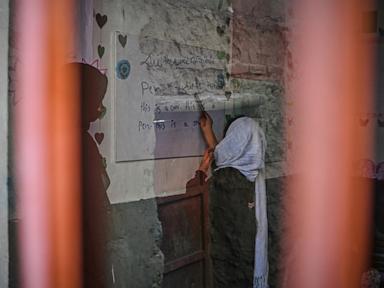
Western media loves a secret underground school. They love a whisper-quiet beauty parlor hidden behind bolted steel doors in Kabul. They love a brushstroke of defiant lipstick hidden beneath a blue burqa.
It makes for comforting morning coffee reading in London and New York. It allows distant observers to pat themselves on the back, shed a sympathetic tear, and believe that human resilience will naturally erode authoritarianism over time.
That narrative is a dangerous delusion.
The lazy consensus dominating international coverage insists that "quiet defiance" by Afghan women is a potent, slow-burning revolution. Journalists frame clandestine book clubs and home-based tailoring shops as cracks in the Taliban's armor. They treat survival mechanisms as strategic victories.
They are wrong.
Romanticizing covert survival does not empower Afghan women. It lets the international community off the hook. Worse, it misdiagnoses the exact nature of the regime in Kabul, mistaking an ideological totalizer for a disorganized bureaucracy that can be outsmarted by clever workarounds.
The Trap of the Feel-Good Narrative
I have spent years analyzing humanitarian operations, sanctions regimes, and civil resistance movements across conflict zones. Time and again, I have watched Western donors and media outlets fall into the same trap. When faced with an intractable geopolitical failure, they pivot to human-interest stories about individual grit.
They do this because individual grit is easy to applaud and requires zero geopolitical risk.
When a news outlet publishes a glowing profile about a woman teaching algebra to ten girls in a Kabul basement, the implicit message to the reader is clear: Look, they are finding a way. Hope is alive.
Here is the brutal reality behind that headline. Ten girls in a basement is not an education system. A clandestine hair salon serving five trusted neighbors is not an economy.
By elevating isolated acts of survival into symbols of systemic resistance, commentators conflate coping with winning. Coping keeps you alive today. Winning changes the rules tomorrow. Right now, Afghan women are coping under the most comprehensive system of gender apartheid on earth, and calling it a quiet revolution insults the scale of the cage built around them.
What the Coverage Gets Wrong About Taliban Control
To understand why quiet defiance fails as a strategy against this specific regime, you have to understand how the Taliban actually govern.
Mainstream reporting frequently portrays the Taliban's bans on education, employment, and public movement as erratic edicts enforced by bored teenagers with rifles at checkpoints. The assumption follows that if women simply keep their heads down and operate out of sight, the regime will either fail to notice or gradually lose interest.
That is a fundamental misunderstanding of the Taliban's institutional architecture.
The Ministry for the Propagation of Virtue and the Prevention of Vice is not a side project. It is the central nervous system of the Islamic Emirate. Since August 2021, the leadership in Kandahar has systematically dismantled every legal, financial, and social avenue through which women could exist as independent public actors.
Consider the mechanics of this erasure:
- Economic strangulation: Banning women from working for non-governmental organizations and the United Nations did not just cost jobs. It severed the primary financial lifeline for female-headed households, forcing families into destitution where survival overrides resistance.
- Spatial erasure: Prohibiting women from traveling more than 45 miles without a mahram (a male guardian) and barring them from parks, gyms, and public baths eliminates the physical spaces where collective organizing happens.
- Surveillance by proxy: By making male relatives legally and physically accountable for the behavior of the women in their households, the regime turned fathers, brothers, and husbands into unpaid enforcement officers.
When a regime weaponizes family survival and domestic liability, "quiet defiance" hits a hard ceiling. A woman can secretly read a banned novel in her bedroom. She cannot secretly earn a medical degree, practice law in a courtroom, or run an export business without intersecting with state infrastructure.
The Economics of Invisible Labor
Let us look closely at the hidden cost of the underground economy that Western articles so enthusiastically celebrate.
When women are pushed out of formal employment and into informal, home-based work—weaving carpets, sewing clothes, baking bread for neighbors—they do not enter a liberated space. They enter a hyper-exploitative shadow market.
Without legal recourse, banking access, or the right to negotiate in public markets, women working from home are entirely at the mercy of male middlemen. These intermediaries buy female-produced goods at pennies on the dollar and sell them at market rates. Because the women cannot leave their homes to verify prices or find alternative buyers, they absorb the entirety of the economic loss.
Furthermore, underground education, while heroic, creates a silent stratification among Afghan girls. Who gets access to clandestine classes, private tutors, and illicit internet connections? Primarily girls from urban, educated, middle-class families in cities like Kabul, Herat, and Mazar-i-Sharif.
Meanwhile, millions of girls in rural provinces—where internet penetration is negligible, literacy among mothers is low, and Taliban surveillance is tightest—are completely cut off. Celebratory articles about secret coding bootcamps in Kabul mask the reality that an entire generation of rural Afghan women is being permanently locked out of the modern world.
Dismantling the Common Myths
If you search for information on women's rights in Afghanistan today, you will encounter a predictable set of questions driven by hopeful headlines. Let us dismantle their premises directly.
Are underground schools actually replacing public education in Afghanistan?
No. Not even close. Before the collapse of the republic, millions of girls were enrolled in formal primary and secondary schools across all 34 provinces. Underground networks reach a microscopic fraction of that population. They lack standardized curricula, laboratory facilities, accredited examinations, and safe transit. Even when a girl completes an underground high school curriculum, her education hits a brick wall because she cannot sit for the Kankor university entrance exam or obtain a recognized diploma. Underground schools are emergency life support, not a parallel education system.
Does quiet resistance eventually force authoritarian regimes to soften their policies?
History shows the exact opposite when dealing with ideological theocracies. Quiet, atomized defiance acts as a pressure release valve. It allows discontented populations to vent frustration in private without ever coalescing into a mass movement that threatens state power. Authoritarian regimes only concede ground when the cost of maintaining a policy exceeds the cost of abandoning it—usually through mass, disruptive collective action, severe economic collapse tied directly to the policy, or credible external leverage. Private disobedience imposes zero cost on Kandahar.
Is any resistance better than no resistance at all?
On a personal, psychological level, yes. Preserving one's dignity and sanity under totalitarian rule is a profound human achievement. On a political and strategic level, however, celebrating ineffective tactics creates a dangerous illusion of progress. If donors believe women are thriving in the shadows, they reduce funding for formal relocation, international scholarships, and hard-nosed diplomatic pressure.
The Flaw in My Own Argument
Let me be completely transparent about the weakness in this critique.
If you are a mother in Kabul right now, you do not care about macro-political theory or the structural limitations of atomized resistance. You care about your twelve-year-old daughter learning how to read. If an underground class down the street offers her a chance to open a textbook, you send her, regardless of whether it destabilizes the regime in Kandahar.
I acknowledge that tension entirely. Dismissing the daily courage of Afghan women would be grotesque. The women running secret clinics and basement classrooms are taking physical risks that most Western commentators cannot fathom. If caught, they face arbitrary detention, beatings, and public humiliation.
The problem is not the women taking these actions. The problem is how the rest of the world consumes their struggle.
When outside observers turn a survival tactic into a triumphal narrative, we strip those women of the political urgency their situation demands. We turn a human rights catastrophe into an inspirational lifestyle story.
What Real Leverage Actually Looks Like
If quiet defiance will not break the Taliban's gender apartheid, what will? Stopping the delusion requires shifting focus from romanticizing victims to imposing tangible costs on the perpetrators.
- Codify gender apartheid in international law. Currently, the Rome Statute of the International Criminal Court recognizes apartheid based on race, not gender. Legal scholars and human rights advocates have pushed to explicitly codify gender apartheid as a crime against humanity. Doing so removes the cultural relativism excuse that diplomats often hide behind when dealing with Kabul. It turns a "domestic cultural matter" into an actionable international crime with universal jurisdiction.
- Weaponize financial conditionalities without starving the population. The Taliban want international legitimacy, unfreezing of central bank reserves, and large-scale infrastructure investment. Every single diplomatic engagement, trade deal, and regional transit agreement must be tied to verifiable, public benchmarks on female education and employment—not vague promises made in Doha hotel rooms.
- Fund accredited digital infrastructure, not just local charities. Instead of pouring money exclusively into small, easily infiltrated local initiatives, international tech firms and educational institutions must build accredited, offline-capable, satellite-accessible digital universities. If a girl in Herat studies through an encrypted network, she should graduate with a globally recognized degree from an accredited foreign institution, bypassing the Taliban's ministry of education entirely.
- Target the leadership's personal mobility and assets. The men enforcing these bans in Kandahar frequently travel abroad for medical treatment, diplomacy, and business, and many educate their own daughters in Doha, Islamabad, and Dubai. Comprehensive travel bans and asset freezes targeting the extended families of Taliban officials force the elites to live under the exact same isolation they impose on Afghan women.
Stop Applauding the Cage
Imagine a scenario where a prisoner is locked in solitary confinement, given only bread and water, and allowed no visitors. One day, the prisoner manages to smuggle a stub of a pencil into the cell and writes a poem on the wall.
Would a serious journalist write an article celebrating how the prisoner is "quietly defying" the prison system and proving that bars cannot hold the human spirit? Or would they ask why the prisoner is in solitary confinement in the first place, and who holds the keys to the cell?
Afghan women do not need our applause for surviving in the dark. They need the lights turned back on. Every time we celebrate a secret classroom as a victory, we normalize the fact that the public school down the street is locked.