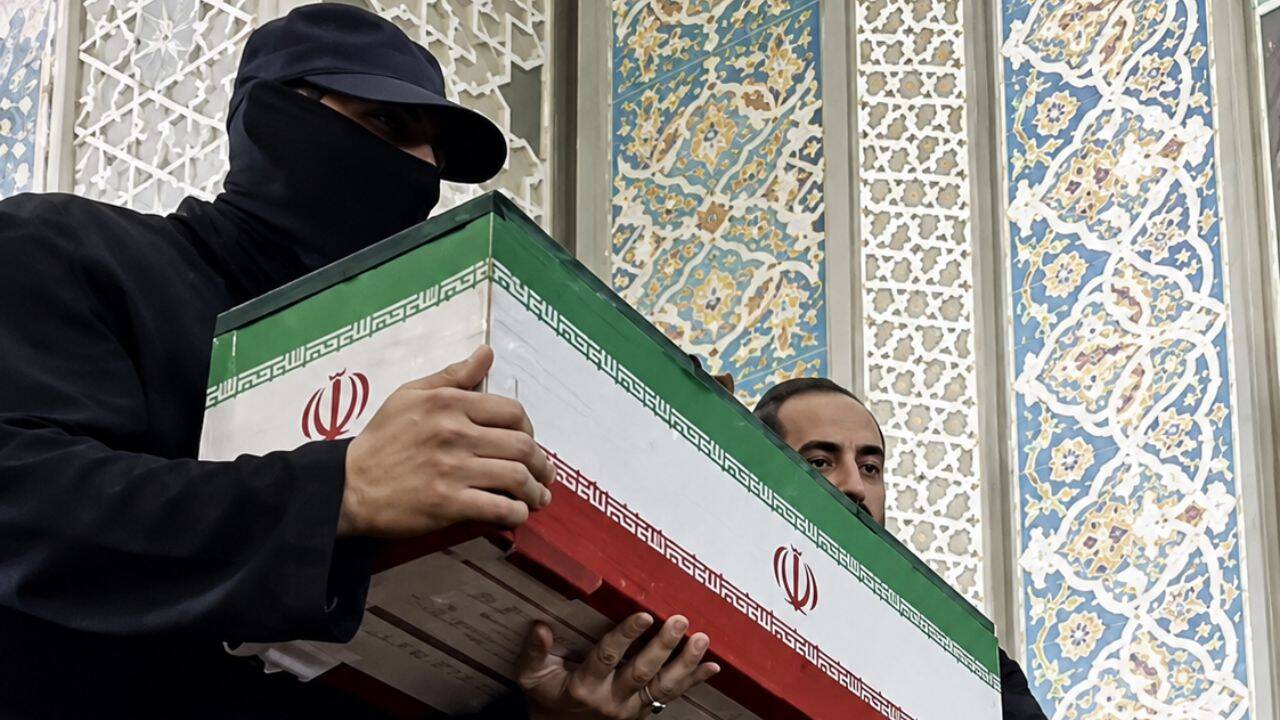
The stability of a theocratic regime depends on the visibility of its sovereign. In the wake of the February 28 joint United States and Israeli airstrikes that eliminated Supreme Leader Ayatollah Ali Khamenei, the political ecosystem of the Islamic Republic of Iran faced a systemic vulnerability: the total public absence of his designated successor, Mojtaba Khamenei. When state television broadcast images from the private funeral rites at the Imam Reza shrine in Mashhad, the presence of a heavily masked individual in the front row—wearing a black baseball cap and a surgical mask—was immediately interpreted by regional intelligence networks and domestic actors as a calculated proxy deployment.
Understanding this event requires bypassing speculative social media narratives and examining the structural mechanics of authoritarian survival, physical regime continuity, and information warfare. The identification of the masked individual resolves a immediate family mystery, yet exposes a profound structural bottleneck within the upper echelons of Iranian state power.
The Identity Matrix: Dissecting the Proxy Signaling
Speculation initially identified the masked attendee as the newly appointed Supreme Leader, Mojtaba Khamenei, attempting to secretly signal his survival while managing severe physical disfigurement from the February 28 strikes. Verifiable reporting from regional intelligence channels and domestic outlets, including the Rokna news agency, disproved this thesis. The individual has been confirmed as Mohammad Javad Khamenei, the eldest grandson of the deceased Supreme Leader and son of Mostafa Khamenei.
This identification underscores two distinct operational variables within the regime's current crisis management framework:
- The Physical Trauma Vector: Mohammad Javad Khamenei sustained severe facial lacerations and thermal burns during the kinetic action on February 28. The mask served a clinical purpose rather than an espionage function.
- The Proximity Premium: In Shiite funeral protocols, positioning during the recitation of the Salat al-Janazah (funeral prayer) denotes hierarchical standing and familial legitimacy. Standing directly adjacent to the coffin alongside Mostafa Khamenei, the eldest grandson functioned as a biological proxy for a severely fractured inner circle.
The confusion generated by this appearance highlights the information vacuum surrounding the regime. When a state relies on highly centralized, opaque decision-making bodies, the domestic populace and external adversaries interpret any deviation from standard visual protocols as a high-value signal.
The Absent Sovereign: The Cost Function of Invisible Leadership
The resolution of the masked man's identity does not mitigate the primary strategic vulnerability facing the Islamic Republic: the continued public sequestration of Mojtaba Khamenei. Having assumed the office of Supreme Leader in March following his father's death, Mojtaba has passed the four-month threshold without a single public appearance, audio broadcast, or unedited video address.
This operational invisibility introduces severe institutional friction across three distinct vectors.
The Legitimacy Deficit
The authority of the Supreme Leader (Velayat-e Faqih) is anchored in perceived divine mandate and constant rhetorical reinforcement. Governing exclusively via text-based Telegram communiqués—such as the July 11 message promising asymmetric retaliation against Western assets—erodes the psychological control mechanism required to command the loyalty of the domestic population and regional proxies. Domestic critics have already weaponized this absence, applying the derogatory moniker "the cardboard Ayatollah" to undermine his institutional weight.
The Command-and-Control Vacuum
In highly centralized military structures, the perceived health of the commander-in-chief dictates institutional stability. The total absence of verified biometric data (voice or video) regarding Mojtaba Khamenei forces a decentralized reliance on the senior leadership of the Islamic Revolutionary Guard Corps (IRGC). This structural shift alters the balance of power, transferring absolute decision-making capabilities from the clerical elite to the military apparatus.
The Credibility Gap of State Media
To counter accelerating domestic instability, the IRGC released a heavily curated photograph purporting to show Mojtaba Khamenei wearing a traditional turban and spectacles, accompanied by a declaration of his optimal health. However, the metadata and environmental indicators of the photograph remain unverified. In digital information environments, the deployment of easily staged static imagery fails to satisfy the verification parameters required to quell succession rumors, ultimately compounding the public's skepticism.
The Geography of Martyrdom: The Imam Reza Strategic Choice
The strategic decisions surrounding the state funeral extended beyond personnel to the deliberate selection of the burial site. The choice to inter Ali Khamenei at the Imam Reza Shrine in Mashhad, rather than the expansive mausoleum complex of Ruhollah Khomeini in Tehran, represents a highly calculated ideological maneuver.
[Regime Survival Strategy]
  │
  ├──► Personnel: Deploying Grandson as Proxy (Mitigates Succession Panic)
  │
  └──► Geography: Burial at Imam Reza Shrine (Leverages Martyrdom Symbolism)
The shrine holds supreme religious significance as the burial site of Ali al-Rida, the eighth Imam of Twelver Shia Islam, who according to theological tradition was martyred via poisoning by a Sunni caliph in the ninth century. By placing the assassinated Supreme Leader within this specific architectural and theological locus, the regime actively shifts the narrative from a catastrophic security failure—the penetration of sovereign airspace to eliminate the head of state—into an epic framework of historic martyrdom. This structural alignment aims to convert public grief and vulnerability into internal cohesion and kinetic mobilization against foreign adversaries.
Strategic Forecast: The Equilibrium of the Armed Clergency
The current political architecture of Iran cannot sustain an invisible executive indefinitely. The ongoing reliance on written decrees to project sovereign power creates an unstable equilibrium that will inevitably break along one of two trajectories.
If Mojtaba Khamenei remains physically incapacitated and incapable of delivering a public address by the conclusion of the current mourning cycle, a formal restructuring of the sovereign office will become necessary. This will likely manifest as the public emergence of a governing council dominated by senior IRGC generals and compliant clerical figures, reducing the role of the Supreme Leader to a symbolic, text-based entity.
Conversely, if the current seclusion is a strict security countermeasure against ongoing targeted strike threats, the transition back to visible governance must be marked by an unedited, real-time broadcast to neutralize the domestic legitimacy deficit. Until such verification occurs, the regime remains highly vulnerable to internal fractionalization, with regional intelligence agencies holding the analytical advantage as they exploit the profound gap between state propaganda and physical reality.