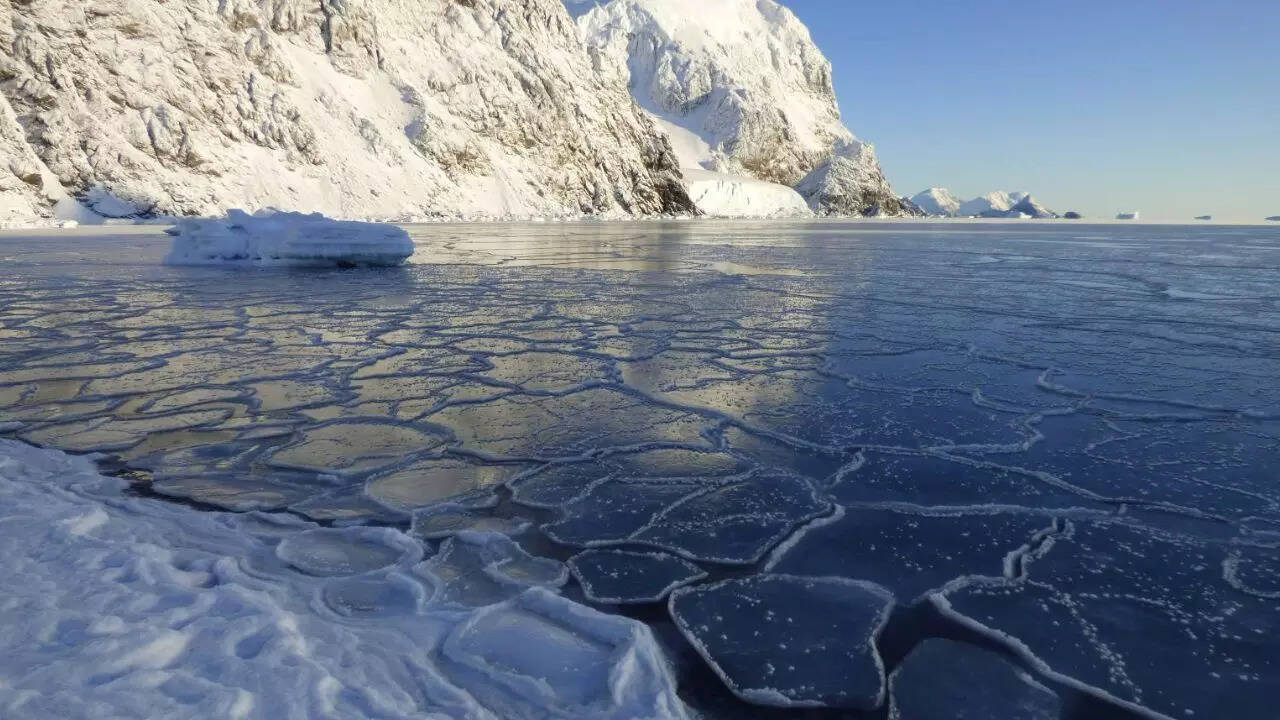
Antarctica functions as the primary heat sink of the Earth, a planetary-scale cooling engine governed by a specific set of thermodynamic constraints that render the traditional definition of a "heatwave" functionally obsolete. While mid-latitude regions experience heatwaves as transient spikes in ambient temperature driven by atmospheric blocking, the Antarctic interior operates under a regime of extreme thermal isolation. The continent’s resistance to rapid temperature shifts is not a result of "luck" or geographical isolation alone; it is the product of three interlocking physical pillars: the high-altitude polar plateau, the Antarctic Circumpolar Current (ACC), and the self-reinforcing properties of the ice-albedo feedback loop.
The Mechanism of Thermal Isolation
The Antarctic continent is characterized by a mean elevation of approximately 2,500 meters, with the East Antarctic Ice Sheet reaching heights over 4,000 meters. This elevation creates a structural barrier to poleward heat transport. In standard meteorological models, warm air masses move from the tropics toward the poles to balance the global energy budget. However, Antarctica’s topography forces these air masses to rise and cool adiabatically before they can penetrate the interior.
This geographic barrier is reinforced by the Polar Vortex, a persistent, high-pressure system of circling winds. The strength of this vortex is directly proportional to the temperature gradient between the pole and the mid-latitudes. Because Antarctica remains significantly colder than the surrounding Southern Ocean, the vortex acts as a kinetic fence, trapping cold air in and keeping warm air out. This creates a closed thermodynamic system where local radiative cooling dominates over external advection.
The Albedo Constraint and Energy Absorption
The primary reason Antarctica cannot experience a "heatwave" in the sense of high absolute temperatures—such as 30°C or 40°C—is the Albedo-Inertia Constraint. Fresh snow and ice possess an albedo coefficient of approximately 0.8 to 0.9, meaning they reflect up to 90% of incoming solar radiation back into space.
In a typical heatwave scenario in Europe or North America, dry soil absorbs solar energy, heats up, and then warms the air via sensible heat flux. In Antarctica, the surface lacks the capacity to absorb this energy. Even during the austral summer, when the sun is present 24 hours a day, the angle of incidence is low. The energy that does reach the surface is primarily used to facilitate phase changes (sublimation) rather than increasing the kinetic energy of the air molecules.
The Specific Heat Capacity of Ice further complicates temperature spikes. To raise the temperature of the massive Antarctic ice sheet significantly, an astronomical amount of energy is required. The ice acts as a thermal buffer; any marginal increase in atmospheric temperature is immediately countered by the vast, cold reservoir of the ice sheet beneath it.
Redefining the Antarctic Heatwave: Relative vs. Absolute Anomalies
To analyze Antarctic climate volatility correctly, one must move away from absolute temperature thresholds and focus on Standard Deviation Anomalies. In March 2022, parts of East Antarctica recorded temperatures 38.5°C above the seasonal average. In any other context, this would be classified as the most extreme heatwave in recorded history. However, because the starting point was -50°C, the peak temperature remained well below freezing at -11.5°C.
This distinction is critical for infrastructure and biological risk assessment. The "heat" in an Antarctic context does not cause melting in the interior; instead, it disrupts the Atmospheric Water Vapor Budget. Warmer air holds more moisture (governed by the Clausius-Clapeyron relation). Consequently, an Antarctic "heatwave" often manifests as an extreme precipitation event—snowfall—rather than a melt event.
The Role of Atmospheric Rivers
The primary failure point in Antarctic thermal isolation occurs through Atmospheric Rivers (ARs). These are narrow corridors of intense moisture transport that originate in the subtropics. When an AR manages to breach the Polar Vortex, it brings two types of energy:
- Sensible Heat: Direct warming of the air.
- Latent Heat: Energy released when water vapor condenses into snow or rain.
These events represent the only mechanism capable of producing rapid temperature shifts on the continent. The frequency of these breaches is increasing as the Southern Annular Mode (SAM) shifts, driven by changes in the ozone layer and greenhouse gas concentrations. As the SAM fluctuates, the "fence" of the Polar Vortex becomes wavy, allowing warm, moist air to penetrate deeper into the high plateau.
Thermal Lag and Ocean Coupling
The Southern Ocean acts as a massive dampener on continental temperature fluctuations. The Antarctic Circumpolar Current effectively insulates the continent from the warmer waters of the Atlantic, Pacific, and Indian Oceans. This current is the strongest on Earth, moving roughly 100 times the flow of all the world’s rivers combined.
The thermal inertia of this water mass is so great that it takes decades, if not centuries, for surface temperature changes to penetrate the deep ocean. While the rest of the planet warms, the Southern Ocean absorbs a disproportionate amount of that heat, protecting the Antarctic ice sheet from rapid atmospheric warming. This creates a "delayed response" profile. The continent is not immune to warming; it is simply operating on a much longer time horizon than the rest of the global climate system.
Strategic Risk and Forecast
The stabilization of the Antarctic climate is dependent on the maintenance of the Cryospheric Equilibrium. If the sea ice extent continues to hit record lows, the albedo of the surrounding ocean drops from 0.9 (ice) to 0.06 (open water). This triggers a localized feedback loop where the ocean absorbs more heat, further weakening the coastal ice shelves and potentially destabilizing the inland glaciers.
The strategic takeaway for climate monitoring and global logistics is to stop looking for "high temperatures" in the Antarctic and start measuring Ice Shelf Basal Melt Rates. The real "heatwave" is happening underwater. Warm circumpolar deep water is encroaching onto the continental shelf, melting the ice from below.
Future modeling must prioritize the Mechanical Stability of Ice Tongues over atmospheric temperature readings. The threat to global sea levels does not come from the air warming to a point of surface melting; it comes from the ocean removing the "brakes" of the ice shelves, allowing the massive interior glaciers to slide into the sea at accelerated rates. Monitoring efforts should shift resources toward sub-ice autonomous vehicles and satellite gravimetry to track mass loss, as surface thermometers provide a misleading sense of stability in a system that is failing from the bottom up.
The next tactical move for researchers and policy-makers is the deployment of high-resolution acoustic sensors along the grounding lines of the Thwaites and Pine Island Glaciers. Detecting the frequency of "icequakes" and sub-glacial water flow will provide a more accurate lead time for sea-level rise projections than any atmospheric temperature model currently in use.
Would you like me to analyze the specific economic impacts of sea-level rise on global shipping hubs based on these Antarctic melt projections?