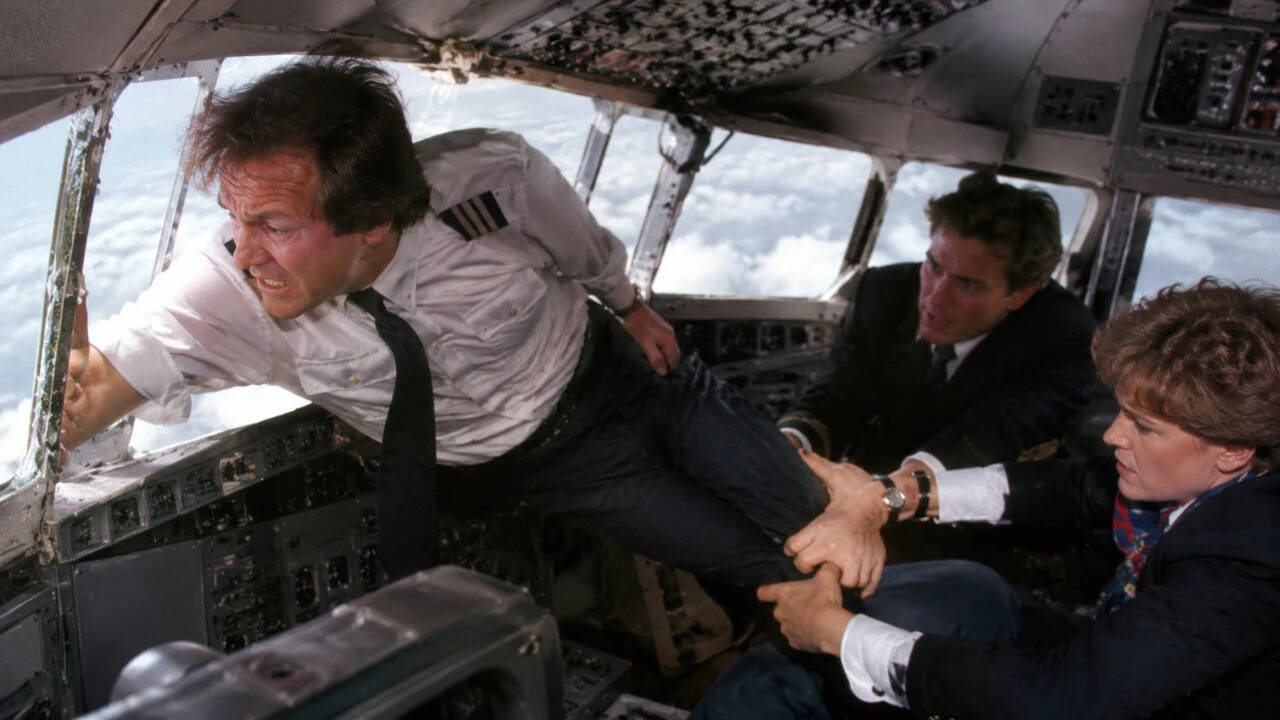
On June 10, 1990, British Airways Flight 5390 suffered an explosive decompression at 17,300 feet over Oxfordshire, England, after a newly installed cockpit windscreen blew out entirely. Captain Tim Lancaster was sucked headfirst out of the flight deck, his knees jammed against the control column while flight attendants gripped his ankles for over twenty minutes until Co-pilot Alastair Atchison executed an emergency landing in Southampton. Lancaster survived with frostbite, shock, and fractures to his right arm, left thumb, and right wrist, exposing a cascade of maintenance shortcuts that changed global aviation safety protocols forever.
Most retellings treat the survival of British Airways Flight 5390 as a miracle of pure luck and upper-body strength. That framing misses the real story. Aviation disasters rarely stem from a single catastrophic failure or an act of God. They are built slowly, bolt by bolt, in quiet hangars hours before takeoff. To understand how a veteran airline captain ended up pinned against the exterior fuselage of a BAC One-Eleven at 350 miles per hour, you have to look away from the dramatic struggle in the cockpit and examine a poorly lit maintenance bay in Birmingham the night before.
The Anatomy of a Blowout
At 07:20 local time, the twin-engine BAC 1-11 Series 528FL lifted off from Birmingham International Airport bound for Málaga, Spain. Eighty-one passengers and six crew members were aboard. Captain Tim Lancaster, 42, was a seasoned aviator with over 11,000 flight hours. Beside him in the right seat sat First Officer Alastair Atchison, 39, who was flying his first sector with Lancaster.
Thirteen minutes into the climb, the aircraft passed through 17,300 feet. The cabin crew was preparing breakfast service. Lancaster had just loosened his shoulder harness, leaving only his lap belt fastened, while Atchison took over the controls.
Then came a deafening bang.
The left-hand windscreen panel—directly in front of Lancaster—separated completely from the airframe. Inside a pressurized cabin climbing toward cruising altitude, the air pressure is significantly higher than the thin, freezing atmosphere outside. When that barrier vanished, the pressurized air rushed out of the flight deck with violent force.
The cockpit door blew inward, slamming onto the radio console and nearly knocking flight attendant Nigel Ogden off his feet. Lancaster was instantly ripped from his seat. The suction dragged him headfirst through the empty window frame until his torso was entirely outside the aircraft, battered by slipstream winds exceeding 300 knots and temperatures around minus 17 degrees Celsius. Only his knees, caught beneath the flight controls, kept him from disappearing into the sky over Didcot.
His body jammed against the yoke pushed the nose of the aircraft downward, disengaging the autopilot and sending the jet into a steep, accelerating dive toward busy airspace.
Inside the Wind Tunnel
Noise inside the flight deck was absolute. With the windscreen gone, freezing air roared into the cabin at hurricane force, filling the cockpit with thick condensation fog and ripping paper charts, manuals, and debris out into the slipstream. Communication by voice was impossible.
Nigel Ogden, who had been entering the cockpit to offer tea just as the window failed, acted on instinct. He lunged forward and grabbed Lancaster around the waist, locking his arms as the wind tried to tear the captain free. Within seconds, the sub-zero slipstream began draining the warmth from Ogden’s body, threatening him with frostbite and exhaustion.
Flight attendant John Heward rushed into the flight deck, wedging himself behind Ogden and gripping the belt of Ogden's trousers to anchor him. A third attendant, Simon Rogers, strapped himself into the captain's vacated seat to gain mechanical advantage, wrapping his arms around Lancaster’s legs.
From the right seat, First Officer Atchison was fighting a multi-front war. He had to wrestle control of the aircraft back from Lancaster's body weight pressing on the yoke, fight the deafening roar of the wind, wear an oxygen mask, and fly a crippled airliner without wind protection.
"I looked across and saw Tim’s legs going up through the window. He was bent double over the roof of the aircraft. I thought he was dead, yet I knew we could not let go because his body would go straight into the left engine."
That grim calculation—first voiced by the crew during the subsequent investigation—dictated every second of the descent. Had the crew lost their grip, Lancaster’s body would almost certainly have been ingested by the port-side Rolls-Royce Spey engine, causing catastrophic engine failure or structural damage to the tailplane. Even though the crew believed their captain was already dead—his eyes were open and unblinking, his face hammered against the side of the fuselage visible through the direct-vision side window—they refused to release him.
Flying Blind into Southampton
Atchison executed an immediate emergency descent to reach breathable air below 10,000 feet, leveling off while decelerating to reduce the wind blast tearing through the open frame. Because the roar of the slipstream drowned out his headset, he could not hear air traffic control responses to his Mayday calls. He had to transmit blind, stating his intentions and hoping controllers were clearing the airspace below him.
Air traffic control in London picked up the broken transmissions and cleared a corridor toward Southampton Airport, the nearest suitable runway capable of handling a commercial jet. Atchison had never landed at Southampton before. His approach plates and charts had been sucked out of the window during the decompression.
Guided by intermittent snippets of radar vectors he managed to hear during brief lulls in the wind noise as the plane slowed, Atchison brought the BAC 1-11 down on Runway 02 at 07:55—twenty-two minutes after the windscreen blew out.
Emergency crews boarding the aircraft expected to recover a body. Instead, Lancaster was alive. He had suffered severe frostbite, bruising, shock, and fractures to his right arm, left thumb, and right wrist, yet he sustained no permanent neurological damage. Within five months, he was back in the cockpit flying commercial routes.
The Maintenance Failure Nobody Caught
When investigators from the UK Air Accidents Investigation Branch (AAIB) examined the wreckage and maintenance logs, they uncovered a chain of human errors so ordinary it terrified the aviation industry.
Twenty-seven hours before Flight 5390 took off, the left windscreen had been replaced during a night shift at Birmingham Airport. The shift maintenance manager, pressed for time and short-staffed, decided to do the job himself.
To secure the windscreen, 90 bolts were required. The manager took the old bolts out and went to the stores department to get replacements. The original specification called for A211-8D bolts. Looking at the old bolts, the manager matched them visually rather than checking the aircraft's illustrated parts catalogue. He grabbed a box of A211-7D bolts from the carousel.
The difference between the two fasteners was microscopic to the naked eye, yet structurally fatal.
| Bolt Specification | Diameter | Length | Structural Role |
|---|---|---|---|
| A211-8D (Required) | 0.190 inches | 0.8 inches | Full thread engagement in countersunk holes |
| A211-7D (Installed) | 0.164 inches | 0.7 inches | Undersized diameter by 0.026 inches; insufficient grip |
Of the 90 bolts used to secure the windscreen, 84 were the undersized 7D variants. The remaining six were 8C bolts—the right diameter, but too short.
During installation, the manager noticed that the countersunk heads of the bolts sat slightly lower in the windscreen frame than expected. Instead of stopping to verify the part numbers, he assumed it was normal and continued torquing them down. Because the bolts were 0.026 inches too narrow, their threads barely caught the anchor nuts on the inside of the fuselage.
Why the System Failed to Catch a Single Error
Aviation safety relies on the Swiss Cheese Model, a concept developed by psychologist James Reason just months before the Flight 5390 incident. The theory holds that disasters occur only when holes in multiple layers of defense align simultaneously. On the night of June 9, every layer of British Airways' maintenance defense had a hole in it.
First was the physical environment. The stores area was poorly lit, and the carousel holding the bolts was disorganized. The manager bypassed the computer terminal that would have cross-referenced the exact part number because he relied on three decades of experience and visual memory.
Second was the design of the aircraft itself. On the BAC 1-11, the windscreen was fitted from the outside of the fuselage rather than the inside. Most modern commercial airliners use plug-type windows and doors, which are larger on the inside than the opening they seal. Cabin pressure pushes a plug-type window firmly against its frame, meaning air pressure actually helps hold it in place. Because the BAC 1-11 windscreen was mounted externally, internal cabin pressure pushed against the bolts, relying entirely on the strength of those 90 fasteners to keep the glass attached to the plane.
Third was the lack of independent inspection. Under the regulations in place at the time, replacing a windscreen on a BAC 1-11 was not classified as a "vital point" task requiring a second, independent engineer to sign off on the work. The same manager who selected the wrong bolts, installed them, and failed to notice the improper seating was legally permitted to certify his own work as airworthy.
The Shift in Global Aviation Standards
The AAIB report on Flight 5390 did not merely blame a tired maintenance manager. Investigators recognized that punishing an individual for an honest visual error would do nothing to prevent the next mechanic from making the same mistake under night-shift fatigue.
Instead, the investigation forced structural changes across commercial aviation maintenance:
- Mandatory Dual-Inspection Rules: Critical structural components—including externally mounted windscreens and flight control surfaces—were reclassified so that no single technician could both perform and certify the installation.
- Optical and Lighting Audits: Airlines overhauled lighting standards in parts stores and hangars, recognizing that dim fluorescent bulbs directly contribute to visual identification errors on small hardware.
- End of "Match-by-Sight" Culture: Maintenance organizations instituted strict protocols requiring technicians to verify every fastener against the Illustrated Parts Catalogue by batch number rather than comparing new parts against removed ones.
- Human Factors Training: Prior to 1990, Crew Resource Management (CRM) focused almost exclusively on pilots in the cockpit. Flight 5390 accelerated the expansion of human factors training into maintenance hangars, teaching mechanics how fatigue, time pressure, and confirmation bias degrade decision-making.
Every commercial flight that takes off today carries invisible safeguards written in the aftermath of those twenty-two minutes over southern England. When a technician pulls a bag of bolts from a brightly lit bin, scans a barcode, and waits for a second inspector to verify the torque, they are practicing habits forged because three flight attendants refused to let go of a man they thought was already gone.