The air inside the press room was thick with the scent of expensive cologne, damp wool coats, and the collective anxiety of two hundred journalists waiting for permission to speak. Outside, the New Delhi heat was a living thing, pressing against the glass. Inside, the chill of the air conditioning felt like a warning.
Every seat was filled. Camera lenses, thick and black as artillery pieces, lined the back wall. Everyone knew the rules. They were unwritten, of course, but etched deeply into the psyche of every reporter who covered the beat. You listen. You take notes. You transmit the statement. You do not disrupt the choreography.
Then, a hand went up. It belonged to a foreigner.
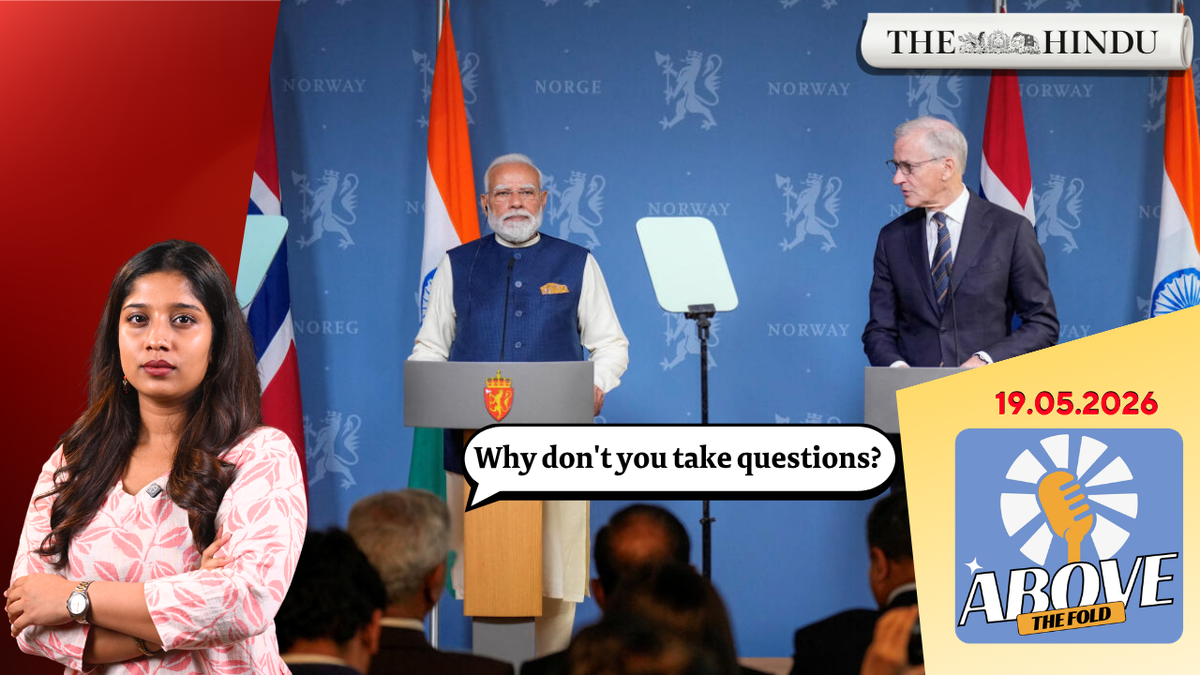
Jerker Wettre, a veteran journalist from Norway’s public broadcaster, NRK, did not look like a disruptor. He looked like a man who had spent thirty years asking questions in drafty town halls and orderly European parliaments. But when he opened his mouth, the carefully constructed theater of the press conference evaporated.
"Why don’t you take some questions?" he asked.
The words were not shouted. They were delivered with the calm, slightly puzzled politeness of a tourist asking for directions to the train station. But in that room, under the grand chandeliers, the sentence detonated.
Twenty seconds of absolute, suffocating silence followed. It was the kind of silence that makes your ears ring. In those twenty seconds, the invisible scaffolding holding up modern political communication didn't just creak; it shattered.
The Architecture of the Unasked Question
To understand why a simple question about asking questions went viral across the globe, you have to understand how modern power protects itself.
Once upon a time, a press conference was a gladiatorial arena. Leaders walked in knowing they would be bloodied. Today, it is an exercise in brand management. The podium is a fortress. The statements are pre-baked, engineered by algorithms and tested by focus groups to ensure they contain exactly zero percent nutritional value and one hundred percent narrative control.
Consider a hypothetical reporter named Maya. She has spent three months investigating a local government contract. She has the receipts. She has the leaked emails. She sits in the third row of a ministerial briefing, her heart hammering against her ribs. She raises her hand. The press secretary’s eyes skim right over her, landing instead on a friendly outlet whose representative asks, “Minister, how do you manage to stay so energetic with such a grueling schedule?”
Maya lowers her hand. The story dies in her notebook. The public receives a infomercial disguised as news.
When Wettre asked his question, he wasn’t just challenging the specific Indian officials at the table. He was pulling back the curtain on a global epidemic of managed silence. From Washington to London, Canberra to New Delhi, the open press conference is being systematically replaced by the "press statement"—a monologue masquerading as transparency.
The Algorithm of Outrage
What happened next is a masterclass in how our digital ecosystem processes friction.
Within minutes, the clip of Wettre’s question was cut, compressed, and uploaded to X, the platform formerly known as Twitter. By the time the journalists in that room had packed up their tripods, the video had crossed a million views. By midnight, it was ten million.
The internet did what it always does: it split down a fault line of pure, unadulterated tribalism.
On one side, the video was weaponized as proof of an authoritarian crackdown on free speech. "See?" the captions screamed. "They are terrified of the truth!" On the other side, nationalist accounts launched a ferocious counter-offensive. Wettre was branded a colonial relic, a arrogant Westerner coming to a sovereign superpower to lecture its leaders on manners. His past articles were scrutinized. His motives were dissected.
Lost in the digital noise was the human reality of what had actually occurred. Wettre wasn’t fighting a geopolitical crusade. He was just doing his job.
There is a distinct physical sensation to being the only person in a room who speaks up. Your throat goes dry. The skin on the back of your neck prickles. You can feel the collective weight of disapproval from your peers—not because they disagree with you, but because you have broken the script. You have made things awkward. You have extended the workday.
We have all been there, even outside of journalism. It is the board meeting where everyone nods at a disastrous proposal because the CEO looks tired. It is the family dinner where no one mentions the elephant in the living room because it might ruin dessert. Silence is comfortable. Silence is safe.
Wettre chose discomfort.
The Death of the Follow-Up
The real tragedy of the modern media landscape isn't just that politicians don't want to answer questions. It’s that we, the audience, have forgotten how to listen to the answers.
We live in an era of conversational snacks. We consume five-second soundbites and dunk-videos. But journalism—the kind that keeps societies from rotting from the inside out—is an act of endurance. It relies entirely on the follow-up question.
The first answer from a politician is almost always a shield. It is a wall of jargon, a pivot to a different topic, or a flat-out denial. The truth is never in the first answer. It is in the third. It is in the stutter that happens when the pre-approved talking points run out and the human being behind the politician is forced to think on their feet.
When we allow leaders to eliminate questions entirely, we aren't just losing information. We are losing our ability to judge character. We are replacing human intuition with public relations.
In the days following the viral moment, the Indian government’s defenders pointed out that Prime Minister Modi does, in fact, speak to the media. He gives interviews. He hosts a regular radio show.
But there is a vast, unbridgeable chasm between an interview granted to a selected anchor on a pristine television set and standing before a room of unvetted reporters who might ask you about inflation, or religious violence, or a bridge that collapsed in a provincial town. One is a commercial; the other is a audit.
The Price of Looking Away
It is easy to watch the footage of that New Delhi press room and think of it as a circus, a distant piece of political theater that has no bearing on your daily life.
That is an illusion.
The infrastructure of accountability is fragile. It doesn’t disappear overnight with a dramatic decree or the locking of press gallery doors. It erodes an inch at a time. It vanishes when we get used to the silence. It disappears when we decide that as long as "our side" is in power, it doesn't matter if they take questions or not.
The Norwegian journalist eventually sat down. The press conference ended. The officials left through a back door, flanked by security.
But the question remained hanging in the heavy air of the room, unanswered, vibrating at a frequency that could be heard thousands of miles away. It was a reminder that the most dangerous thing you can do in a room built on compliance is to ask for the truth, out loud, twice.
The cameras turned off. The screens went black. But the silence that followed was no longer peaceful. It felt like an admission.