The air in Jammu and Kashmir does not just carry the scent of pine and chinar leaves. It carries weight. For decades, anyone living near the Line of Control has learned to read the silence. A quiet afternoon can be a blessing, or it can be the tense breath drawn right before a mortar shell shatters the valley.
In this part of the world, peace is not an abstract political concept discussed in air-conditioned rooms. It is the difference between a child walking safely to school or diving into a concrete bunker.
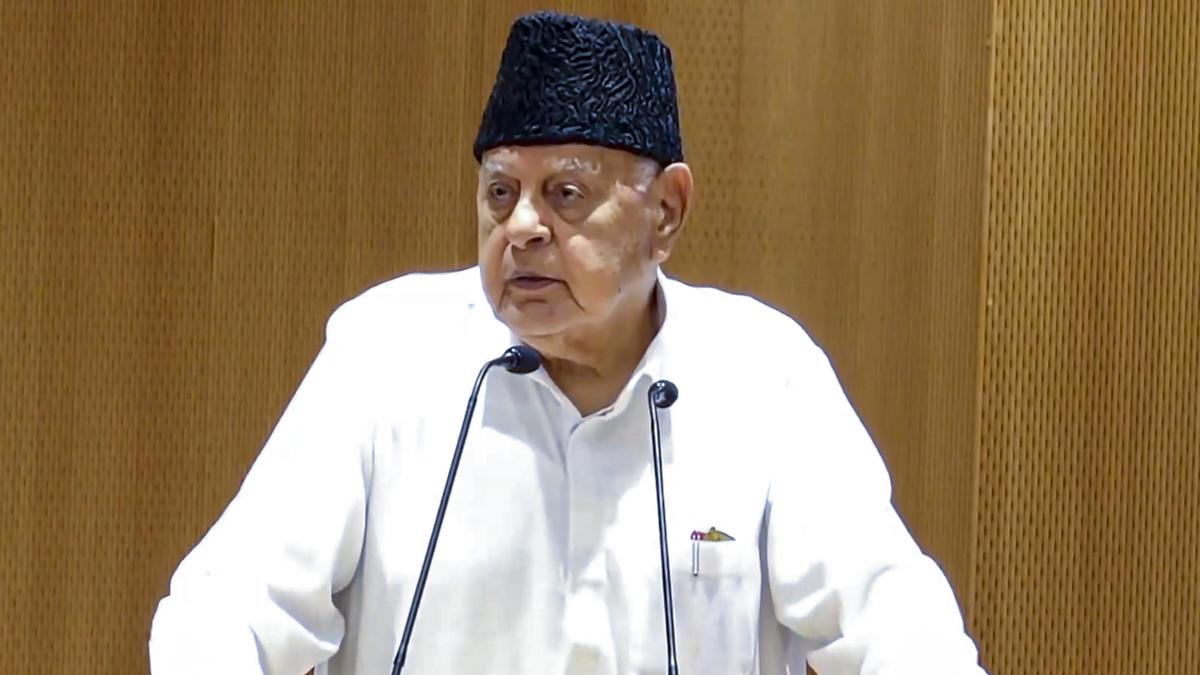
When voices from entirely opposite ends of the ideological spectrum suddenly begin to sound the same, the silence changes. It vibrates. That is precisely what happened when Farooq Abdullah, the veteran leader of the National Conference, publicly aligned his voice with a call for dialogue coming from the highest echelons of the Rashtriya Swayamsevak Sangh (RSS).
To understand why this matters, you have to look past the standard political theater. You have to look at the sheer, historical friction between the entities these men represent.
The Unlikely Resonance
Picture two parallel lines that have spent the better part of a century stretching away from each other, defined by their absolute refusal to meet.
On one side is the RSS, the ideological fountainhead of Hindu nationalism. On the other is Farooq Abdullah, a fierce custodian of Kashmir’s unique, complex identity within the Indian union, often a vocal critic of New Delhi’s muscular policies. For decades, their relationship has been defined by deep-seated wariness.
Then, Dattatreya Hosabale, the General Secretary of the RSS, spoke.
He did not deliver a fiery ultimatum. Instead, he noted that the RSS is not inherently anti-Pakistan and asserted that the organization has never advocated for the destruction of the neighboring country. He went a step further, suggesting that a dialogue between the two nuclear-armed neighbors is not an impossibility, provided the conditions are right.
In the hyper-polarized arena of South Asian politics, a statement like that from the RSS is a stone dropped into a completely still pond. The ripples traveled fast.
They reached Srinagar, where Farooq Abdullah did not deflect or dismiss the comment. He embraced it. Speaking to reporters with the gravitas of a statesman who has buried too many of his own citizens, Abdullah welcomed Hosabale’s remarks. He reiterated a fundamental truth that his father, Sheikh Abdullah, and former Prime Minister Atal Bihari Vajpayee both championed: you can change your friends, but you cannot change your neighbors.
The Human Ledger of a Frozen Conflict
Behind the grand declarations of diplomats and the map-drawing of generals lies a human ledger that rarely makes the front pages.
Consider the border villages of Poonch, Kupwara, or Samba. When relations between New Delhi and Islamabad sour, the people living in these areas pay the immediate dividend. Farmers cannot tend to their crops because their fields are laced with landmines or under the direct line of sight of sniper nests. Families are split by a barbed-wire fence, unable to attend the funerals of their own siblings just a few kilometers away.
The cost of hostility is counted in missed opportunities, generational trauma, and an economy perpetually stuck in survival mode.
When a leader like Abdullah backs a sentiment coming from the RSS, he isn't switching political allegiances. He is responding to a profound weariness. He is acknowledging that the current state of frozen hostility serves no one living on the ground.
The skepticism, of course, is immediate and justified. Critics will ask how a conversation can begin when infiltration attempts continue, and when the wounds of past conflicts remain wide open. Trust between India and Pakistan is not just low; it is practically non-existent. It has been shattered by broken promises, sudden escalations, and the persistent shadow of cross-border terrorism.
But the alternative to dialogue is not a static status quo. It is a slow, grinding decline.
The Logic of the Opening
What Hosabale signaled, and what Abdullah validated, is a pragmatic recognition of geopolitical reality.
India is positioning itself as a global economic powerhouse, a vital player on the world stage. Yet, a nation's global ambitions are always tethered to its neighborhood. A perpetually unstable western border acts as an anchor, pulling resources away from human development, infrastructure, and education, and redirecting them into an endless cycle of security management.
For Pakistan, currently grappling with severe economic distress, internal political instability, and its own escalating security challenges on its western frontier with Afghanistan, the cost of sustained confrontation with India has become mathematically unsustainable.
The math is simple. The human cost is immeasurable.
Dialogue does not mean capitulation. It does not mean ignoring the grievances of the past or letting down one's guard. It means recognizing that the current path has reached a dead end.
When the RSS talks about the possibility of discussion, it provides a unique political cover. It signals to the broader conservative ecosystem in India that exploring avenues of stability is not a sign of weakness, but a strategic necessity. When Abdullah echoes it, he ensures that the Kashmiri perspective—one that longs for normalcy and an end to the bloodshed—is firmly aligned with that national realization.
Reading between the Fault Lines
This moment reveals a rare alignment of domestic political positioning and hard-nosed realism.
Abdullah’s endorsement is a reminder that the desire for peace in the region transcends partisan divides. It suggests that underneath the fierce debates over autonomy, statehood, and security, there is a shared understanding that nothing sustainable can be built on a foundation of perpetual animosity.
The road from a shared sentiment to actual diplomatic engagement is long, treacherous, and filled with spoilers. A single incident can derail months of quiet, behind-the-scenes effort. The institutional inertia on both sides of the border is massive, fueled by decades of carefully cultivated narratives of enmity.
Yet, the significance of this moment lies in the breach of the narrative itself.
If the RSS and Farooq Abdullah can find a point of convergence on the necessity of talking to Pakistan, it suggests that the old ideological binaries are proving insufficient for the challenges of the present era. It shows that the pressure of reality is forcing even the most hardened positions to adapt.
As the sun sets over the Pir Panjal range, casting long shadows across valleys that have seen too much history and too little peace, the words of these leaders hang in the air. They offer no guarantees. They do not rewrite the past, nor do they instantly secure the future.
They simply open a door that many believed was permanently locked. Whether anyone possesses the courage to step through it remains to be seen, but for the families living along the fence, even the slight creak of that opening door is a sound they have been waiting to hear for a very long time.


:max_bytes(150000):strip_icc():focal(819x186:821x188)/Murdaugh-Family-e90854a716884d608fb6fd925e18d840.jpg)
