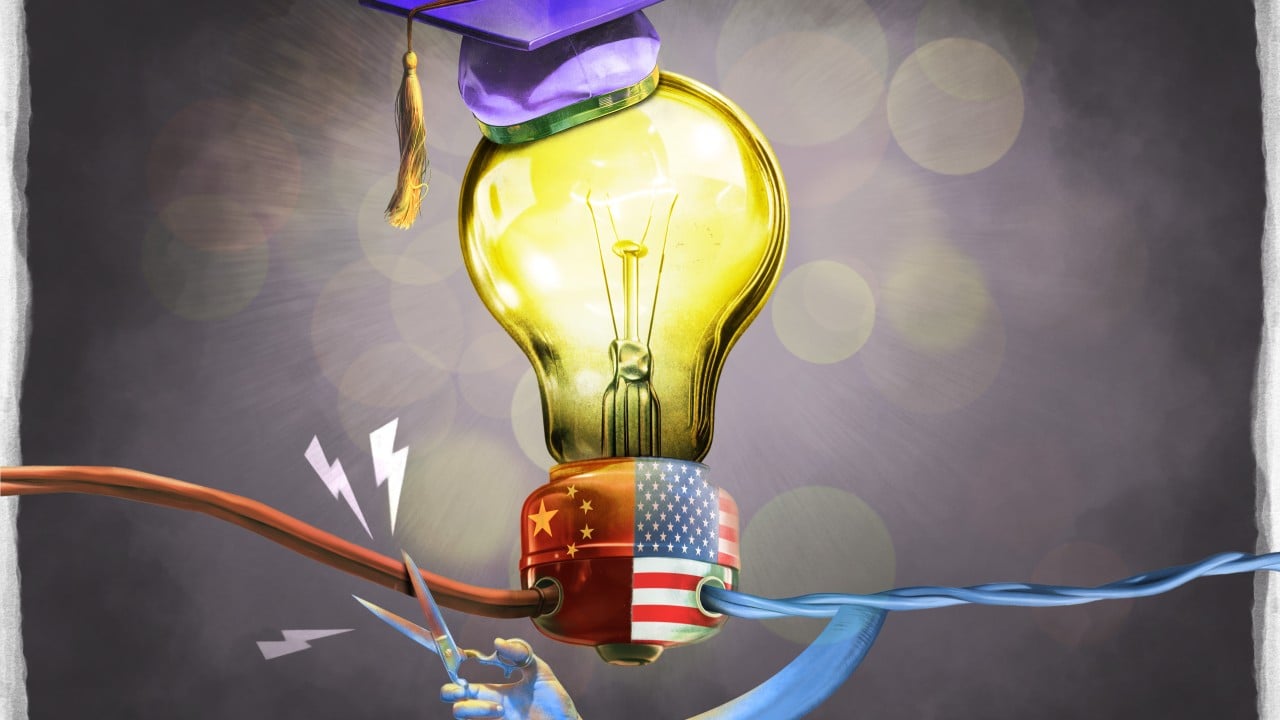
Washington bureaucrats think they are locking the vault doors on American scientific dominance. They are actually sealing themselves inside a shrinking room while the rest of the world builds a better bank next door.
If you read the standard policy commentary coming out of D.C. think tanks or mainstream tech outlets, you get the same tired narrative. Export controls on lithography machines, visa restrictions on graduate researchers, and the dismantling of bilateral research initiatives are framed as tough, necessary medicine. The lazy consensus assumes that science is a zero-sum fortress. Deny Beijing access to high-end silicon and American university labs, the theory goes, and Chinese innovation will stall out in a generational bottleneck.
That theory is dead wrong. It misunderstands how modern research ecosystems actually function, ignores the economics of industrial scale, and confuses choke points with permanent moats.
I have spent fifteen years advising semiconductor equipment suppliers, deep-tech venture funds, and university commercialization offices across North America and East Asia. I have watched hardware startups burn through forty million dollars trying to untangle supply chains that took three decades to optimize, only to realize they cut off their own feedback loops. When you sever a dominant supplier or a massive research market from your ecosystem, you do not freeze them in time. You force them into vertical integration.
The Myth of the Permanent Choke Point
Policy hawks love talking about "choke points." In semiconductor manufacturing, the favorite example is extreme ultraviolet (EUV) lithography—specifically the machines built by Dutch firm ASML, which rely on light sources from San Diego and optics from Germany. When the U.S. Commerce Department pressured allies to halt EUV and advanced deep ultraviolet (DUV) shipments to China, analysts declared victory. Without those machines, domestic Chinese foundries could not print chips at 5 nanometers or below. Game over.
Except hardware physics does not care about export licenses.
By cutting off access to foreign toolmakers, Washington handed domestic Chinese equipment manufacturers—companies like Naura Technology Group and Advanced Micro-Fabrication Equipment (AMEC)—something no state subsidy could ever buy: a captive, desperate, multi-billion-dollar domestic customer base. Prior to 2019, major Chinese foundries like SMIC wanted nothing to do with unproven domestic etching or deposition tools. Why take the yield risk when you could buy proven gear from Applied Materials or Lam Research?
Export controls eliminated that choice overnight. Suddenly, every major fab in Shanghai and Beijing had an existential mandate to qualify local tools, share process data, and co-engineer replacements.
To understand why this backfires, look at how industrial learning curves work. Wright’s Law—formulated by aeronautical engineer Theodore Wright in 1936—demonstrates that for every cumulative doubling of units produced, costs fall by a constant percentage, and reliability climbs through iterative failure. You do not master precision manufacturing in a theoretical vacuum; you master it by running machines 24/7 on high-volume factory floors and fixing what breaks. By forcing Chinese fabs to buy domestic gear, U.S. sanctions subsidized the exact iterative loop Chinese toolmakers needed to survive their clunky early versions.
The Talent Self-Inflicted Wound
The second pillar of the mainstream narrative is that decoupling protects American intellectual property from espionage. Programs like the Department of Justice’s now-defunct China Initiative—and the lingering visa scrutiny that survived its official cancellation—treated academic collaboration as a one-way street where Beijing stole Western breakthroughs.
Anyone who has actually walked the halls of an R1 research university knows how absurd that framing is.
For thirty years, the secret engine of American scientific supremacy was not just federal grant money; it was acting as the global clearinghouse for human capital. The United States imported the top one percent of math, physics, and computer science graduates from Tsinghua, Peking University, and the University of Science and Technology of China, trained them on American soil, and kept roughly 80 percent of them in the U.S. workforce after graduation. They founded startups, led corporate R&D labs at Bell Labs successors, and staffed defense contractors.
When you make visas toxic, subject ethnically Chinese professors to career-ruining investigations over paperwork errors, and choke off joint grants, you do not stop those researchers from doing science. You just change their mailing address.
Data tracked by organizations like the Paulson Institute’s MacroPolo think tank and Stanford’s Human-Centered AI Institute tells a stark story. A decade ago, top-tier Chinese AI researchers overwhelmingly stayed in the United States after earning their doctorates. Today, a rapidly growing share either never leaves China or returns immediately after graduation to join domestic labs in Shenzhen, Hangzhou, and Beijing.
Imagine a scenario where the New York Yankees decided their biggest rival was stealing their batting secrets, so they banned half their own minor league system from entering the stadium. Those players do not quit baseball. They go play for the rival, and now they know how your pitching staff thinks. That is American academic decoupling in a nutshell.
Why "De-Risking" Breaks the Innovation Flywheel
Politicians prefer the softer term "de-risking" over "decoupling," arguing that we only need to fence off a "small yard with a high fence" covering dual-use technologies like artificial intelligence, quantum computing, and synthetic biology.
The problem is that modern science has no neat fences.
Basic research is messy and combinatorial. Breakthroughs in commercial video game graphics processing units (GPUs) inadvertently created the hardware foundation for modern deep learning. Advances in agricultural genomics cross-pollinate directly with mRNA vaccine delivery platforms. When you draw an arbitrary regulatory box around "sensitive" fields, you fracture the global citation and replication network that catches bad science and accelerates good science.
Consider the numbers from the Nature Index, which tracks contributions to research articles published in top natural-science journals. By 2023, China surpassed the United States in overall share of high-impact natural science publications, dominating physical sciences and chemistry while rapidly closing the gap in biological sciences. Meanwhile, bibliometric analyses from researchers like Caroline Wagner at Ohio State University show that bilateral U.S.-China co-authored papers—historically the most highly cited scientific collaborations on the planet—have entered a sharp, sustained decline since 2020.
When American and Chinese scientists stop co-authoring papers:
- Duplication explodes: Both sides spend billions solving the exact same foundational bottlenecks independently instead of building on shared baselines.
- Standards fracture: Global technical standards in telecommunications, battery chemistry, and clinical trials split into incompatible regional blocs.
- Blind spots widen: American researchers lose visibility into what peer labs in Hefei or Wuhan are discovering until a commercial product hits the market and blindsides Western incumbents.
What Everyone Gets Wrong About the Science Race
If you look at what policymakers and investors constantly ask about this geopolitical tech war, the questions themselves reveal how badly they misread the board.
"Can China innovate without Western technology?"
This question rests on an outdated caricature of China as a low-cost assembly line capable only of copying blueprints. That was true in 2004; it is delusional in 2026. Innovation in deep tech is rarely a single "eureka" moment in a garage—it is 5 percent basic discovery and 95 percent brutal, capital-intensive process engineering. China dominates global supply chains in lithium-iron-phosphate (LFP) batteries, solar photovoltaics, and industrial robotics not because it stole IP, but because it built massive manufacturing ecosystems where chemical engineers, materials scientists, and factory operators sit ten minutes apart. You cannot sanction away an entire industrial cluster.
"Won't export controls buy the U.S. a five-to-ten-year lead?"
Export controls buy a temporary window, not a permanent lead—and only if you run faster while the window is open. Right now, Washington is treating restrictions as a substitute for domestic reform. Instead of fixing broken immigration caps for STEM PhDs, streamlining clinical trial bottlenecks at the FDA, or accelerating energy grid permitting for massive AI data centers, politicians pass new export rules because export rules are free to write and poll well on cable news. A head start means nothing if you spend it tying your own shoelaces together.
"Is open science dead in an era of great power competition?"
Open science is not dead, but it is bifurcating. Foundational physics, astronomy, and climate modeling remain heavily international because no single nation can afford every telescope or particle collider. Applied materials, advanced compute, and biotech are moving toward a Cold War-style compartmentalized model. The catch is that during the original Cold War, the Soviet Union had an isolated, dysfunctional consumer economy that could not commercialize military R&D. China is the largest manufacturing economy on earth and the primary trading partner for over 120 countries. Containing an industrial superpower is fundamentally different from containing a stagnant command economy.
The Uncomfortable Downside of Openness
To be intellectually honest, the pure open-border academics are wrong too. Pretending that every research partnership is benign idealism is naive.
Beijing actively practices military-civil fusion, a formal state strategy designed to ensure that breakthroughs in commercial and academic labs transfer rapidly to the People’s Liberation Army. Joint ventures in the 2000s and 2010s routinely required Western firms to hand over core manufacturing know-how in exchange for market access, only for those firms to be squeezed out once domestic competitors mastered the tech. Intellectual property theft in corporate networks and state-subsidized dumping in sectors like steel and solar panels are documented realities, not paranoid fantasies.
If the U.S. does nothing, it risks funding the R&D of companies that will eventually undercut American manufacturers using subsidized capital. That is a real strategic vulnerability.
The tragedy is that Washington chose the clumsiest possible weapon to solve a precision problem. Instead of targeting specific state-backed predatory practices and hardening corporate cybersecurity, policymakers took a sledgehammer to the entire scientific pipeline.
How to Actually Win a Scientific Cold War
If the goal is genuine technological leadership rather than political theater, the playbook needs a complete overhaul.
1. Flip the talent valve wide open.
Stop treating foreign STEM graduates as security threats and treat them as strategic assets. Every non-citizen who earns a PhD in physics, computer science, electrical engineering, or molecular biology from an accredited American university should have a green card stapled to their diploma. If you drain the world’s best minds into Boston, Austin, and Seattle, you win before a single export license is ever drafted.
2. Compete on execution speed, not regulatory friction.
You do not beat a rival runner by throwing pebbles at their ankles; you beat them by sprinting. The U.S. still holds massive structural advantages in deep capital markets, risk-tolerant venture funding, and elite research universities. We squander those advantages when it takes seven years to permit a high-voltage transmission line or four years to disburse federal science grants. Cut bureaucratic overhead in federal research funding by half and let principal investigators build instead of filling out compliance forms.
3. Narrow the fence to true military hardware.
Keep strict export controls on actual weapons systems, radiation-hardened space electronics, and classified cryptography. Drop the sweeping restrictions on commercial-grade semiconductors, foundational AI models, and basic academic research. When Western companies are allowed to sell commercial tech globally, they capture the revenue needed to fund next-generation R&D—and they keep foreign competitors hooked on Western software ecosystems like NVIDIA’s CUDA rather than forcing them to build sovereign alternatives.
4. Fund asymmetric bets instead of copycat subsidies.
Throwing tens of billions of dollars at mature, capital-intensive commodity manufacturing just to match foreign subsidies is a losing game. Federal science funding should focus on high-risk, long-horizon frontier breakthroughs that private venture capital will not touch: fusion energy materials, room-temperature superconductors, next-generation neurotechnology, and automated wet-lab robotics. Own the next wave of discovery rather than fighting rear-guard actions over yesterday’s supply chains.
History has a brutal sense of humor when it comes to technological blockades. In the 1960s, the United States restricted supercomputer exports to Europe, inadvertently catalyzing the creation of Airbus and independent European aerospace consortia that eventually ate Boeing’s market share. In the 1990s, strict U.S. satellite export rules under ITAR pushed European and Asian space agencies to design "ITAR-free" components, gutting America's share of the global commercial satellite market from over 70 percent to under 30 percent within a decade.
Washington never learns from its own trade history. You cannot legislate a monopoly on human curiosity, and you cannot sanction an industrial giant into stagnation. All the current restrictions have accomplished is waking up a sleeping competitor, handing them an urgent national mission, and clearing out their domestic competition so they can scale in peace.