Courts do not settle road safety. They price risk.
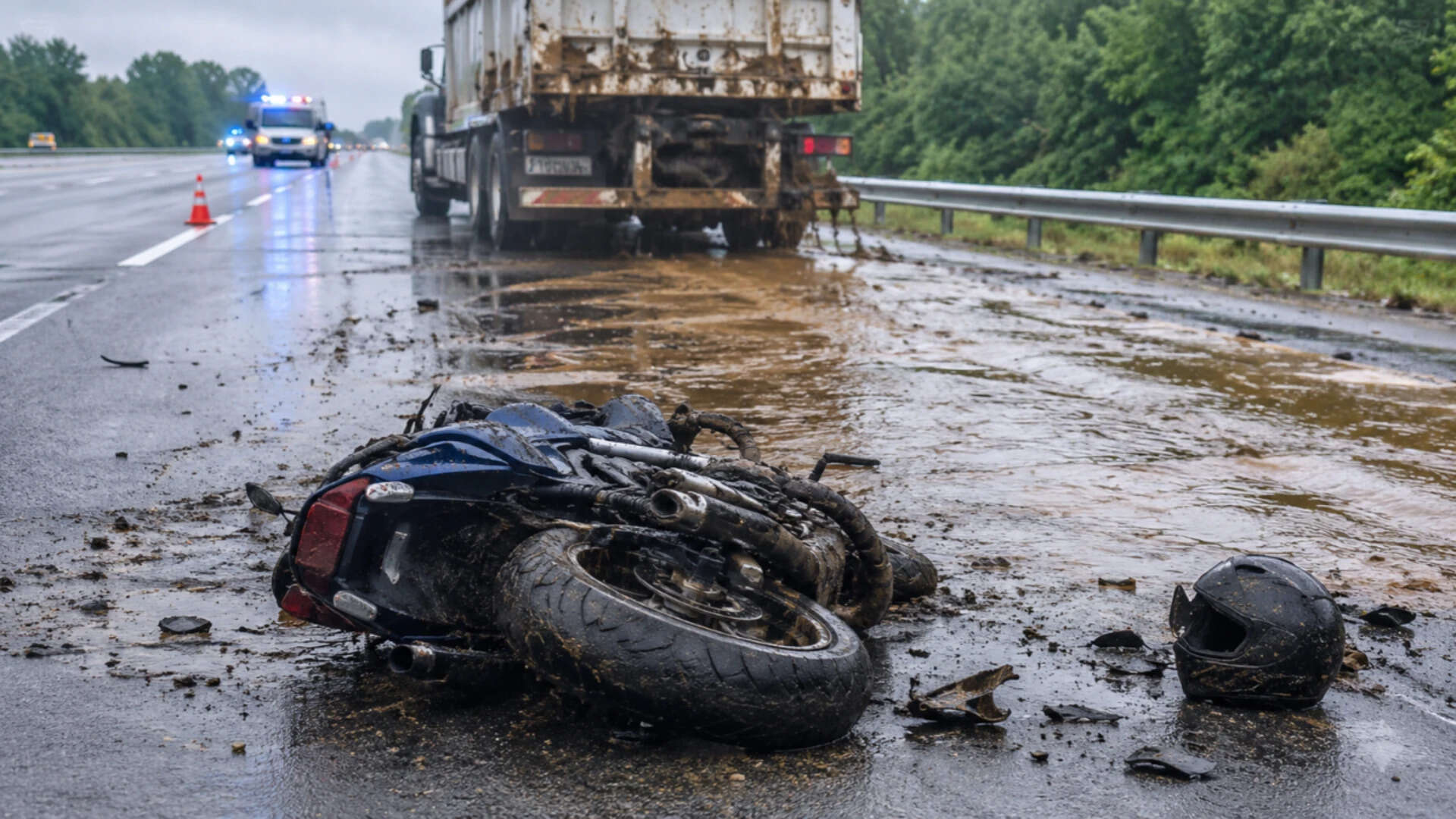
Read the standard coverage of four motorcyclists crashing in a Kentucky waste spill and an appellate court upholding an $11 million award, and you get the exact same moralized script. Villainous slick on the pavement. Noble riders down. Heroic jury delivers justice. Eleven million dollars of accountability.
That script is lazy. It feels satisfying. It is also analytically sloppy.
When a motorcycle goes down on an unexpected fluid or waste deposit, two tires lose grip in a fraction of a second. Unlike a four-wheel passenger car, a two-wheeled machine relies on lean angle, tire contact patches measured in square inches, and continuous balance. A slick that a sedan can cross with mild traction-control chatter can drop a motorcycle immediately. Nobody serious disputes the physical danger of road contamination.
What lazy reporting misses is what an $11 million appellate verdict actually proves—and what it fails to fix. An appellate court affirming a massive award confirms legal boundaries and procedural standards. It does not magically scrape residue off Kentucky asphalt next Tuesday. It does not train drivers to spot leaking loads before they hit a curve. And it does not turn a courtroom victory into a statewide prevention system.
The Wrong Question Everyone Keeps Asking
Most readers scan a headline about four motorcyclists crashing in a Kentucky waste spill and ask a predictable question: How did the court justify an $11 million payout?
Wrong question.
Legal outcomes follow rules of evidence, negligence standards, causation, damages caps or lack thereof, and appellate review. A layperson reading a summary of an appellate ruling often confuses legal liability with engineering certainty or moral perfection. A court deciding whether a verdict stands is evaluating whether the legal process worked within its bounds—not grading every human choice made on the roadway that day.
The better question is sharper and far less comforting: Why do roadways keep failing riders through preventable surface hazards, and why do big verdicts rarely change daily operations until someone's balance sheet bleeds?
Over years working around commercial fleet operations, risk management, and industrial transport compliance, I have watched organizations spend millions on glossy safety slogans while ignoring basic operational hygiene. Pre-trip checks get rushed. Tailgates and valves get treated like routine hardware rather than failure points. Loads shift, seals weep, and nobody notices until sirens echo down a two-lane road.
That is the unglamorous reality behind road spills. Not cartoon villains twirling mustaches. Ordinary shortcuts stacking up until physics collects its bill.
Negligence Versus Road Reality
In legal and safety discussions, people throw around words like negligence, proximate cause, and roadway hazard as if they mean the exact same thing in every context. They do not.
- Negligence in tort law centers on whether a party breached a duty of reasonable care under the circumstances and caused harm.
- Roadway hazard in traffic engineering and rider safety describes any surface, object, or environmental condition that degrades traction, sightlines, or vehicle stability.
- Appellate review examines whether legal errors or unsupported findings tainted the trial outcome—it is a check on legal process, not a retrial of every fact from scratch.
Confusing those buckets leads to two opposite errors. One camp treats any big verdict as proof that every nuance of the crash is settled gospel. The other camp dismisses any big verdict as a "jackpot" without looking at the underlying duty and harm. Both reactions are knee-jerk. Neither helps a rider coming into a blind bend at 55 mph.
Why "Just Ride More Carefully" Is Cheap Advice
Whenever a motorcycle crash hits the news, comment sections fill up with smug advice: Riders should slow down. Riders should scan further ahead. Motorcycles are inherently risky.
True in part. Useless as a cure.
Yes, speed increases kinetic energy and reduces reaction time. Yes, scanning ahead helps spot trouble earlier. Motorcyclists who treat every curve like a potential oil slick survive longer than riders who trust clean pavement blindly.
Still, telling riders to "be more careful" while letting avoidable spills sit on public roads is like telling swimmers to "swim faster" while someone dumps grease in the lane. A rider can do everything right—wear proper gear, maintain tire pressure, keep a steady line—and still hit a patch of spilled waste with almost zero warning. Two wheels give you no margin for sudden, unannounced loss of friction.
That is why accountability matters. Public roads are shared infrastructure. When transport or waste operations drop material onto travel lanes, the hazard is externalized onto everyone behind them—especially motorcyclists, who absorb the worst of surface failures.
What People Also Ask (And Why the Premise Often Breaks)
People searching around a story like four motorcyclists crashed in Kentucky waste spill; court upholds $11m award usually ask a cluster of follow-up questions. Most of those questions hide a shaky assumption.
"Does upholding an $11 million award mean the case is completely over?"
Not necessarily in every practical sense. An appellate ruling upholding a judgment is a massive milestone, yet real-world collection, structured settlements, post-judgment motions, or related disputes can still shape how and when money moves. Treating a headline as the final curtain ignores how civil litigation actually plays out after an appeal.
"Why do awards reach eight figures when four riders are involved?"
Severe injuries—especially on motorcycles—carry steep medical costs, long-term rehabilitation, lost earning capacity, and profound pain and suffering. Multiply severe harm across multiple injured people, factor in years of compounding impact, and eight-figure numbers stop looking like magic. They reflect the brutal price tag of catastrophic injury.
"Does a big payout force companies to fix their safety culture?"
Sometimes. Not automatically.
I have seen companies blow millions on litigation defense, insurance premiums, and PR damage control while leaving front-line habits untouched. A payout hurts finance. Real safety requires changing incentives on the loading dock, the dispatch desk, and the driver's seat. If a firm views a massive verdict as a freak outlier rather than a system warning, the next spill is just waiting on a calendar date.
A Thought Experiment on Incentives
Imagine a scenario where a regional hauling company operates fifty trucks carrying liquid or semi-solid waste across hilly state routes. For three years, nobody checks gasket wear until a leak starts, and drivers are quietly rewarded for fast turnaround times rather than thorough containment checks. One day, a spill coats a curve, four motorcyclists go down, and a jury eventually hits the company with an $11 million judgment that survives appeal.
Now ask: what changes on Monday morning?
If leadership treats the verdict purely as bad luck or a rogue jury, they buy more insurance, tighten lip service, and keep pushing speed over inspection. Nothing structural changes.
If leadership treats the verdict as proof that containment failure is an existential business threat, they audit every valve, enforce pre-departure and mid-route checks, train crews to report leaks immediately instead of hiding them, and tie bonuses to zero-release compliance.
Same court ruling. Completely different outcome on the asphalt.
Where Heavy Hitters and Standards Actually Point
Serious safety frameworks—from federal motor carrier rules to established traffic-safety research bodies like the National Highway Traffic Safety Administration and the Insurance Institute for Highway Safety—do not treat road debris or spills as mysterious acts of fate. They treat cargo securement, containment integrity, and surface maintenance as controllable risk factors.
In heavy transport and highway safety, the pattern is consistent: catastrophic incidents rarely come from a single dramatic blunder. They come from small tolerances slipping until two or three failures line up at once. A worn seal. A rushed check. A curve with poor sight distance. A motorcyclist entering right after the drop.
Courts step in after the damage is done to allocate legal responsibility and compensate victims under the law. They cannot rewind time. They cannot rebuild nerve tissue or restore a shattered collarbone. Money is the blunt instrument the legal system uses when physical wholeness cannot be restored.
The Downside of My Own Contrarian Take
Being contrarian has a trap, and I will own it plainly: focusing too heavily on systemic incentives and legal mechanics can sound cold when four real human beings hit the pavement.
When motorcyclists crash, there are bodies on the asphalt, ambulances, surgeries, months or years of recovery, and families turned upside down. Reducing that human shock to risk models and appellate dynamics can feel detached—or worse, like excusing careless behavior.
It is not an excuse. Accountability is essential. When someone's carelessness or containment failure puts riders in the hospital, pretending "mistakes happen" is a cop-out. The goal of looking past the headline isn't to minimize the crash; it's to stop pretending that a court judgment by itself fixes the road.
What Actually Works Next
If you ride, manage fleets, or care about safer roads, skip the outrage loop and take concrete steps that change real odds:
- For riders: Treat every transition—intersections, ramps, construction zones, agricultural routes, and industrial corridors—as potentially slick until proven otherwise. Smooth throttle and brake inputs matter far more than aggressive cornering on public roads.
- For fleet and waste operators: Audit containment points like your business depends on them, because it does. Make leak reporting frictionless and penalty-free for drivers so small drips get stopped before they become highway hazards.
- For policymakers and local agencies: Track surface-hazard crashes closely and push rapid cleanup and accountability where spills recur. A road kept clean prevents the lawsuit in the first place.
Verdicts make headlines. Clean pavement and disciplined operations keep riders upright.