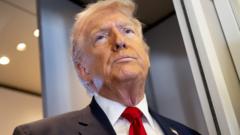
In the quiet, climate-controlled corridors of Tehran, power does not always wear a crown. It wears a clerical robe and a steady, unblinking gaze. While the world watches the formal titles—the presidents who come and go, the diplomats who sit at mahogany tables in Geneva or Doha—the true pulse of the nation beats in a different room. This is the realm of the "De Facto" leader, a man whose decisions ripple across the Persian Gulf like a stone dropped into a still pond, creating waves that eventually crash against distant shores.
The message coming from these inner sanctums is no longer whispered. It is a roar. Don't forget to check out our previous coverage on this related article.
Iran will not surrender. It will not stop. To understand why, we have to look past the headlines of "attacks" and "military maneuvers" and look at the internal logic of a survivor. Imagine a man who has spent forty years building a fortress, brick by brick, while the rest of the neighborhood demands he tear it down. Does he suddenly hand over the keys because the neighbors are shouting? No. He doubles down. He reinforces the gate.
The Geography of Defiance
The air in Tehran in early March carries a sharp chill from the Alborz Mountains. It is a city of contradictions: ancient history layered under the smog of a modern metropolis. When the leadership speaks of "resistance," they aren't just using a political buzzword. They are tapping into a deeply ingrained narrative of Iranian identity. To read more about the history of this, Reuters offers an in-depth summary.
To the strategist in the high office, the various militias and proxy groups scattered across the Middle East are not just pawns. They are a "Forward Defense." Think of it as a series of concentric circles. If the fight stays in Lebanon, in Yemen, or in the waters of the Red Sea, it stays away from the streets of Tehran. This is the cold calculus of survival.
The recent declarations from the top echelons of the Iranian state make it clear: the pressure from the West—the sanctions that have throttled the rial, the isolation that has cut off young Iranians from the global banking system—has not achieved the intended "behavioral change." Instead, it has calcified the resolve of those in charge. They see surrender not as a path to peace, but as a precursor to disappearance.
The Ghost in the Machine
Consider the perspective of a mid-level commander in the Revolutionary Guard, a hypothetical figure we might call Ahmad. Ahmad grew up during the Iran-Iraq war. He remembers the scarcity, the chemical weapons, and the feeling that the entire world was rooting for his country's destruction. To Ahmad, and the leaders he serves, the "attacks" the West decries are seen as necessary strikes to maintain a balance of power.
When the leadership says they will not stop, they are telling Ahmad that his sacrifices have meaning. They are signaling to their allies in the "Axis of Resistance" that the patron is not blinking.
The numbers back up this stubbornness. Despite decades of the most intensive sanctions regime in modern history, Iran has managed to develop a sophisticated domestic arms industry. They have moved from importing Soviet leftovers to exporting high-tech drones that now influence conflicts thousands of miles away.
$$P_{survival} \propto \frac{1}{D_{concession}}$$
In the eyes of the De Facto leader, the probability of regime survival is inversely proportional to the degree of concessions made to foreign powers. It is a grim, mathematical certainty in their worldview. To give an inch is to invite a mile of intervention.
The Invisible Stakes for the Street
But what does this "no surrender" policy mean for the person selling saffron in the Grand Bazaar? Or the tech student in Isfahan who just wants to code for a global firm?
This is where the human element becomes a tragedy. The high-level defiance translates into a grueling daily reality for 85 million people. When the leadership chooses the path of continued confrontation, they are also choosing a path of continued economic strangulation for their citizens.
- Inflation that makes a bag of groceries a luxury.
- A currency that loses value while you sleep.
- A sense of being trapped in a historical loop that never moves toward a resolution.
The leadership views these domestic hardships as a price worth paying for "strategic autonomy." They bet on the resilience of the Iranian people—a resilience that has been tested for millennia. But there is a tension here, a stretching of the social fabric that can only go so far before it begins to fray.
The Chessboard Without an End
The "attacks" mentioned in the briefings—the drone strikes, the maritime harrassment, the support for regional groups—are tools of leverage. In the mind of the De Facto leader, if Iran stops, it loses its only seat at the table. They believe that the moment they stop being a "threat," they become a target.
It is a paradox. To achieve security, they create insecurity for everyone else.
Critics often argue that this path is a dead end. They point to the declining standard of living and the periodic outbursts of domestic unrest as proof that the "Resistance" model is failing. But from the balcony of the leader's office, the view is different. They look at the map and see a "land bridge" to the Mediterranean. They see a West that is tired of "forever wars." They see a shift in the global order where China and Russia provide a diplomatic and economic safety net that didn't exist twenty years ago.
The world keeps waiting for a "pivot," a moment where the leadership realizes the cost is too high and decides to trade its missiles for markets. That wait might be long. The current rhetoric isn't just a negotiating tactic; it is an ideological cornerstone.
The Weight of History
History is a heavy burden in this part of the world. The leadership often references the 1953 coup or the long memory of the Great Game between empires. They operate on a timeline of centuries, while Western democracies operate on election cycles of four years.
This mismatch in timing is why diplomacy often feels like two people speaking different languages at the same time. While one side talks about "de-escalation" and "regional stability," the other talks about "sovereignty" and "thwarting hegemony."
The De Facto leader’s refusal to surrender is, in his mind, an act of historical justice. It is a refusal to let the 20th century repeat itself in the 21st.
The shadow cast by this decision is long. It reaches into the shipping lanes of the Bab el-Mandeb, into the halls of the United Nations, and into the living rooms of families across the Middle East who wonder if the next drone will carry their name. It is a shadow that doesn't seem to be retreating.
As the sun sets over the Milad Tower, the lights of Tehran flicker on, one by one. Millions of lives continue, intertwined with a grand strategy they did not choose but must endure. The leader remains in his room, his gaze fixed on a horizon that only he can see, convinced that the only way to move forward is to never, ever turn back.
The iron stays in the fire. The gates remain barred. The world watches, waiting for a crack in the stone that may never come.