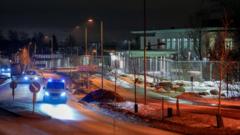
The silence of the Persian Gulf is never truly silent. It is a mechanical hum, a vibration of deep-sea pipelines and the rhythmic churning of tankers the size of horizontal skyscrapers. But on a Tuesday night that felt like every other humid evening in the port, the hum broke.
The sound didn't arrive as a bang. It was a roar that felt like it was peeling the skin off the atmosphere.
When the missiles struck the distillation towers and the storage tanks, the horizon didn't just brighten. It ignited. For those watching from the coast of Bushehr, the sun seemed to have risen in the wrong direction, at the wrong time, with a malevolent, flickering intensity. This wasn't just a military strike. It was the surgical removal of a nation’s economic heartbeat, performed with the cold precision of high-altitude physics.
The Fragile Geometry of a Pipeline
To understand why a few charred ruins on a map matter to a commuter in London or a factory worker in Ohio, you have to look past the geopolitical posturing. You have to look at the pressure.
Oil is a jealous mistress. It requires constant, perfect conditions to move. Inside the sprawling refineries of Iran, crude oil is heated to precise temperatures to separate the lifeblood of modern civilization: gasoline, diesel, and jet fuel. When a kinetic strike hits these facilities, it doesn't just "break" things. It creates a cascading failure of thermodynamics.
The heat from the explosions warps the specialized alloys of the "crackers"—massive units that break down heavy molecules. These aren't parts you can buy at a hardware store. They are bespoke titans of engineering that take years to manufacture and months to install. By hitting these specific nodes, the strike did more than stop production for a day. It paralyzed the circulatory system of the Iranian state.
Imagine a world-class athlete suddenly losing the ability to process oxygen. The muscles are still there. The will to fight remains. But the energy required to move simply vanishes.
The Ghost of $100 Crude
In the sterile trading floors of Singapore and New York, the reaction was instantaneous. While the fires were still raging, the "fear premium" began to seep into the digital ledgers of the global market.
Traders don't care about the smoke. They care about the "Strait."
The Strait of Hormuz is a narrow choke point through which a third of the world’s liquefied natural gas and 25% of its total oil consumption passes. It is a geographical throat. If the retaliation for the strike involves even a partial blockage of this passage, the ripple effect would be a global cardiac arrest.
Consider a hypothetical small-scale logistics manager named Elias in Rotterdam. Elias doesn't follow Middle Eastern history. He follows fuel surcharges. When the Kharg Island facilities went dark, Elias’s dashboard turned red. Within forty-eight hours, the cost of shipping a single container from Shanghai to New York rose by 4%. That 4% isn't a dry statistic. It is the reason a father decides he can't afford the premium tires for the family car this month. It is the reason a grocery chain in the Midwest raises the price of milk by twenty cents.
The stakes are invisible until they hit your wallet.
A War of Cold Math and Hot Metal
For decades, the shadow war between Israel and Iran was fought in the dark. It was a matter of poisoned code, "Stuxnet" viruses, and the occasional silenced pistol in a Tehran suburb. This strike changed the medium. We have moved from the digital to the visceral.
The technology behind these strikes is a terrifying marvel of modern engineering. We are no longer in the era of carpet bombing. These were "smart" munitions, likely guided by a combination of GPS, inertial navigation, and electro-optical sensors that can recognize the shape of a specific valve from miles away.
The precision is meant to send a message: We can touch anything you own.
But precision has a flip side. When you hit an oil refinery, you aren't just hitting a government asset. You are hitting the subsidized fuel that keeps the local baker’s oven running. You are hitting the heating oil for the elderly in the Alborz mountains. The "human element" isn't a byproduct of the war; it is the target. By squeezing the energy supply, the goal is to create a domestic pressure cooker that the Iranian leadership cannot ignore.
The Uncertainty Principle
If you talk to energy analysts off the record, they will admit they are guessing. The world has never seen a conflict this direct between two heavily armed, technologically advanced powers in the heart of the world’s gas station.
There is a psychological weight to this uncertainty. It creates a "hunker down" mentality. When energy security is threatened, innovation slows. Companies stop investing in long-term projects because they can't predict the cost of electricity in six months. Governments begin to hoard.
We often think of history as a series of dates and names. But history is actually a series of reactions to scarcity. The 1973 oil embargo didn't just change car designs; it changed the way we think about the limits of growth. This strike is a reminder that our high-tech, cloud-based, frictionless existence still rests on a foundation of flammable liquid buried in the sand.
The View from the Water
The tankers are still there. They sit in the Gulf like giant, patient beasts, waiting for orders that might never come. Their captains watch the horizon, looking for the telltale flash of another drone or the wake of a fast-attack boat.
There is a specific kind of dread that comes with being on a vessel carrying two million barrels of oil in a combat zone. It is the knowledge that you are sitting on a bomb the size of a city block.
As the smoke from the refineries eventually begins to thin, the soot settles on the water. It leaves a shimmering, iridescent film on the surface of the Persian Gulf—a beautiful, toxic reminder of what happens when the global economy collides with ancient grievances. The fires might be extinguished, but the heat remains. It’s in the eyes of the people at the gas pumps in Tehran. It’s in the frantic whispers of the diplomats in Geneva. And it’s in the cold, calculated clicking of the algorithms that now decide how much it costs for you to turn on your lights.
The sky over Kharg Island is dark again, but it is no longer the darkness of peace. It is the darkness of a breath being held.