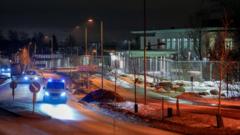
Fear moves faster than facts in a city as quiet as Oslo. When reports surfaced about an explosion near the United States Embassy, the digital sirens started screaming immediately. For a moment, it felt like 2011 again. People froze. We’ve seen how these headlines evolve, often turning into something much larger—or much smaller—than the initial panic suggests. This time, the reality on the ground in the Norwegian capital was a masterclass in why we shouldn't trust our first instincts during a breaking news cycle.
Police cordoned off the area. Bomb squads moved in. The embassy, a fortress-like structure located in the Huseby neighborhood, became the center of a geopolitical guessing game. But here’s the thing about "explosions" in high-security zones. They aren't always what they seem.
The Reality of the Oslo Embassy Incident
Initial reports from Norwegian media and police units indicated a "loud bang" that triggered an immediate security protocol. You don't take chances with a US diplomatic mission. That’s just common sense. The embassy had already moved from the city center to the outskirts years ago specifically to create a buffer zone against exactly this kind of threat.
When the dust settled—or rather, when the noise stopped echoing—the "explosion" turned out to be something far less sinister than a coordinated attack. Police later confirmed the sound was actually a controlled detonation of a suspicious object. A false alarm? Basically. But in the world of high-stakes diplomacy, there’s no such thing as "just" a false alarm. It’s a live-fire drill for the real thing.
Security forces found a bag. They couldn't verify its contents. They blew it up. That's the standard operating procedure that leads to the terrifying headlines you see on your feed.
Why Embassy Security Is Always on Edge
If you think the reaction was overkill, you haven't been paying attention to global security trends over the last decade. US embassies are essentially lightning rods. They represent American power on foreign soil, making them the ultimate "soft" targets that are actually incredibly hard to hit.
The Huseby facility isn't just a building. It's a bunker disguised as an office. It features reinforced walls, blast-resistant glass, and a massive setback from the main road. When someone leaves a backpack nearby, the machine starts turning. It doesn't matter if it's a forgotten gym bag or a sophisticated IED. The response is identical.
- Detection: Cameras and sensors pick up an unattended item within seconds.
- Isolation: The immediate perimeter is cleared. Traffic is diverted.
- Neutralization: If the item looks remotely off, the EOD (Explosive Ordnance Disposal) team uses a water cannon or a small charge to "render it safe."
That last step is what usually causes the "explosion" reports. We're living in an era where the countermeasure creates more noise than the threat itself.
The Psychological Toll of a False Alarm
Oslo is a city that carries deep scars. The memory of the 2011 government quarter bombing remains a baseline for how residents process loud noises near official buildings. When the police tell you to stay away from the embassy, you don't ask questions. You run.
The problem is that every time a "suspicious object" turns out to be trash, the public's internal alarm system gets a little more frayed. We call it "threat fatigue." You start to ignore the sirens until they're right outside your door. However, the Norwegian police (Politiet) handled this with the kind of transparency we rarely see in the States. They were on Twitter (X) and local news outlets within minutes, de-escalating the situation before the conspiracy theories could take root.
Lessons from the Oslo Perimeter
What can we actually learn from a bag that turned out to be nothing?
First, the physical relocation of the embassy worked. In the old location near the Royal Palace, a controlled blast like this would have shattered windows for blocks and caused a massive traffic nightmare in the heart of the city. At Huseby, the impact was contained.
Second, the coordination between the US State Department’s Diplomatic Security Service and local Norwegian law enforcement is tighter than people realize. They aren't just roommates; they're an integrated defense unit.
If you find yourself in a city during a security lockdown, stop refreshing your social media feed for three minutes. Most of what you see in the first sixty seconds is wrong. Look for official police handles. If they aren't saying "evacuate the city," you’re probably looking at a controlled detonation.
Stay away from the yellow tape and let the guys with the robots do their jobs. If you see a bag that doesn't belong to you, don't be a hero and don't be a bystander. Report it and move. The "loud bang" you hear later is just the sound of the system working exactly how it's supposed to.