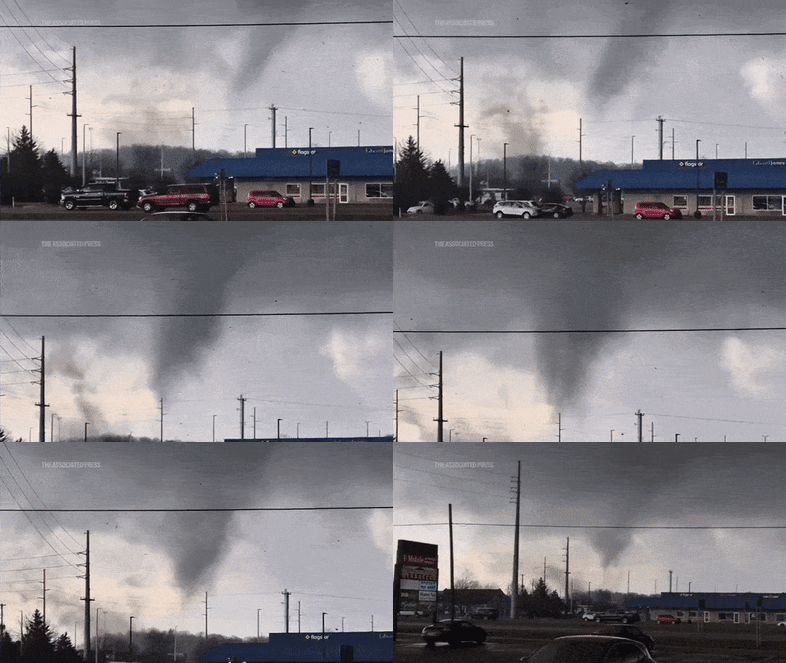
The recent tornadic activity across Michigan and Oklahoma represents a critical failure in the intersection of high-velocity atmospheric physics and outdated residential engineering. While media reports focus on the visceral imagery of "lifting houses," a rigorous analysis reveals that these events are the result of specific pressure differentials and structural load-path failures. The loss of at least six lives is not a random tragedy but the quantifiable outcome of wind-speeds exceeding the design limits of standard wood-frame construction.
The Triad of Tornadic Destruction
To understand why these specific storms caused catastrophic failure, we must categorize the damage through three distinct physical mechanisms.
Pressure Differential Induced Uplift
Tornadoes create a localized drop in atmospheric pressure. When the core of a vortex passes over a sealed or semi-sealed structure, the higher internal pressure of the building pushes outward and upward. This is the "lifting" phenomenon. If the roof-to-wall connections—specifically hurricane ties or anchor bolts—are absent or degraded, the roof acts as a wing, generating enough lift to overcome the weight of the structure and any mechanical fasteners.Aerodynamic Drag and Lateral Shearing
Standard residential buildings are designed to withstand vertical gravitational loads. They are significantly less efficient at managing lateral (horizontal) loads. As wind speeds enter the EF2 range (111–135 mph) and above, the lateral force exerted on the windward wall creates a pivot point at the foundation. Without reinforced shear walls, the house undergoes "racking," where the rectangular frame tilts into a parallelogram until the joints fail.Impact-Based Penetration and Pressurization
The integrity of a building often fails the moment a window or door is breached by flying debris. Once the envelope is punctured, wind enters the interior, causing a massive increase in internal pressure that works in tandem with the external low pressure to "blow" the roof off from the inside out.
The Fragility of the Wood-Frame Paradigm
The Michigan and Oklahoma events highlight the inherent limitations of "stick-built" construction. In the United States, the vast majority of residential units rely on nominal 2x4 or 2x6 lumber held together by nails. While cost-effective, this system relies on the assumption of static loads.
Load Path Discontinuity
A structural load path is the continuous route that forces take through a building to the ground. In the impacted regions, many of the destroyed homes suffered from "load path discontinuity."
- Roof-to-Wall: Many older homes in Michigan rely on "toe-nailing" (driving nails at an angle) to secure rafters to the top plate of the walls. This provides almost zero resistance to uplift.
- Wall-to-Foundation: In high-velocity events, houses are often shifted entirely off their foundations because the mudsill (the bottom-most piece of wood) was not bolted deeply enough into the concrete or the washers used were too small, allowing the wood to pull right over the bolt heads.
Mechanical Failure of the "Lifting" House
The statement that a tornado "lifts" a house is physically accurate but requires technical nuance. The lift is a function of Bernoulli's principle. As air moves faster over the roof’s surface, the pressure drops.
$$L = \frac{1}{2} \rho v^2 A C_L$$
In this equation:
- $L$ represents the lift force.
- $\rho$ is the air density.
- $v$ is the wind velocity.
- $A$ is the surface area of the roof.
- $C_L$ is the lift coefficient (determined by the roof's pitch and shape).
Because the velocity ($v$) is squared, doubling the wind speed quadruples the lift force. This explains why a move from an EF1 to an EF2 tornado results in exponentially more "lifted" structures rather than a linear increase in damage.
Regional Vulnerability Variations
The disparity in impact between Michigan and Oklahoma can be attributed to differing building codes and historical "storm literacy."
Oklahoma: The Hardened Core
In Oklahoma, the frequency of high-intensity vortices has led to a higher density of "safe rooms" and storm cellars. These are independent structures, often steel-reinforced concrete, that are physically decoupled from the main house's structural frame. This decoupling is essential; if the house fails, the safe room remains anchored.
Michigan: The Latent Risk
Michigan’s building codes are historically driven by snow-load requirements—vertical pressure. A roof designed to hold 50 pounds per square foot of snow is actually more susceptible to wind damage if the pitch is steep, as it creates a larger surface area for lateral wind pressure. Furthermore, many Michigan homes have basements, which provide life-safety benefits but do nothing to prevent the total loss of the above-ground assets.
Quantifying the Debris Field as a Weapon
The six deaths reported were likely not caused by the wind itself, but by the "missile effect" of the built environment. When one house fails, it provides the ammunition to destroy the next.
- Primary Debris: Materials from the environment (trees, vehicles).
- Secondary Debris: Building components (shingles, siding, 2x4s).
A standard 2x4 propelled at 100 mph has sufficient kinetic energy to pierce through reinforced masonry. In the Oklahoma and Michigan corridors, the density of secondary debris becomes a "force multiplier" for the tornado, effectively turning a localized vortex into a grinding machine that scours the land.
The Economic Friction of Retrofitting
The technology to prevent "lifted" houses exists:
- ICF (Insulated Concrete Forms): Concrete walls poured into foam blocks, creating a monolithic structure.
- Steel Strapping: Continuous metal ties from the roof rafter down to the foundation bolts.
- Aerodynamic Roof Profiles: Hip roofs (sloping on all four sides) perform significantly better than gable roofs (two-sided slopes) because they break up the wind flow and reduce the lift coefficient.
The barrier to implementation is the "Low-Probability, High-Consequence" (LPHC) cognitive bias. Homeowners and developers are hesitant to add 5–10% to the initial construction cost for an event that may never occur on their specific GPS coordinates. This creates a legacy of vulnerable housing stock that remains until a terminal event—like the one we just witnessed—forces a rebuild.
Strategic Hardening of the Residential Grid
Moving forward, the reliance on reactive disaster relief is an inefficient use of capital. A proactive structural hardening strategy must prioritize the following:
- Mandatory Anchor Bolt Inspections: Shifting from simple nailing patterns to 5/8-inch bolts with 3-inch square washers as the minimum standard for all new builds.
- The Internalized Safe-Room Mandate: Rather than trying to save the entire $400,000 asset, construction should focus on an "indestructible core" (usually a bathroom or closet) that remains standing even if the exterior envelope is stripped.
- Passive Venting Systems: Implementing pressure-release valves in attic spaces that allow internal and external pressures to equalize rapidly, reducing the "wing effect" of the roof.
The physics of the atmosphere cannot be changed, but the structural response of our habitat is a variable within our control. The destruction in Michigan and Oklahoma serves as a data point proving that the "stick-built" era has reached its safety ceiling in an era of increasing atmospheric volatility.
Homeowners in high-risk zones should immediately audit their roof-to-wall connections. If the rafters are secured only by nails, the installation of retrofitted steel hurricane straps is the single most effective investment for preventing total structural lift-off. In the absence of this mechanical bond, the house is not a shelter; it is a pressurized vessel waiting for a breach.