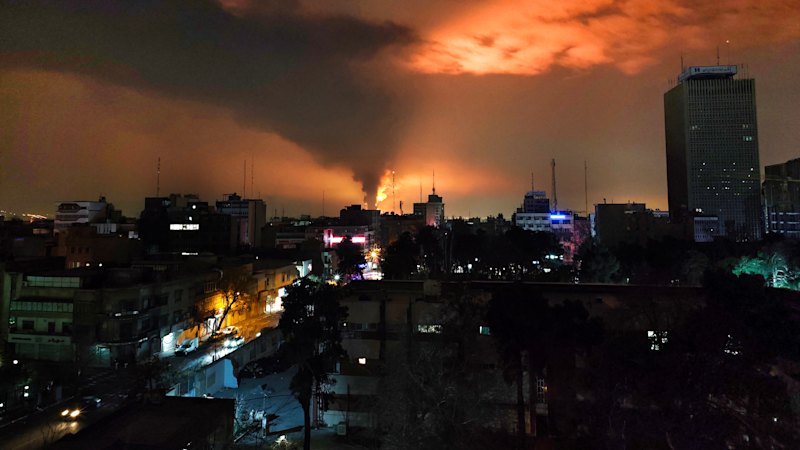
Thinking a ground invasion of Iran would play out like a "Mission Accomplished" rerun in Iraq isn't just optimistic—it’s dangerous. As of March 2026, the rhetoric coming out of Washington about "cleaning out" the Iranian leadership is hitting a fever pitch. President Trump’s administration has labeled the current offensive Operation Epic Fury, and while the air campaign has been devastating, the whispers of boots on the ground are getting louder.
But here’s the reality that a classified National Intelligence Council (NIC) report just laid bare: even a massive US ground invasion might not be enough to actually oust the regime. We’re talking about a system designed to survive the very scenario we're currently creating.
The Myth of the Quick Collapse
The logic often used by hawks is that if you cut off the head, the body dies. In Iran, that’s a total misunderstanding of how the power structure works. The Islamic Republic isn't a "sultanistic" dictatorship where everything hinges on one guy’s heartbeat. It’s a layered, bureaucratic security state.
When Supreme Leader Ali Khamenei died recently, the world waited for the system to shatter. It didn't. Instead, the Assembly of Experts and the Islamic Revolutionary Guard Corps (IRGC) moved into high gear. They have protocols for this. They’ve spent 47 years preparing for existential threats.
A ground invasion forces these factions to do one thing: close ranks. Internal rivalries between "pragmatists" like Mohammad Javad Zarif and the hardline IRGC commanders evaporate when American tanks cross the border. At that point, it’s no longer about politics; it’s about survival.
Geography is the Ultimate Defender
If you think the mountains in Afghanistan were a headache, Iran is a nightmare on a different scale. It’s a fortress of a country. The central plateau is surrounded by the Zagros and Alborz mountain ranges, making any move toward Tehran a slow, bloody crawl through narrow passes.
- Distance: Tehran is hundreds of miles from the coast. Unlike the quick dash to Baghdad, a push to the Iranian capital requires securing massive stretches of hostile territory.
- Urban Warfare: Iran’s cities are densely populated and highly nationalistic. Even Iranians who hate the mullahs—and polls from late 2024 suggest that’s nearly 70% of the population—don't necessarily want to see US Marines patrolling Isfahan.
- Asymmetric Response: While US and Israeli jets have turned many "missile cities" into rubble, the regime still has thousands of mobile launchers and drones. They don't need to win a set-piece battle; they just need to make the cost of staying too high for the American public to stomach.
The Rise of IRGCistan
The most likely outcome of a "successful" invasion isn't a Jeffersonian democracy. It’s a military junta. Analysts call this scenario IRGCistan.
If the clerical leadership is wiped out or sidelined, the IRGC is the only organized force left with the guns and the logistics to run the country. They’re essentially a state within a state. They control the docks, the black-market oil trade, and the most elite military units. If the US breaks the back of the religious government, the IRGC will likely step into the vacuum, perhaps keeping a puppet cleric for "legitimacy" while running a much more aggressive, purely military autocracy.
This doesn't solve the problem of regional stability. It actually makes it worse. A cornered IRGC is more likely to use what’s left of its proxy network—Hezbollah, the Houthis, and various militias—to set the entire Middle East on fire.
The Kurdish Wildcard
There’s a lot of talk right now about a "ground-enabled" campaign. This basically means the US and Israel arming ethnic minorities, particularly the Kurds in the north, to do the heavy lifting.
While this sounds good on paper, it’s a recipe for a "Libya-style mess." If you arm these groups to collapse the center, you don't get a new government. You get a fragmented map of warlords and ethnic conflict that could spill over into Turkey and Iraq. The Pentagon might want a regime change, but what they’d likely get is a decade-long civil war that requires a permanent US presence just to keep the borders from dissolving.
The Bottom Line
A ground invasion is the most expensive, highest-risk option on the table, and the "reward" is a high probability of failure. The NIC report was right to be skeptical. The Iranian regime is "brittle" in terms of popularity, but it’s "firm" in its coercive power.
If you're following the news, watch the rhetoric about "limited ground operations." There’s no such thing with a country of 93 million people. If the US goes in, it’s either all-in for a multi-decade occupation or it’s a retreat that leaves a power vacuum for the IRGC to fill.
Don't wait for the headlines to tell you the invasion has started. Keep a close eye on:
- The deployment of ammunition technicians and medical support to the region.
- The movement of the USS Gerald R. Ford and other carrier groups.
- Statements from the UK or France regarding the use of their bases—so far, they're staying out of it.
If these indicators keep trending up, we're looking at a conflict that won't end with a statue being toppled in a square. It’ll just be the beginning of a much longer, darker chapter.
Keep your eyes on the logistics, not just the "Operation Epic Fury" briefings. The real story is always in the supply lines.