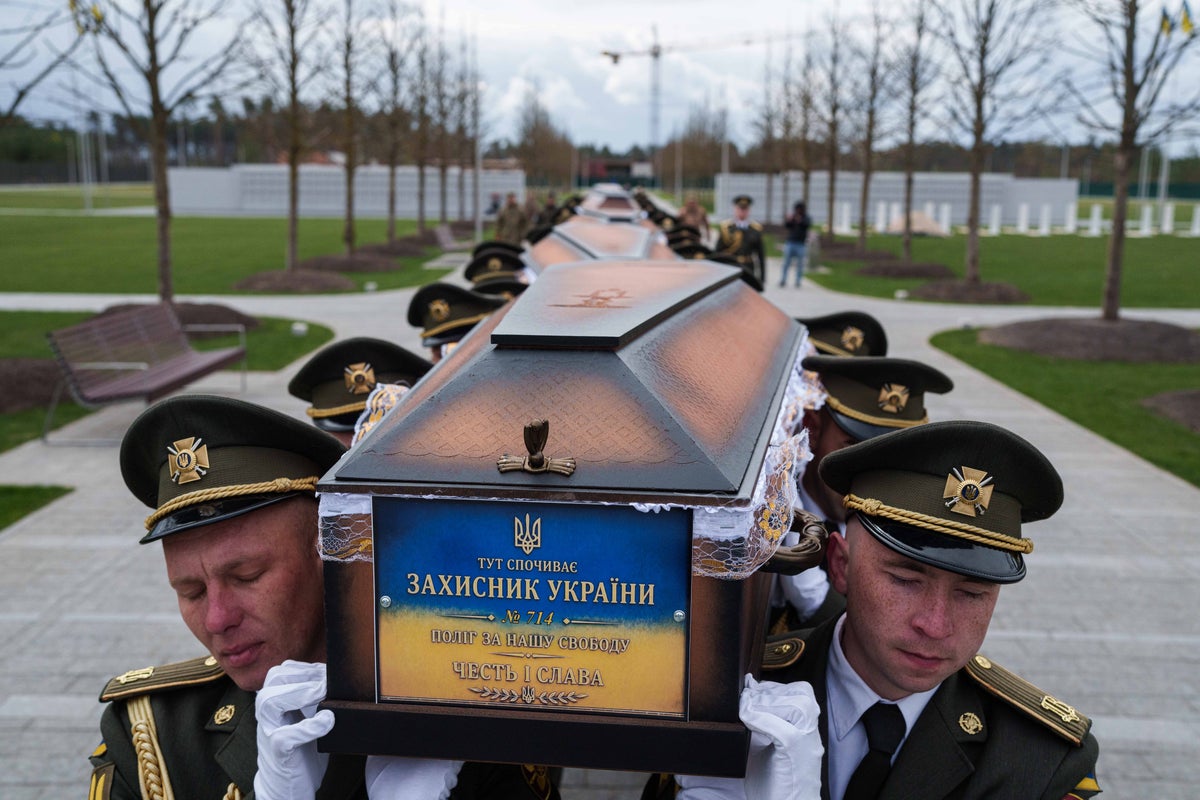
In the outskirts of Dnipro and Zaporizhzhia, fields of freshly turned earth are marked not by names, but by plastic placards bearing sequential numbers. These are the graves of Ukraine’s unidentified soldiers, men and women who went into battle and returned only as genetic fragments. Behind these silent rows lies a massive, breaking bureaucratic and forensic machine. While the human tragedy is stark, the systemic crisis—driven by DNA backlogs, fragmented battlefield recovery, and the limits of rapid testing in an active war zone—threatens to leave thousands of families in permanent limbo.
The public narrative often focuses on the heroism of the front lines, but the quiet crisis of the unidentified dead is a logistical bottleneck that Ukraine is struggling to manage.
To understand why so many soldiers are buried under plastic numbers, one must look at the chaotic journey of a body from the zero-line to the cemetery. When a position is struck by heavy artillery or thermobaric weaponry, recovery is rarely immediate. Days, weeks, or even months can pass before teams like "Cargo 200" or military chaplains can safely access the site.
By the time a recovery team reaches the scene, physical identification is frequently impossible.
The process then shifts to the regional morgues, which have operated at and beyond capacity for years. Here, the bottleneck begins. Identifying a body when there are no dental records, dog tags, or recognizable features relies almost entirely on DNA profiling.
Ukraine’s forensic infrastructure was never designed for a war of this scale. In the early months of the invasion, the country possessed only a handful of laboratories capable of high-throughput DNA extraction and sequencing. While international donors have since supplied advanced rapid-DNA analyzers, the volume of cases continually outpaces the throughput.
A DNA profile is useless in isolation. It requires a match.
This brings us to the second, more complex hurdle: the reference database. For every unidentified body, forensic scientists must obtain a comparative sample from a close relative—ideally a parent or a child. But millions of Ukrainians have been displaced. Families are scattered across Europe, making the collection of reference swabs a highly fragmented, international effort.
Even when a family member is located and submits a swab, the bureaucratic loop is agonizingly slow. Police departments, investigators, and laboratory technicians must coordinate across regions disrupted by power outages, missile strikes, and staff shortages. The result is a backlog that stretches for months, sometimes over a year, during which morgues cannot indefinitely store the remains.
To prevent sanitary crises and free up cold storage, municipalities have had to establish dedicated sectors in local cemeteries.
These are not mass graves. They are highly organized, individual plots, cataloged with meticulous precision. Each body is assigned a unique registry number that corresponds to a specific forensic file containing DNA data, physical descriptions, and any personal effects recovered from the scene.
The system is designed to be reversible. When a DNA match is eventually confirmed, the family is notified, the plastic placard is removed, and a permanent headstone is erected—or the remains are exhumed and moved to the family's home village.
But exhumation is its own administrative and emotional nightmare. It requires judicial approval, which adds another layer of legal red tape to an already exhausted judicial system.
Furthermore, the psychological toll on the families is devastating. Many find themselves trapped in an ambiguous state of grief. Without a body, some hold onto the hope that their loved one is a prisoner of war or simply missing in action, refusing to give DNA samples because doing so feels like accepting death. Others are forced to wait for months for a laboratory to confirm what they already suspect, suspended in a state where they can neither bury their dead nor begin to heal.
There are also structural gaps in how the military handles personal data. While efforts have been made to digitize soldier records and collect pre-deployment DNA samples, the sheer speed of mobilization has meant that many territorial defense units and volunteer battalions went to the front without comprehensive biometric registration.
This is not a failure of will, but of capacity.
The international community has stepped in with training and equipment, but the scale of the task remains unprecedented in modern European history. Organizations like the International Commission on Missing Persons (ICMP) are working to help Ukraine build a more resilient system, but international treaties and protocols often move at a diplomatic crawl compared to the relentless pace of artillery warfare.
As the war continues, these silent fields of numbers will grow. The challenge for Ukraine is not just winning the war on the battlefield, but ensuring that the administrative and forensic systems can eventually bring every nameless soldier home, preventing a generation of families from being haunted by the unresolved silence of the missing.