A single vibration in a pocket in Goma is not just a text message. It is the hum of a supply chain that begins in a mud-slicked trench in the Kivu hills and ends in the sterile, glass-bottomed boardrooms of Silicon Valley. For the people living in the shadow of the Nyiragongo volcano, the distance between their reality and the Oval Office has always felt cosmic. But today, that distance has collapsed.
The conflict between the Democratic Republic of Congo (DRC) and Rwanda is no longer a localized tragedy. It has become a high-stakes poker game where the chips are cobalt, tantalum, and the unpredictable ego of a returning American president.
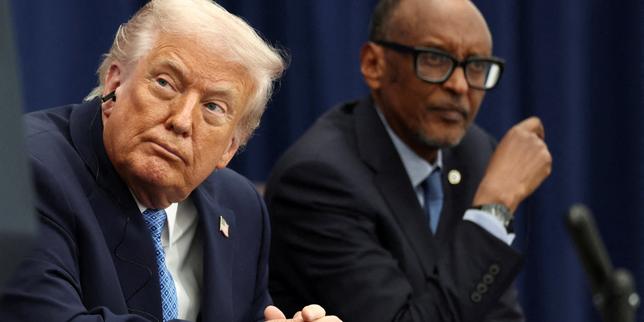
Donald Trump’s "America First" doctrine is a blunt instrument. When applied to the delicate, blood-soaked intricacies of the African Great Lakes, it acts like a sledgehammer in a watchmaker's shop. The nuances of the Luanda process—the fragile diplomatic ceasefire meant to quiet the guns—are being incinerated by a new, transaction-heavy reality.
The Mineral Shadow
Consider a young man named Jean. He doesn't exist in the briefing papers, but he is the personification of the data. Jean spends twelve hours a day descending into unsupported shafts to claw at the earth. He is looking for "3T" minerals—tin, tungsten, and tantalum. These are the elements that allow your smartphone to vibrate and your electric vehicle to hold a charge.
In the traditional diplomatic world, Jean is a human rights concern. In the Trumpian world, Jean’s output is a strategic asset in the cold war against Chinese industrial dominance.
The DRC holds over 70% of the world’s cobalt. For years, China has quietly tightened its grip on these mines, securing the raw materials needed to fuel the green energy transition. The new administration in Washington sees this not as a humanitarian crisis, but as a lost trade war. The conflict between the DRC and the M23 rebels—widely documented by UN experts as being supported by Rwanda—is the messy backdrop to a much larger play for resource security.
The Kigali Calculation
Paul Kagame has long played the role of the West’s favorite disciplinarian. Rwanda is clean, efficient, and technologically forward-facing. It is the "Singapore of Africa." This image has bought Kigali years of diplomatic cover, even as accusations of its involvement in the DRC’s instability mounted.
But the winds have shifted.
The previous American stance was one of "concerned engagement." There were sanctions, yes, but they were surgical. There were statements, but they were couched in the polite language of international law. Trump doesn't do polite. He does deals.
Kagame knows this. He understands that to a president who views foreign policy through the lens of a balance sheet, the M23 rebellion is a variable that can be traded. If Rwanda can position itself as a more reliable partner for American tech interests than the chaotic, corruption-riddled administration in Kinshasa, the "hubris" of the White House might favor the smaller, more organized player.
It is a dangerous gamble.
The Kinshasa Crisis
In Kinshasa, President Félix Tshisekedi finds himself backed into a corner. He has watched as the international community’s "red lines" were crossed repeatedly by rebel advances. He has seen the MONUSCO peacekeepers begin their exit, leaving a vacuum that is being filled by private military contractors and local militias known as the Wazalendo.
The DRC’s strategy has been to appeal to the global conscience. They point to the millions displaced, the systematic violence, and the blatant violation of sovereignty.
That appeal falls on deaf ears when the listener is only interested in the price of a metric ton of copper.
If the Trump administration decides that the quickest path to "securing" the minerals is to back the strongest local bully, the DRC’s sovereignty becomes a secondary concern. The "America First" approach suggests that as long as the cobalt flows and the Chinese are locked out, the internal borders of the Congo are negotiable.
The Invisible Stakeholders
We often talk about "the markets" as if they are sentient beings. They aren't. They are reflections of fear and greed.
The fear in the Great Lakes is palpable. It is the sound of a drone over a displacement camp. It is the silence of a village that has been emptied overnight. The greed, however, is global.
The minerals in the eastern DRC are the "blood oil" of the 21st century. We are told that the transition to green energy is a moral imperative—a way to save the planet. But for the people of North Kivu, the "green" transition is painted in the red of ongoing war.
The irony is thick. To save the atmosphere in Los Angeles or London, we are destabilizing the ground in Goma.
The Hubris of the Deal
Trump’s foreign policy is built on the belief that everything is a negotiation and every negotiator has a price. This works when you are building a hotel in Manhattan. It fails when you are dealing with ethnic grievances that span generations and a geography so vast it swallows armies.
The hubris lies in the assumption that the U.S. can simply "turn off" the conflict by picking a side or striking a mineral deal with a strongman.
History is a graveyard of such assumptions.
When the U.S. signals that it no longer cares about democratic norms or human rights, it doesn't create stability. It creates a "free-for-all." If the Luanda and Nairobi peace processes are discarded as "weak" or "ineffective" by the White House, the local actors won't go to the negotiating table. They will go to the armory.
The Cost of Disengagement
The U.S. has historically acted as a stabilizer in the region—not because it was exceptionally virtuous, but because it provided a predictable framework. Even the threat of a withheld aid package or a sternly worded UN resolution acted as a brake on the worst impulses of regional leaders.
Remove that brake, and the vehicle accelerates down a very steep hill.
The "ghost" in the White House is the specter of a total American withdrawal from the moral dimension of foreign policy. If the only metric for success is the American bottom line, then the lives of the six million displaced Congolese are literally worthless in the eyes of the world's most powerful man.
This isn't just a political shift. It is an existential threat to the concept of international order.
The Digital Mirror
Pick up your phone. Look at the screen.
The minerals inside it are likely tied to the very violence we are discussing. We are all stakeholders in this war. We provide the capital that pays for the bullets. When the U.S. government shifts its policy toward a more transactional, "hubris-driven" model, it is doing so in our name.
The tragedy of the Congo is that it is too rich for its own good. Its wealth is its curse.
As the new administration settles in, the orders coming out of Washington will determine whether the Great Lakes region moves toward a fragile peace or a total conflagration. The early signs suggest a preference for the "strongman" model—a preference for order over justice, and profit over peace.
But order without justice is just a pause between wars.
Jean, the miner in the trench, doesn't know who the American president is. He doesn't know about the "America First" policy or the trade war with China. He only knows that the price of the stones he finds has gone up, and the number of soldiers in the hills has doubled.
He is the one who will pay the price for the hubris of men in suits thousands of miles away. The earth in the Kivu hills is red, not just from the minerals, but from the reality of a world that has decided some people are merely the overhead costs of progress.
The vibration in your pocket is a reminder. The story is moving. The stakes are rising. And the ghost in the White House is just getting started.