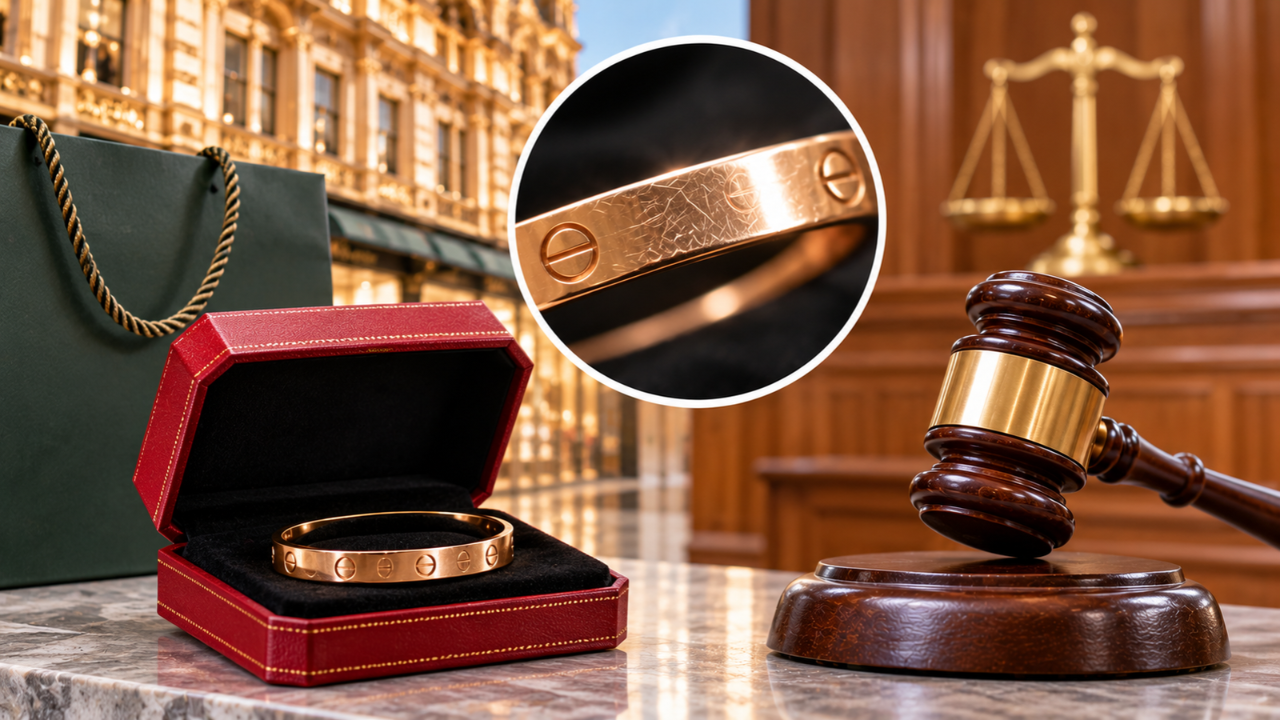
Everybody is cheering for the woman who dragged Harrods to court over a £4,550 Cartier bracelet and walked away with £5,131.
You have seen the headlines. A David-versus-Goliath triumph. A brave shopper taking on a monolithic Knightsbridge department store and winning back her cash plus interest and court fees. The internet loves a story where the little guy sticks it to a billionaire-backed luxury titan.
Here is the problem with that narrative. It completely misses the real story.
This was not a heartwarming victory for consumer empowerment. It was an embarrassing, self-inflicted wound by a legacy retailer that confused its own house rules with actual UK statutory law. More importantly, the public reaction to this case reveals a massive blind spot among modern shoppers. People are celebrating a legal outcome they barely understand, while walking straight into the exact same traps every time they tap their contactless card at a high-end boutique.
If you think this ruling means you can simply change your mind about a luxury purchase and demand your money back, you are going to lose a lot of cash.
The Myth of the Automatic Refund
Let us dismantle the biggest lie in retail first. Consumers operate under the delusion that returning an item because you changed your mind is a God-given right.
It is not.
If you walk into a physical store on Brompton Road, buy a £4,550 piece of gold, walk out the door, and decide the next morning that it clashes with your watch, the retailer owes you nothing. Zero. Under the UK Consumer Rights Act 2015, a physical brick-and-mortar store has no legal obligation to offer a refund, an exchange, or even a credit note simply because you suffered from buyer's remorse.
Store return policies for unwanted goods are pure commercial goodwill. Retailers offer 14-day or 30-day return windows because they want you to feel safe parting with your money. When Harrods, Selfridges, or Bond Street boutiques put restrictions on those returns—like demanding unworn condition, intact security tags, or offering exchange-only terms—they are usually within their rights to do so.
So why did Harrods lose?
Because there is a massive legal chasm between unwanted goods and faulty goods. And luxury retail staff are notoriously poorly trained on where that line is drawn.
When a product fails to meet the legal standard of satisfactory quality, fit for purpose, or as described, store policy becomes completely irrelevant. A laminated sign at the cash register cannot override an Act of Parliament. Yet, year after year, I watch luxury brands train their floor managers to recite store policy like a religious text while ignoring basic statutory protections.
Why Luxury Brands Police Returns Like Maximum Security Prisons
To understand why Harrods fought a £4,550 claim all the way to a judgment—a rounding error for a store that pulls in hundreds of millions in annual revenue—you have to understand the paranoia gripping the high-end jewelry and watch sector.
Luxury boutiques are under siege. They deal with three distinct threats every single day:
- Wardrobing and Event Fraud: Wealthy clients buying high-ticket jewelry on a Friday, wearing it to a gala in Mayfair on Saturday, and attempting to return it on Monday morning with microscopic scratches on the clasp.
- Counterfeit Swapping: Organized crime rings buying a genuine Cartier Love bracelet, swapping it with a high-grade "super-clone" made of real 18k gold with identical weight and engravings, and demanding a refund.
- Grey Market Arbitrage: Resellers buying up stock to flip overseas, then dumping the unsold pieces back on the boutique when currency rates shift.
Because of these threats, luxury houses have turned their return desks into interrogation rooms. Sales associates are incentivized to protect their commission and prevent stock loss at all costs. If a clasp looks slightly off, or a tiny hairline mark appears on polished gold, the default institutional reflex is to blame the customer.
You dropped it.
You wore it.
You misused it.
That reflex works 99% of the time. Most shoppers, intimidated by security guards, velvet ropes, and condescending managers in bespoke suits, simply back down. They accept the repair offer, take the store credit, or walk away fuming.
Harrods ran into the 1% who knew the statute book better than their legal department did.
The Six-Month Rule That Changes Everything
Here is the exact legal mechanism that breaks the luxury retail playbook, and the one piece of knowledge every high-end buyer needs burned into their brain.
Under the Consumer Rights Act 2015, the burden of proof shifts dramatically depending on when a fault appears.
If you buy a luxury item and a defect—a faulty clasp, a loose stone, a snapping mechanism—emerges within the first six months, the law assumes the fault was present at the time of delivery.
Read that again. You do not have to prove the bracelet was defective when you bought it. The retailer has to prove it wasn't.
Imagine a scenario where you buy a £5,000 watch, and three weeks later the crown falls off. The boutique manager inspects it under a loupe and claims you must have knocked it against a doorframe. Under the law, their opinion is worthless. Unless Harrods or the manufacturer can provide independent, expert forensic proof that you caused the damage through misuse, the law sides with you.
Furthermore, within the first 30 days, you hold the short-term right to reject. If the goods are faulty, you do not have to accept a repair. You do not have to accept a replacement. You do not have to accept a gift card. You are entitled to a full refund to your original payment method.
Even after 30 days—up to the six-month mark—if the retailer attempts one repair or replacement and it fails, or if they refuse to repair it within a reasonable time without significant inconvenience, your right to a full refund snaps back into place.
Luxury brands hate this. Their entire business model relies on controlling the client journey. When a Cartier piece has an issue, the brand wants to send it to their workshop in Switzerland or London, polish it up, fix the mechanism, and hand it back to you six weeks later with a complimentary travel pouch. They treat statutory rights as an inconvenient interruption to their brand narrative.
The Real Cost of Fighting a £4,550 Claim
Let us look at the sheer operational stupidity of letting this go to court.
The woman paid £4,550. She ended up winning £5,131. That extra £581 covers statutory interest and court fees. On paper, Harrods lost £581 more than the original transaction.
In reality, the damage is exponentially worse.
First, calculate the internal burn rate. Before a single pound was awarded by a judge, Harrods had customer service managers, boutique directors, compliance officers, and external solicitors reviewing emails, drafting defence statements, and tracking court deadlines. In London, commercial legal representation bills out at anywhere from £350 to £800 an hour. Even a basic small claims defence consumes thousands of pounds in internal man-hours and external fees.
Second, look at the PR bleed. Every major news outlet in the UK ran the headline. When a luxury brand built on trust, heritage, and impeccable service gets publicly humiliated for stiffing a customer over a basic consumer rights issue, the brand equity hit costs far more than five grand.
I have watched major retail groups blow six figures defending petty disputes simply because nobody in the chain of command had the authority—or the spine—to override a rigid store policy. Corporate bureaucracy is designed to protect middle managers from making exceptions. If a manager approves an out-of-policy refund, they have to explain it to loss prevention. If they deny the refund and the customer sues, the manager tells their boss, "I followed the handbook."
The handbook just cost them £5,131 and a week of toxic press.
The Dark Side of Weaponized Consumer Law
Before you march into Bond Street demanding refunds on everything in your jewelry box, let us acknowledge the ugly side of this legal reality.
Strong consumer protection laws are a double-edged sword. While they protect legitimate buyers from arrogant retailers, they also hand a loaded weapon to bad-faith actors.
Because the burden of proof falls entirely on the merchant during the first six months, small independent jewelers and boutique brands get destroyed by fraudulent claims. A massive department store like Harrods can absorb a £5,131 hit without blinking. An independent Hatton Garden jeweler cannot.
When a dishonest buyer damages a delicate piece of jewelry—snagging a fine gold chain on a sweater or dropping a watch on bathroom tiles—and claims it was "inherently defective," proving user damage is nearly impossible. Hiring an independent metallurgist or horologist to write a formal court report costs upwards of £1,500. For a £2,000 item, fighting a dishonest claim is financial suicide.
As a result, retailers quietly bake these losses into their margins. Every time a company takes a hit on a disputed return, whether legitimate or fraudulent, the price of next year's collection goes up for everyone else. You are paying a hidden tax for the friction between aggressive buyers and stubborn retailers.
How to Actually Win When a Luxury Brand Stonewalls You
Most people handle retail disputes all wrong. They get emotional. They raise their voice on the shop floor. They threaten to "post about this on TikTok" or "call their lawyer."
Sales directors hear those threats ten times a week. It makes them dig their heels in. When you make a dispute personal, the manager stops looking at the merits of your case and starts protecting their ego.
If you ever find yourself holding a defective luxury item while a boutique manager hides behind store policy, drop the emotion and execute a clinical paper trail:
- Stop talking in person. Verbal promises on a shop floor mean nothing. The moment a store refuses a legitimate return for a faulty item, take the item home, take high-resolution timestamped photos and video of the defect, and move everything to email.
- Cite the exact statute, not your feelings. Do not write a three-page essay about how disappointed you are as a loyal client. Write four sentences. State the date of purchase, the exact nature of the fault, and explicitly invoke Section 9 (Satisfactory Quality) and Section 20 / Section 22 (Short-Term Right to Reject) of the Consumer Rights Act 2015.
- Reject the "brand inspection" trap. Luxury stores love to say, "We need to send this to Paris/Geneva for six weeks to see if it's a manufacturing fault." Under UK law, you do not have to wait months for a manufacturer's verdict to exercise your statutory rights against the retailer. Your contract is with the store that took your money, not the brand that made the item.
- Use Section 75 as your first strike, not court. If you paid even £1 of that £4,550 purchase on a UK credit card (for items between £100 and £30,000), the credit card provider is jointly and severally liable under Section 75 of the Consumer Credit Act 1974. Filing a Section 75 claim forces the bank to investigate the breach of contract. Banks do not care about Harrods' store policy; they care about statutory compliance.
- Issue a formal Letter Before Action (LBA). If the retailer still refuses to budge, send a formal LBA giving them 14 days to refund the full amount before you file via Money Claim Online (MCOL). This bypasses retail customer service entirely and lands directly on the desk of an in-house lawyer who understands the math of losing in small claims court.
What Everyone Missed About the Harrods Verdict
The media wants you to view this case as a quirky news story about a rich shopper and a famous store.
Look closer. It is a warning shot across the bow of the entire luxury sector.
For decades, high-end retail operated on an unspoken social contract: we sell you status and exclusivity, and in return, you submit to our rules, our velvet ropes, and our unilateral return policies. Buyers accepted poor post-purchase treatment because they didn't want to look "difficult" or risk being blacklisted from buying limited-edition bags and watches.
That dynamic is dead.
Today's luxury consumer spends £4,550 on a bracelet with one hand while pulling up statutory legislation on their smartphone with the other. Prestige no longer buys immunity from the law. If legacy retailers keep training their staff to treat statutory consumer rights like optional suggestions, they are going to keep getting dragged into courtrooms—and losing.
Next time you stand at a luxury counter and a manager taps a laminated sign to tell you why they cannot refund a broken product, smile politely, ask for their refusal in writing, and start the clock.