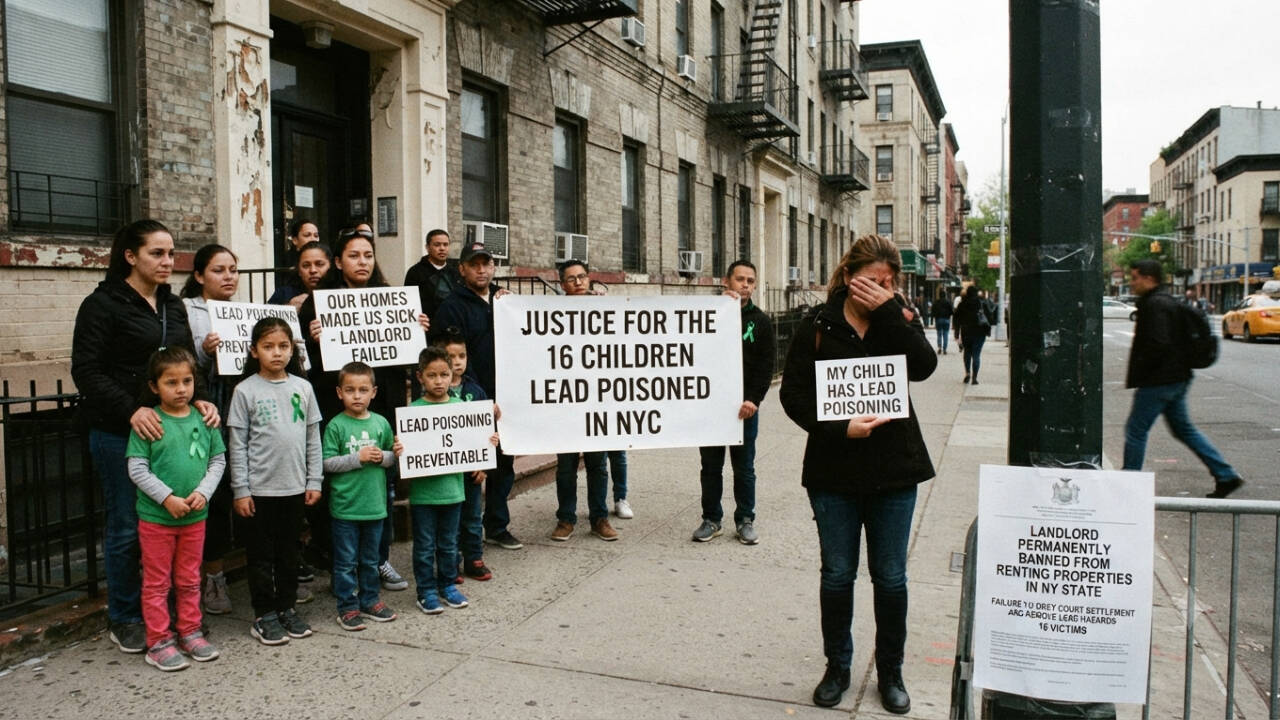
Banning a landlord after sixteen children suffer lead poisoning treats a downstream biological catastrophe as an enforcement milestone, rather than confronting the unit economics that make deferred maintenance profitable. When municipal enforcement removes a single operator only after elevated blood lead levels appear in multiple households, the regulatory system is measuring failure through pediatric neurotoxicity instead of preventing hazardous exposure before tenancy begins.
Standard news coverage of landlord bans typically follows a narrow arc: a headline highlights the number of affected children, regulators announce a ban or penalty, and the story implies that removing a bad actor closes the case. That framing misses the structural incentives governing older residential portfolios. In New York, where a large share of multi-family housing predates federal and state lead paint restrictions, compliance costs are immediate and upfront, while penalties often lag behind years of occupancy, turnover, and contested inspections.
To understand why lead hazards persist across rental stock and why post-harm bans have limited preventative reach, analysts need a structured model covering four areas: the unit economics of lead compliance, the biological and environmental mechanisms of exposure, the operational mechanics of inspection and enforcement, and the legal and structural boundaries of landlord bans.
The Cost Function of Lead Compliance
A property owner operating aging residential units faces a classic economic trade-off between upfront capital expenditure and delayed, probabilistic liability. Preventive remediation—such as window replacement, friction-surface stabilization, or certified abatement—requires immediate cash outlay and temporary vacancy or relocation friction. By contrast, deferring maintenance preserves near-term net operating income, especially in tight rental markets where demand exceeds supply across lower- and middle-income tiers.
This dynamic creates a compliance cost function shaped by four variables:
- Upfront remediation cost: The direct price of certified contractors, containment protocols, dust clearance testing, and component replacement across windows, trim, and painted surfaces.
- Vacancy and turnover drag: Lost rent during work windows, tenant relocation logistics, and potential friction when units turn over or when families with young children occupy apartments.
- Probability of detection: The likelihood that a routine inspection, tenant complaint, or public health referral triggers formal enforcement before an injury occurs.
- Expected discounted penalty: Fines, orders to abate, municipal repair charges, or civil settlements discounted by time and legal contestation.
When the expected discounted penalty is lower than the immediate cost of full remediation, rational profit-maximizing behavior under weak enforcement skews toward deferral. Even when nominal fines look substantial on paper, collection rates, administrative delays, shell entities, and prolonged litigation reduce the certainty and speed of financial consequences.
A useful operational example illustrates the gap between reactive enforcement and preventive investment. Consider a multi-unit building with aging painted window sashes. Replacing or professionally rehabilitating sashes and sills requires substantial capital per opening before a child ever crawls near the sill. Waiting until an elevated blood lead test triggers a violation shifts the cash outflow into the future, while exposing occupants during the interval. From a pure cash-flow standpoint, deferral wins unless enforcement is rapid, certain, and costly enough to outweigh delayed outlays.
Exposure Pathways and Pediatric Vulnerability
Lead exposure in older residential buildings is rarely a single dramatic event; it is typically a continuous physical process driven by friction, moisture, and hand-to-mouth behavior. Paint applied before lead limits were enacted remains in millions of homes. Over decades, layers of paint accumulate over wood and plaster. When windows open and close, painted surfaces rub together and generate fine lead-contaminated dust. Water leaks and high humidity cause paint to chalk, blister, and peel, releasing flakes and dust onto floors, sills, and toys.
Young children face heightened risk because of both behavior and physiology. Infants and toddlers spend substantial time on floors and frequently place hands and objects in their mouths, ingesting dust that settles on horizontal surfaces. Physiologically, children absorb a higher fraction of ingested lead through the gastrointestinal tract than adults do, and their developing central nervous systems are far more sensitive to neurotoxic effects.
A critical distinction separates established clinical science from case-specific attribution. Public health and medical research firmly establish that lead is a neurotoxin with no known safe blood lead level in children and that exposure can impair cognitive development, attention, and learning. What cannot be inferred from a headline alone—without clinical records, environmental sampling, and household history—is the exact timing, primary source, or relative contribution of paint dust versus water service lines or soil in each individual child's case. Treating all sixteen children as having identical exposure timelines or identical environmental sources would overstate what a summary report proves.
Why Bans Lag Behind Harm
A landlord ban sounds decisive, yet it operates at the end of a long causal chain. In most enforcement systems, public health surveillance and housing code enforcement run on separate tracks. Children are often identified only after routine or diagnostic blood lead testing flags an elevated level. A public health investigation then looks for environmental sources in the child's home or other frequented locations.
By the time multiple children in a landlord's portfolio are linked to lead hazards, several structural lags have already compounded:
- Detection lag: Children may be exposed for months or years before testing occurs or before clusters across units are recognized as a systemic portfolio pattern.
- Inspection and enforcement lag: Scheduling inspections, issuing orders to correct, verifying compliance, and escalating repeat violations take time, especially when agencies manage large backlogs.
- Portfolio and entity friction: Ownership structures can involve multiple limited liability companies, managing agents, or transfers of interest, complicating efforts to tie past violations to future operations.
- Displacement risk: Removing an operator or shutting down non-compliant units without coordinated relocation support can leave affected families facing housing instability in an already constrained market.
This creates a bottleneck in preventative protection. If enforcement relies primarily on severe sanctions after repeated pediatric poisonings, the system functions as a retrospective accountability mechanism rather than a prospective safety filter. A ban penalizes a past record, yet it does not automatically remediate the lead dust already settled on windowsills across the rest of the building stock.
Structural Limits of Bans and Enforcement
Banning a bad actor is an understandable political and regulatory response when harm is visible and concentrated. Still, no single legal or administrative tool acts as a silver bullet across a complex housing market.
First, bans face practical circumvention and transfer risks. Unless restrictions are tightly drafted and actively policed across affiliated entities, family members, or nominal managers, an operator barred from holding certain licenses or contracts may attempt to shift day-to-day control or asset ownership. Even when a ban holds firmly against the named individual, the physical building remains, and its lead hazards require capital and certified labor to resolve.
Second, aggressive enforcement without financing and compliance pathways can collide with housing affordability and habitability. Small and mid-sized landlords operating older buildings with razor-thin margins may struggle to fund comprehensive remediation all at once. If compliance costs spike sharply without access to low-cost remediation capital, grants, or clear technical standards, some owners may default, abandon maintenance further, or exit in ways that disrupt tenants. Conversely, granting endless extensions in the name of housing stability prolongs exposure for children currently living in the units.
Third, data visibility remains uneven. Tracking violations at the single-building level is far easier than mapping cross-property patterns across complex ownership networks before harm clusters. When agencies lack unified ownership and inspection intelligence, early warning signals—such as recurring peeling-paint citations or unresolved lead orders across related addresses—can remain fragmented until a public health case surfaces.
Operationalizing Prevention Before Injury
Moving from reactive bans to systematic prevention requires shifting enforcement from post-injury punishment to pre-exposure verification and continuous risk scoring. Municipal agencies, housing authorities, and public health departments can apply a four-step operational sequence to close the gap between hazard creation and intervention.
- Link ownership graphs with inspection and health data: Cross-reference property registries, business filings, code violation histories, and public health lead surveillance to flag multi-property operators with recurring unresolved hazards or clusters of elevated blood lead cases.
- Prioritize high-risk units for proactive inspection: Focus proactive inspections on pre-1978 multi-family housing—and specifically units with friction windows, deteriorating paint, or households with young children—rather than waiting solely for post-poisoning referrals.
- Enforce strict lead-safe work and clearance standards: Require certified personnel, containment, and post-work dust clearance testing whenever painted surfaces in older buildings are disturbed during repairs or turnover, treating improper dry scraping or uncontained sanding as high-severity violations.
- Pair escalating sanctions with rapid remediation execution: Use tiered penalties, receivership or municipal repair-and-lien mechanisms, and targeted remediation financing so that hazardous conditions are physically corrected on a firm timeline rather than argued over for years.
The central strategic play for policymakers and housing regulators is to decouple lead hazard elimination from post-injury enforcement by mandating verifiable lead-safe clearance before occupancy or lease renewal in high-risk older units, backed by automatic municipal remediation at the owner's expense when deadlines are missed. A ban after sixteen children are poisoned proves that the system can punish an outlier after the damage is done; pre-occupancy clearance and rapid hazard removal determine whether the next sixteen children stay safe in the first place.