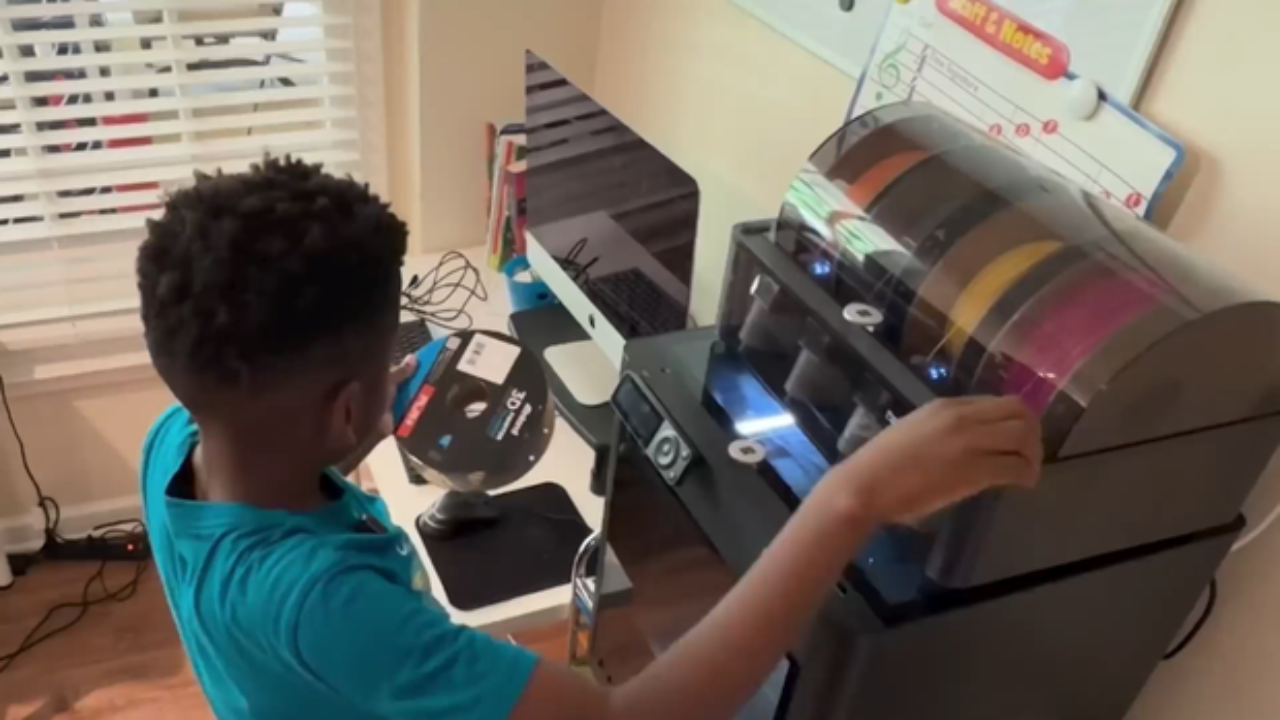
Most adults treat a 3D printer like a dusty weekend hobby. Meanwhile, two 12-year-old twins in Georgia turned their playroom into a functioning micro-factory that clears $200 a month in profit after paying off supplies and labor.
You've probably seen the feel-good headlines about Aaron and Alain Osirus and their company, A3D. Every local news segment frames it as a cute kid-entrepreneur story—a modern upgrade to the classic driveway lemonade stand. That framing completely misses the point. When you look closely at how these two run their operation, you aren't looking at kids playing store. You're looking at lean manufacturing, unit-cost accounting, and direct-to-consumer validation happening between homework assignments.
How a $600 Loan Became a Playroom Factory
It started with a simple classroom observation. Aaron looked around at his classmates, noticed nearly everyone was carrying plastic fidget toys, and asked a straightforward question: if all of these are just molded plastic, why can't I make them myself?
Instead of begging for a toy, he pitched a capital investment. Aaron borrowed $600 from his parents to purchase a multicolor 3D printer equipped with an automatic material system capable of swapping filament colors mid-print. That hardware choice matters more than people realize. Single-color prints look like cheap prototypes, whereas multi-color prints look like retail products kids actually want to trade and show off.
Once orders started piling up from classmates and neighborhood kids, Aaron didn't try to hero-ball the entire workload alone. He brought in his twin brother, Alain, and divided the company along clear operational lines.
- Production and Custom Orders: Aaron focuses heavily on running the machines and fulfilling custom requests tailored to each buyer's preferred size, design, and color palette.
- Design and Operations: Alain handles product design, marketing, print-time tracking, cost calculation, and final fulfillment.
- Lean Staffing: Before bringing on any paid help, the brothers recruited friends to volunteer when volume spiked, keeping overhead near zero while they built cash reserves.
Splitting roles like this prevents the classic solo-maker bottleneck. One twin keeps the nozzles hot while the other checks the math.
The Real Unit Economics Behind a $5 Toy
Let's talk numbers, because this is where most adult side-hustlers fail miserably.
According to CBS News Atlanta, A3D's top-tier item is a four-color articulated kitten figurine. It takes roughly 24 hours to print and sells for $5. Repeat buyers get a 50-cent discount. After accounting for filament supplies and labor, the twins pocket around $200 in net profit every month.
Wait a second. A 24-hour print for five bucks?
If you're an adult trying to pay a mortgage, $5 for a full day of machine time sounds like a terrible margin. Honestly, for a grown-up paying commercial electricity rates and valuing their own time at $40 an hour, it would be. For two 12-year-olds living at home with zero rent and a machine that works overnight while they're in math class, the math changes completely.
A standard spool of PLA filament costs around $15 to $25 for a full kilogram. A small articulated fidget or kitten uses maybe 30 to 60 grams of plastic—roughly $0.60 to $1.20 in raw material. Even after factoring in electricity and purge waste from color swaps, they're clearing roughly $3.50 to $4.00 in gross margin per big piece, and even higher margins on faster pass-through fidgets. Hit 50 to 60 sales a month across your school and neighborhood, and suddenly you're clearing $200 pure profit while paying down your startup loan.
More importantly, Alain actually tracks print duration against material cost before quoting custom orders. Most hobbyists guess their prices, undercharge for failed prints, and wonder why they're broke. Tracking machine hours at age 12 puts them ahead of half the sellers on Etsy.
Why Classroom Distribution Beats Online Ads
Think about how hard it is to acquire a customer online right now. You build a website, film TikToks, pay for clicks, and pray a stranger trusts your checkout page.
Aaron and Alain skipped the entire digital marketing funnel by owning a hyper-local, high-trust network. School hallways are basically the world's most efficient focus groups. When one kid pulls a custom four-color articulated toy out of a backpack at lunch, thirty other kids immediately ask where it came from.
That word-of-mouth loop eliminates customer acquisition cost. There are no shipping boxes, no postage fees, and no platform commissions eating 15% of every $5 sale. Handing a toy directly to a classmate at pickup or in the neighborhood turns fulfillment into a zero-cost walk down the street.
And that 50-cent loyalty discount? Pure retention psychology. Knocking 10% off a $5 repeat order costs them almost nothing in plastic, yet it gives every buyer a reason to come back next week instead of buying mass-produced junk at a big-box store.
Where Young 3D Print Businesses Usually Crash
It's easy to romanticize a playroom print farm until things break. Anyone who has spent real time around consumer 3D printers knows they aren't magic Star Trek replicators. They clog. Bed adhesion fails at 3:00 AM, leaving you with a $2 pile of plastic spaghetti.
If you're a parent thinking about backing your kid's 3D printing venture—or a young maker planning to copy the A3D blueprint—you need to watch out for four traps that kill momentum fast.
1. Ignoring Safety and Intellectual Property
Printing random files downloaded from the internet is fine for your own shelf. Selling them changes the rules. Many 3D model designers release files under Creative Commons Non-Commercial licenses, meaning selling physical prints without a commercial license violates their copyright. Smart young sellers either learn basic CAD modeling themselves—like Alain stepping into design—or pay $10 a month for commercial merchant tiers from authorized model creators.
Safety matters just as much. Small articulated parts break if dropped on concrete, creating choking hazards for younger siblings. Stick to durable PLA filaments, avoid sharp edges, and never market small prints to toddlers.
2. Letting Print Time Bottleneck Cash Flow
A 24-hour print ties up your entire factory for a single $5 bill. If you only own one printer, three custom kitten orders lock up your machine from Monday morning until Thursday afternoon.
You solve this by batching. Instead of printing one item at a time, you fill the entire build plate with ten pass-through fidgets at once. Batch printing cuts down color-change waste and raises your revenue per machine hour dramatically. Save the 24-hour showpieces for weekends when you don't need quick turnaround.
3. Forgetting Maintenance and Filament Waste
Multicolor systems are fantastic, until you see the "poop chute" pile up. Every time a single-nozzle printer switches from black to white filament, it has to purge the old color out of the nozzle. On a four-color print, waste purge can easily weigh more than the toy itself.
If you don't weigh that scrap plastic and include it in your material cost, your profit margin is an illusion. You also need a small maintenance reserve for replacement nozzles, build plates, and isopropyl alcohol to keep beds clean.
4. Over-Borrowing Before Validating Demand
Aaron borrowed $600—enough for a capable multicolor machine, not a $3,000 industrial setup. That discipline kept the break-even point realistic. Three months of steady $200 profits pays off the entire machine. Everything after that is pure upside.
How to Test This Model Yourself This Week
You don't need a massive budget or a background in engineering to replicate what works here. You just need discipline and a willingness to test real demand before spending serious money.
- Validate before buying hardware. Ask ten friends, classmates, or neighbors what kind of fidgets or desk toys they actually carry—and ask what they'd pay for a custom color version. If nobody pulls out cash or commits to an order, keep researching.
- Draft a clear family loan agreement. If parents are fronting the $300 to $600 for an entry-level multicolor printer, put the repayment schedule in writing. Dedicate 50% of every dollar earned straight to paying back the loan until the balance hits zero.
- Track every gram and every minute. Use free slicer software like Bambu Studio or OrcaSlicer to see exact filament weight and print duration before you hit start. Multiply material cost by at least three to set your minimum price.
- Build a repeat-buyer hook. Offer a small discount on a second order or let repeat customers pick rare specialty filaments like glow-in-the-dark or silk dual-color spools.
Aaron and Alain Osirus didn't succeed because they bought a fancy gadget. They succeeded because they spotted an obvious gap in their own school, split the workload based on their strengths, and treated $5 plastic toys with the same financial discipline most adults reserve for real companies. Start with one machine, know your exact material costs, and let your first ten customers sell the next fifty.