The weight of steel changes when it is forged into a weapon. On an assembly line, it is just cold metallurgy, a calculated alignment of pins, springs, and barrels. But when those pieces are packed into crates, slipped into the false panels of transport trucks, and ferried across borders into quiet suburban neighborhoods, that steel absorbs a different kind of gravity. It becomes a shadow.
For months, that shadow hung over the Halton region, a sprawling stretch of Ontario where families move specifically to escape the anxieties of the urban core. People buy homes here for the top-rated schools, the manicured parks, and the unspoken promise that the chaos of the world stops at the municipal line. They do not expect the baseline of their quiet nights to be shattered by the revelation of an underworld operating right beneath their feet.
Then came the morning the tables were filled.
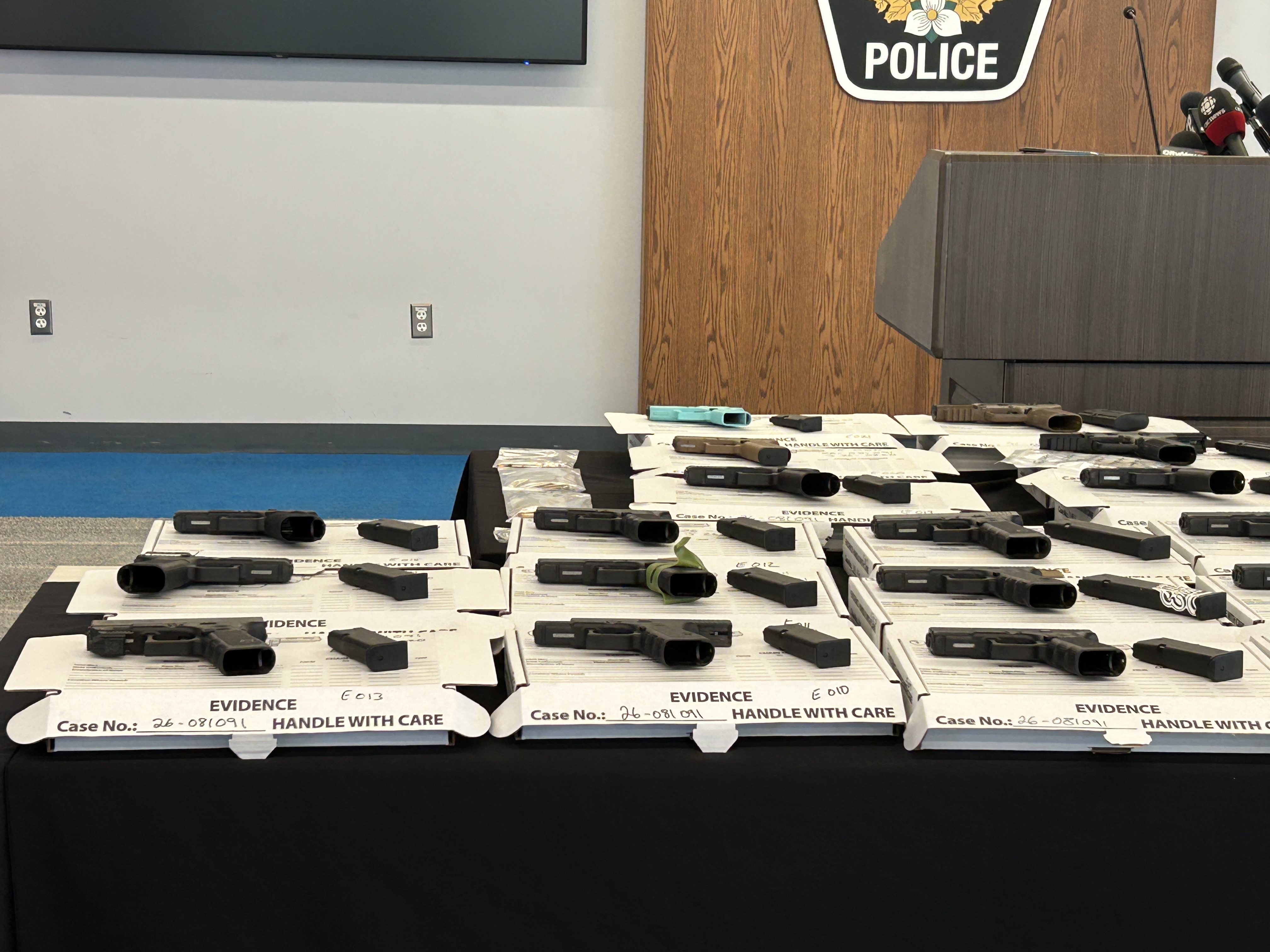
When investigators from the Halton Regional Police Service finally laid out the haul from Project Kingfisher, the sheer volume transformed a routine press room into something resembling a military depot. Row after row of black polymer frames, polished metal slides, and high-capacity magazines stretched across the room. It was the largest firearm seizure in the region’s history. A historic bust. But numbers on a police ledger—even historic ones—fail to capture the true anatomy of a crisis. To understand what happened, you have to look past the inventory lists and look at the spaces those weapons were meant to fill.
Imagine a living room in a quiet Oakville cul-de-sac. Hypothetically, let us call the resident Sarah, a mother who moves through her morning routine with the rhythmic certainty of someone who believes her environment is entirely safe. She pours coffee, listens to the school bus brakes squeak down the street, and checks her phone. She sees the headline. She looks out the window at the peaceful, tree-lined street, suddenly forced to reconcile the idyllic view with the knowledge that thousands of lethal mechanisms were circulating through her broader community, waiting to be distributed. The contrast is a psychological jolt. It dismantles the illusion of distance.
The sheer logistics of the seizure tell a terrifying story of modern supply chains. This was not a collection of rusted hunting rifles or crimes of passion waiting to happen. This was an industrial-scale operation.
Police recovered hundreds of restricted and prohibited firearms, alongside thousands of rounds of ammunition and specialized modification components. Consider the anatomy of a modern illegal firearm market. Many of these weapons begin their lives legally in manufacturing plants across the United States. They are purchased through straw buyers—individuals with clean records who buy weapons legally only to hand them over to trafficking networks. From there, they travel north, hidden in commercial cargo or smuggled through porous border crossings, completely invisible to the thousands of commuters passing by them every day.
The most chilling revelation of the bust lay in the boxes of small, unassuming metal switches. To an untrained eye, these pieces of metal look like harmless machinery scrap. In reality, they are conversion kits designed to turn semi-automatic handguns into fully automatic machine pistols. They modify a weapon so that a single pull of the trigger unleashes a torrent of lead in milliseconds. These are not weapons of self-defense. They are weapons of terror, engineered for maximum devastation in crowded urban spaces where accuracy matters less than the sheer volume of violence inflicted.
The detectives who worked Project Kingfisher spent months pulling at loose threads. It started with a single anomaly, a localized blip in criminal intelligence that didn't quite make sense. In policing, as in medicine, a minor symptom often hides a systemic infection. Investigators followed the digital breadcrumbs, tracing encrypted communications, tracking suspicious vehicles, and mapping out the financial networks that fund these acquisitions.
Illegal guns are expensive. They require capital. The money that buys these weapons is almost always tied to the illicit drug trade, creating a self-sustaining ecosystem of harm. Fentanyl, cocaine, and methamphetamine flow down into the streets; cash flows up; weapons flow back down to protect the turf where the drugs are sold. It is a closed loop of human misery. Every single gun laid out on those police tables represented a transaction paid for in the currency of community destabilization.
The public often asks how this happens in a country with strict firearm regulations. The answer lies in the borderless nature of modern criminal enterprise. While law-abiding citizens navigate rigorous background checks, waiting periods, and storage laws, trafficking networks operate entirely outside the framework of national sovereignty. They exploit the sheer volume of global trade, betting that border security cannot check every single box truck or shipping container without paralyzing the economy.
But the real problem lies elsewhere. It rests in the demand. As long as there is an underground economy generating millions of dollars in untaxed profit, there will be a demand for the ultimate tool of enforcement. Guns are the currency of fear. In the criminal underworld, the person with the most firepower dictates the terms of survival.
When the operation finally culminated in a series of coordinated tactical raids, the tension in the briefing rooms was palpable. Officers knew exactly what they were walking into. Executing a search warrant on a suspected weapons cache is an exercise in managed adrenaline. Every door breached carries the potential for a catastrophic firefight. The fact that Project Kingfisher concluded with the recovery of these weapons without a major loss of life is a testament to tactical precision, but the relief is tempered by a sobering reality.
This bust, as massive as it was, represents a snapshot of a single pipeline. It is a finger in a leaking dam.
The aftermath of the announcement left the Halton community in a state of quiet reflection. The initial shock of the headlines gave way to deeper, more uncomfortable questions about safety, geography, and the invisible networks that connect suburban tranquility to global crime syndicates.
The true victory of Project Kingfisher is not found in the statistics or the accolades showered upon the investigative teams. It is found in the quiet nights that were allowed to remain quiet. It is found in the accidental discharge that never happened in an apartment complex, the drive-by shooting that was averted because the trunk of a specific car was emptied by police instead of a street gang, and the domestic dispute that didn’t escalate into a homicide because the weapon wasn't available in the drawer.
We measure the success of law enforcement by what we can see: the arrests, the seized contraband, the rows of steel on display. But the true metric of safety is entirely invisible. It is the absence of tragedy. It is the peaceful evening routine of a family completely unaware of how close the shadow came to their doorstep, protected by a thin line of individuals who spent months tracking the silence before the storm.
The tables in the press room have since been cleared. The firearms have been cataloged, locked away, and marked for eventual destruction in a blast furnace, melted back down into anonymous, harmless industrial slag. The heavy silence of those one thousand triggers has been neutralized, leaving behind a community that breathes a little easier, even as it looks at the quiet streets with a newly awakened vigilance.