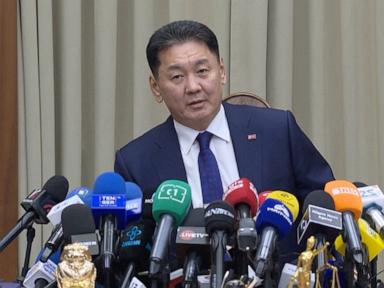
Mongolia’s parliament officially accepted the resignation of its president following intense public outrage over systemic corruption, illicit coal exports, and allegations of state capture. The departure marks an unprecedented constitutional crisis in Ulaanbaatar, stripping the nation's highest office of its leader amid street protests and parliamentary infighting. While surface-level reports frame this exit as a sudden victory for public accountability, the reality inside the State Great Khural reveals something far more entrenched. The resignation is not an isolated purge of bad actors; it is the predictable combustion of a political system completely dependent on resource extraction, patronage networks, and opaque cross-border trade.
To understand how a head of state gets forced out of office in one of Asia's few landlocked democracies, you have to look beneath the snow-covered streets of the capital and straight into the coal mines of the South Gobi. For over two decades, Mongolia has promised its citizens that vast deposits of copper, gold, and coking coal would transform their nomadic economy into a modern powerhouse. Instead, that mineral wealth created a parallel political economy.
The Anatomy of a Political Collapse
Political resignations in Ulaanbaatar rarely happen because of a sudden crisis of conscience. They happen when the internal balance of power among competing political factions fractures beyond repair.
In the weeks leading up to the parliamentary vote, pressure mounted from two distinct directions. Outside the government palace, thousands of citizens—primarily young, urban, and exhausted by double-digit inflation—gathered in sub-zero temperatures demanding transparency over missing state revenues. Inside the chamber, lawmakers from rival factions within the ruling party and the opposition recognized a rare opportunity. By aligning with the street protesters, parliamentarians could neutralize a powerful executive branch while insulating themselves from the same public anger.
The constitutional mechanism in Mongolia gives the State Great Khural decisive authority over the presidency, particularly following constitutional amendments passed in recent years that curtailed executive overreach. When the president submitted the resignation letter, the legislative vote to accept it was swift. Lawmakers knew that delaying the decision risked turning a targeted anti-corruption protest into a broader systemic revolt against the entire political class.
The Triggers Behind the Outcry
The immediate catalyst involved leaked documents and whistleblowers pointing to massive discrepancies between the volume of coal exported across the southern border and the revenue officially recorded by state-owned enterprises. When billions of dollars in raw commodities vanish into thin air while ordinary families struggle to afford basic heating and imported groceries, the social contract dissolves.
Accusations quickly climbed the chain of command. Critics alleged that senior officials, including figures closely tied to the presidential office, had shielded shell companies, manipulated off-take agreements, and used state institutions to block independent audits. Whether every allegation against the departing president holds up in a court of law almost became secondary to the political reality on the ground. In Ulaanbaatar, perception hardened into consensus, and consensus forced an exit.
Follow the Coal Money
You cannot analyze Mongolian politics without examining Erdenes Tavan Tolgoi, the state-owned mining giant sitting atop one of the world's largest untapped coking coal deposits. Over the years, this single enterprise has functioned less like a traditional corporation and more like an off-budget slush fund for whoever holds power in the capital.
Whenever an election approaches or a political crisis looms, state mining revenues are routinely tapped to fund populist cash handouts, infrastructure promises, or quiet settlements between rival oligarchs. The mechanism for siphoning wealth out of this sector is brutally simple, even if the paper trail is intentionally obscured.
- Off-take contracts are signed in secret, locking in below-market prices for years at a time under the guise of securing upfront financing for rail and road projects.
- Middleman logistics firms owned by politically exposed persons capture the margin between the mine gate price and the actual delivery price at the Chinese border.
- Customs discrepancies allow millions of tons of coal to cross the border without matching export declarations, depriving the national treasury of royalties and corporate taxes.
Consider a hypothetical example to illustrate how this operates in practice. Imagine a state mine sells coal at fifty dollars a ton to a shell company registered in an offshore jurisdiction. That shell company never touches a shovel or drives a truck; it simply resells the exact same shipment ten minutes later to a foreign steel mill for one hundred and fifty dollars a ton. The hundred-dollar spread stays offshore, split among the brokers and their political protectors, while the public absorbs the environmental damage and infrastructure debt.
This is not an aberration. It is the core business model that has distorted Mongolia's democratic institutions since the mining boom began in the late 2000s.
The Geopolitical Tightrope
Every domestic crisis in Mongolia carries immediate geopolitical weight. Sandwiched between Russia and China, Ulaanbaatar operates in one of the most constrained neighborhoods on earth.
China buys roughly ninety percent of Mongolia's exports, predominantly coal and copper. Russia supplies the overwhelming majority of Mongolia's refined fuel and a critical portion of its electrical grid. When the Mongolian presidency collapses under the weight of a corruption scandal, both Moscow and Beijing watch closely, though for entirely different reasons.
Beijing prioritizes border stability and uninterrupted commodity flows. Prolonged protests in Ulaanbaatar or a paralyzed parliament threaten the rail corridors and border crossings that feed northern China's industrial base. Any new leadership in Mongolia must immediately reassure Chinese buyers that existing supply contracts will be honored, even as domestic protesters demand that those very contracts be torn up and renegotiated.
Moscow, meanwhile, views democratic turbulence on its southern border with deep suspicion. Russian state media routinely frames popular protests in neighboring countries as foreign-backed instability. At the same time, Russian energy leverage gives the Kremlin quiet influence over Ulaanbaatar's domestic calculations, particularly during harsh winters when fuel shortages can bring the Mongolian capital to a standstill within days.
The Third Neighbor Dilemma
To counterbalance its two massive neighbors, Mongolia has spent decades cultivating its Third Neighbor policy, building diplomatic and economic ties with the United States, Japan, South Korea, and the European Union. Western democracies have long pointed to Mongolia as a rare success story—a peaceful, functioning democracy thriving in the heart of Eurasia.
The presidential resignation severely tests that narrative. Foreign investors looking at Mongolia's critical minerals—including rare earth elements essential for global green energy transitions—are acutely sensitive to political volatility and weak rule of law. When a president steps down amid graft accusations, international capital retreats to the sidelines.
Why Anti-Corruption Campaigns Keep Failing
If this resignation feels familiar to seasoned observers of Central and East Asian politics, there is a good reason. Mongolia has cycled through high-profile anti-corruption purges before. Prime ministers have been ousted, cabinet ministers have been jailed, and state agencies have been restructured with great fanfare.
Yet the underlying corruption persists. Why?
The answer lies in the concentration of economic power within the state. In an economy where the private sector remains small and heavily dependent on government permits, state-owned enterprises control the lion's share of capital. Entering politics is not merely a path to public service; it is the primary avenue to wealth accumulation and asset protection.
When anti-corruption drives are launched in Ulaanbaatar, they are almost always weaponized by one political faction to weaken another. Instead of strengthening independent courts, empowering investigative journalists, or opening state contracts to public scrutiny, incumbents use the anti-corruption agency to selectively prosecute their rivals. Once the rival is removed from the board, the victorious faction simply takes over the exact same patronage networks.
The Flawed Architecture of Oversight
Institutional checks and balances exist on paper, but they routinely buckle under political pressure.
- The Judiciary remains vulnerable to executive and legislative influence, with appointment processes that reward political loyalty over legal independence.
- The Independent Authority Against Corruption possesses broad investigative powers, yet its leadership changes frequently alongside shifting parliamentary coalitions, leading to selective enforcement.
- Media Ownership is heavily concentrated in the hands of business conglomerates and politicians, making sustained, independent investigative reporting financially perilous for local journalists.
Without structural reforms that strip politicians of direct control over state-owned mining assets, replacing a president changes the face at the top without altering the incentives at the bottom.
The Myth of the Clean Slate
Public reaction to the resignation has been a mix of cautious relief and deep cynicism. Among the protesters who braved freezing temperatures to demand accountability, there is a clear understanding that forcing one leader out is only the opening move.
Many citizens recall previous waves of reform that promised a clean break from the past, only to see the same political dynasties return to power under new party banners a few election cycles later. Young Mongolians, in particular, are voting with their feet. Brain drain has accelerated sharply, with tens of thousands of educated workers leaving for South Korea, Australia, the United States, and Europe, convinced that domestic opportunities remain locked behind walls of nepotism and bribery.
Lawmakers who voted to accept the presidential resignation now face an immediate credibility test. They can treat this moment as a convenient pressure valve, offering up a single high-profile casualty to quiet the streets while quietly preserving the closed-door contracting system. Or they can use the crisis to force genuine transparency onto the extractive sector.
What Real Reform Would Actually Require
If Mongolia's parliament intends to prove that this resignation represents more than political theater, the legislative agenda over the coming months will tell the whole story. Empty pledges and newly formed parliamentary commissions will not suffice.
Real structural change demands concrete, verifiable actions that remove discretion from politicians and place sunlight on every ton of ore leaving the country.
- Full contract disclosure: Every off-take agreement, transport contract, and joint venture involving state-owned mining companies must be published online in unredacted form, detailing beneficial ownership down to the individual shareholder.
- Commodity exchange mandates: All state coal and mineral exports must be sold transparently through an open, auditable commodity exchange at market prices, eliminating private bilateral deals at the border.
- Independent sovereign wealth management: Resource revenues must be ring-fenced inside a professionally managed sovereign wealth fund governed by strict statutory rules, preventing lawmakers from raiding the treasury to fund pre-election spending sprees.
- Judicial tenure protection: Judges and prosecutors must be granted genuine security of tenure and independent budgetary control so they can investigate sitting officials without fear of immediate dismissal.
None of these measures require inventing new legal concepts. They are standard governance practices in resource-rich democracies that have successfully avoided the worst effects of the resource curse. The obstacle in Ulaanbaatar has never been a lack of technical knowledge; it has always been a lack of political will among those who profit from the status quo.
The Cost of Business as Usual
Mongolia stands at a genuine crossroads, though the political class has used that phrase so often it has lost its urgency. The country possesses immense natural wealth, a young and literate population, and a democratic tradition that sets it apart from its authoritarian neighbors.
Yet democracy cannot survive indefinitely on symbolism alone when its economic foundation is hollowed out by systemic theft. Every dollar siphoned from state mines is a dollar stolen from underfunded schools, overburdened hospitals, and the power grid upgrades desperately needed to choke off the toxic winter smog blanketing Ulaanbaatar.
Accepting a president's resignation clears an immediate constitutional hurdle, but it does not put a single tugrik back into the public treasury or restore faith in the rule of law. Until the lawmakers who cast their votes today dismantle the off-budget pipelines that enriched their predecessors, the next political explosion in Ulaanbaatar is merely waiting for its spark.