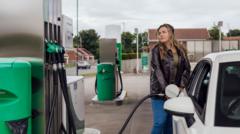
The alarm rings at 4:15 AM. It is a cold, uncompromising sound. For Sarah, a self-employed courier delivering medical supplies across the rain-slicked ribbon of the M6, this is where the day begins. Before the first sip of lukewarm coffee, before the headlights of her transit van cut through the pre-dawn mist, there is a mental calculation. It happens every single morning. She clocks the digital glow of the petrol station sign down the road.
Drivers across the country perform this exact ritual daily. It is a quiet, stressful piece of mental arithmetic that dictates whether a small business stays afloat, whether a family can afford the good groceries, or whether a weekend trip to see aging parents gets pushed back another month. For another view, read: this related article.
When petrol and diesel prices creep upward, it feels like a slow leak in a household budget. Every penny added to the price of a litre is a tiny, invisible tax on human connection and economic survival.
That is why the sudden, late-night announcement from the Treasury felt less like a standard policy update and more like a collective intake of breath. Similar coverage on this matter has been shared by NBC News.
The government extended the freeze on fuel duty until the end of the year.
To a casual observer scrolling through a financial news feed, the phrase "fuel duty freeze extended" sounds dry. It reads like bureaucratic jargon, a minor line item in a sprawling national budget. But macroeconomics is never truly about numbers on a spreadsheet. It is about the friction of daily life. By maintaining the 5p per litre cut and halting the planned inflation-linked rise, the policy injects a fragile sense of predictability into an unpredictable world.
The Anatomy of a Fuel Pump
To understand why this matters, we have to look at what actually happens when you squeeze the trigger at a filling station.
Most motorists assume they are paying purely for the crude oil, the refining process, and a healthy profit margin for the oil giants. The reality is far more clinical. A massive chunk of what you pay goes straight to the exchequer. Fuel duty is a flat tax levied on every litre of petrol, diesel, biodiesel, and bioethanol sold.
On top of that flat tax, the government tacks on standard Value Added Tax (VAT). It is a tax on a tax.
When the cost of crude oil spikes due to geopolitical tension halfway across the world, the pump price skyrockets. If the fuel duty rate were to rise simultaneously, the compounding effect would be catastrophic for the average household.
Consider a hypothetical but highly representative scenario: a small regional plumbing firm operating five diesel vans. If fuel duty had risen by the predicted inflationary markers alongside the expiration of the previous 5p cut, that minor shift would scale up to thousands of pounds in extra overheads by winter. The business owner faces two choices. Absorb the hit and cancel plans to hire a local apprentice, or pass the cost onto homeowners who are already struggling with rising energy bills.
The freeze prevents that domino effect from toppling the first brick.
The Tug of War in Downing Street
Every fiscal decision is a compromise. This particular extension represents a fierce, invisible debate happening behind the closed doors of Whitehall.
On one side of the ledger, the Treasury loses billions in potential revenue by keeping the freeze active. That is money that could, theoretically, be funneled directly into ailing public services, road repairs, or green energy initiatives. Critics of the extension argue that freezing fuel duty flies in the face of net-zero targets. They suggest that keeping fossil fuels artificially cheaper prolongs our collective dependence on carbon, delaying the inevitable transition to electric vehicles.
It is a valid dilemma. How do you fund the future when the present is so expensive?
But the counter-argument is rooted in immediate human survival. The transition to a green economy cannot be built on the backs of people who currently have no alternative. An electric van requires upfront capital that a struggling independent trader simply does not possess. A rural worker living in an area completely abandoned by public transport networks cannot commute to work on a hypothetical future train line.
For millions, driving is not a luxury or a lifestyle choice. It is the infrastructure of their livelihood.
The decision to extend the freeze suggests a pragmatic realization within government. Throttling the immediate cash flow of working families in the name of long-term environmental policy creates economic stagnation today.
The Ripple Effect Across the High Street
The impact of this policy extends far beyond the tarmac of our motorways. It winds its way into the supply chains of everything we consume.
Almost every physical object you own—the phone in your hand, the loaf of bread on your kitchen counter, the shoes on your feet—spent time on the back of a heavy goods vehicle. Logistics companies operate on razor-thin margins. When diesel costs rise, the shipping rates for supermarkets and retailers rise instantly.
A freeze on fuel duty acts as a stabilizer for the entire supply chain. It prevents another sudden spike in food inflation, offering a rare moment of equilibrium for supermarkets trying to keep prices steady on essential goods.
When you look at it through this lens, the policy stops being about cars. It becomes about the price of a basket of groceries.
The Long Road Ahead
Nothing lasts forever, and this freeze is explicitly temporary. It buys time, but it does not solve the structural vulnerability of our transport network. By the end of the year, the same debate will resurface. The Treasury will look at the deficit, environmental groups will point to emission targets, and motorists will watch the digital displays at the pumps with the same anxious scrutiny.
For now, the extension offers a brief reprieve. It is a acknowledging nod from policymakers that the squeeze on ordinary people has a breaking point.
As the sun finally breaks through the clouds over the M6, Sarah pulls her van into a delivery bay. The journey was smooth, the tank is full enough for tomorrow, and the overheads remain, for the moment, manageable. The grand macroeconomic debates will continue to rage in television studios and parliament buildings, but down here on the asphalt, success is measured in miles gained and promises kept.
The price of moving forward is still high, but tonight, it is just a little bit easier to bear.