The alarm clears the silence at two in the morning. It is a cold, sharp sound that doesn't care about comfort. In the zoo's nocturnal habitat, the world is inverted, but in the staff breakroom, it is just late, dark, and exhausting. You wipe the sleep from your eyes, pull on a heavy fleece, and prepare a bottle of specialized warm milk.
Most people associate zoo conservation with majestic tigers or sweeping savannahs. They think of grand gestures. They do not think of a concrete room, a plastic bowl of warm water, and an creature that looks like an improbable collage of leftover animal parts.
An aardvark calf is not conventionally beautiful.
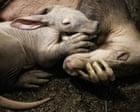
When they are born, they look like wrinkles wrapped in pink, translucent skin. They have oversized ears that fold over their eyes like wilted cabbage leaves, a snout that resembles a rubber plug, and heavy, dinosaur-like claws designed for tearing through rock-hard termite mounds. To the uninitiated, they look alien. To the conservationists at Chester Zoo, the wrinkled, hairless arrival represents an extraordinary triumph over steep biological odds.
But birth is only the first hurdle. The real challenge begins when the mother sits down.
The Heavy Peril of a Clumsy Mother
In the wild, aardvark burrows are tight, dark, and dangerous. Female aardvarks are famously heavy, often weighing up to sixty-five kilograms. They are also notoriously clumsy parents. In the darkness of a subterranean den, it is tragically common for a mother to accidentally roll over and crush her newborn calf. The skin of a newborn aardvark is so thin you can almost see its tiny heart beating beneath the surface. One wrong move from a heavy parent means disaster.
To combat this, the husbandry team at Chester Zoo developed a grueling, around-the-clock intervention strategy. It is a delicate dance of shifting boundaries.
Every evening, keepers gently remove the newborn calf from the maternal enclosure. The mother, focused on her nocturnal foraging and digging routines, is blissfully unaware of the temporary separation. The calf is placed in a specialized incubator, a warm microclimate that mimics the humid depths of a perfect burrow.
Then, the clock starts ticking.
A newborn cannot feed itself. It relies entirely on a precise schedule of bottle-feeding every few hours, using a milk formula specifically engineered to replicate the high-fat, nutrient-dense profile of maternal aardvark milk.
Consider the mechanics of feeding an animal with a mouth designed exclusively for vacuuming up ants. Aardvarks do not have traditional teeth; they have column-like structures that lack enamel. Their jaws are long and narrow. Getting a calf to accept a rubber teat requires patience that cannot be taught in a textbook. It requires an understanding of the subtle pressure of a thumb against a tiny jaw, the exact temperature that triggers a suckling reflex, and the restraint to stop before the calf breathes liquid into its fragile lungs.
The Invisible Stakes of a Bizarre Dynasty
Why expend this level of energy on a creature that spends its life hiding from the sun?
The answer lies in the delicate architecture of the African ecosystem. Aardvarks are not merely eccentric oddities; they are ecological engineers. The massive burrows they excavate with their powerful, spoon-shaped claws provide vital shelter for dozens of other species. Warthogs, hyenas, jackals, owls, and reptiles all rely on abandoned aardvark holes to survive the harsh African elements and escape predators. If the aardvark disappears, the housing market of the savannah collapses.
Yet, tracking them in the wild is a scientist's nightmare. They are solitary, strictly nocturnal, and spend their lives underground or moving through the shadows.
Every calf born in a controlled conservation environment offers an unprecedented window into a world that remains largely hidden from science. We learn about their growth rates, their vocalizations, and their developmental milestones. We gather data that can be used to protect their wild counterparts as human development encroaches further into their native habitats.
The calf at Chester Zoo, born after a seven-month gestation period, quickly became the center of this quiet, high-stakes universe. The keepers named him Dobby, a nod to the beloved fictional house-elf he so strikingly resembled with his oversized ears and hairless, prominent features.
Shifting Back to Nature
The goal of hand-rearing is never to create a pet. Domesticating the wild is a failure of conservation. The true art of the process lies in knowing when to step back.
While the keepers provided the nutritional lifeline during the perilous night hours, daytime belonged to the family. Every morning, as the sun rose and the adult aardvarks prepared to sleep, keepers returned the calf to his mother, Oni.
Oni proved to be an attentive parent under supervision. As she settled into the deep straw of her artificial burrow, the calf would snuggle against her side, drawing warmth from her large body and bonding through scent and touch. The keepers watched via low-light cameras, ready to intervene if Oni shifted her weight too aggressively, but trusting the natural instincts that have kept this species alive for millions of years.
Progress in the animal kingdom is measured in grams.
Every evening before the first bottle feed, the calf was placed on a digital scale. In the beginning, the numbers moved up in tiny, nerve-wracking increments. A few grams gained felt like a celebration; a plateau meant a sleepless night of worrying about hidden infections or digestive issues.
But week by week, the wrinkles began to fill out. The translucent pink skin deepened into a tougher, greyish hue. The large, floppy ears began to stand erect, swiveling like radar dishes toward every unfamiliar sound in the nursery. The claws, initially soft and pliable at birth, hardened into formidable digging tools.
The calf was doing brilliantly. The grueling routine of two-am alarms, meticulous formula preparation, and anxious observation began to pay off. The fragile alien was transforming into an aardvark.
The Solitary Path Ahead
Eventually, the nocturnal bottle feedings ceased. The calf transitioned fully to a diet reflecting his adult needs, moving away from the nursery and into the main habitat. The intense, intimate bond between keeper and calf naturally dissolved as the animal's wild instincts took over.
There are no public awards for the keepers who spent months living on broken sleep to ensure a hairless calf survived the night. The reward is found in the quiet observation of a healthy animal doing exactly what it was evolved to do.
On a quiet evening, visitors to the zoo might catch a glimpse of a young aardvark testing the air with his long, sensitive snout. He will catch the scent of insects, or perhaps the familiar musk of his mother. He will dig his heavy claws into the dirt, testing his strength against the earth, entirely unaware of the human hands that guided him through the fragile dawn of his existence.