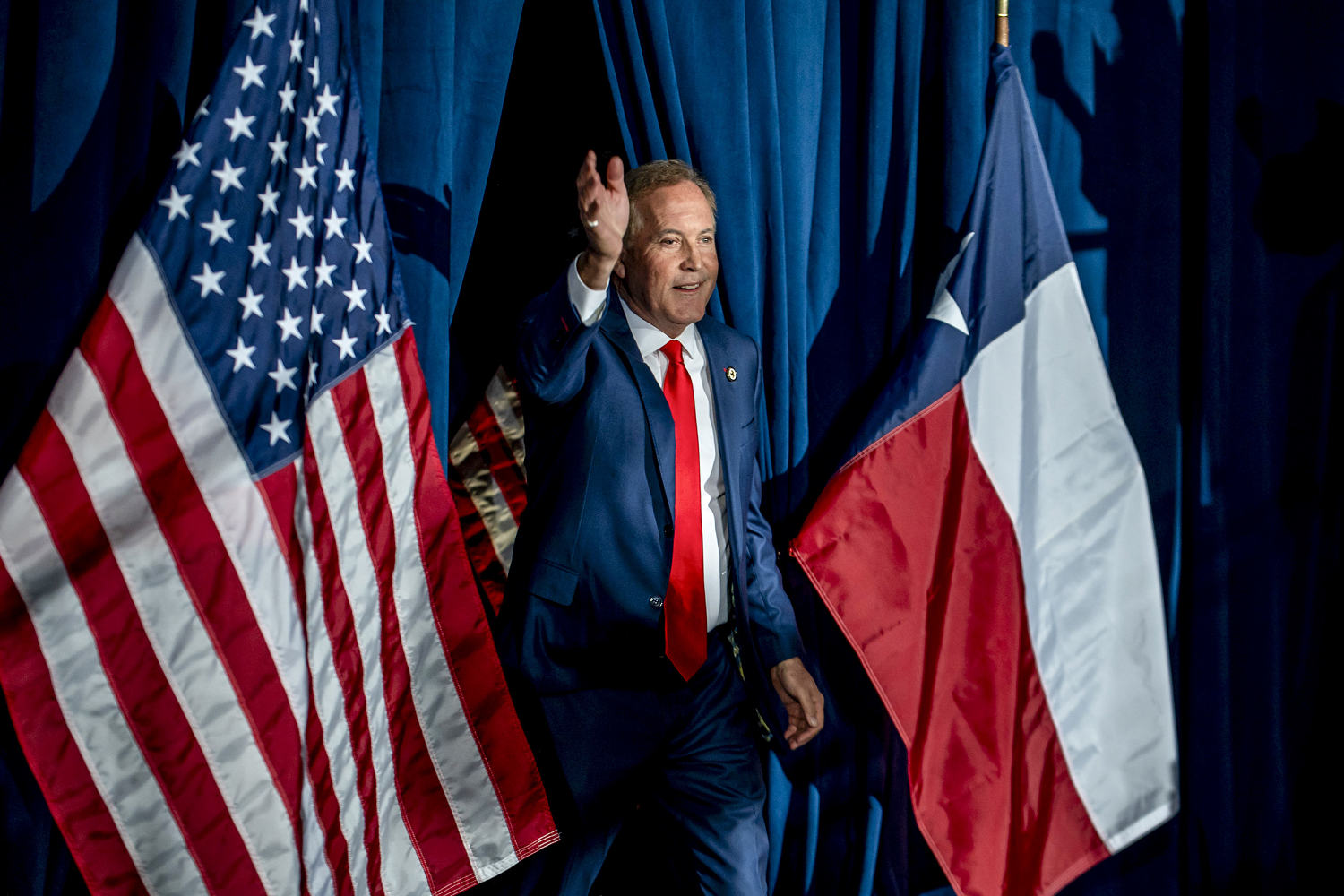
Donald Trump has officially broken the unspoken rule of establishment Republican preservation. By endorsing Texas Attorney General Ken Paxton in the state's Republican primary runoff, Trump has chosen to actively decapitate a four-term incumbent senator, John Cornyn. This is not just a standard mid-term endorsement. It is a calculated, transactional strike meant to fundamentally rewrite the power dynamics of the U.S. Senate. While national Republicans view the move as a dangerous gamble that could hand a reliably red seat to rising Democratic star James Talarico, Trump is playing a different game. He is demanding absolute, retroactive loyalty, and using Texas as the ultimate testing ground for total party dominance.
The endorsement landed on Tuesday like a political mortar shell. For over a year, both camps engaged in furious behind-the-scenes lobbying. Just twenty-four hours prior, Cornyn told reporters he believed "that ship has finally sailed," assuming Trump would stay neutral to avoid fracturing the state party. He was wrong. Trump took to social media to crown Paxton a "true MAGA Warrior," while simultaneously delivering a public shaming of Cornyn. The senator, Trump noted, was "not supportive of me when times were tough" and was "very late" in backing his presidential ambitions.
The Currency of Total Loyalty
To understand why Trump is risking a Senate seat in a state that has been the anchor of the Republican electoral college map, you have to look at the scoreboard of personal grievances. Cornyn represents the old guard. He is an institutionalist who served as regional elite leadership, routinely voting for conservative judges and legislative packages, but occasionally veering off script.
In 2023, Cornyn committed the ultimate sin in the modern GOP. He publicly doubted Trump's general election viability, stating that Trump's time "has passed him by" and noting that winning requires appealing to voters beyond the hard core base. Trump does not forget. More importantly, he does not forgive.
Paxton, conversely, has built his entire brand on being Trump’s ultimate legal shield. When Trump attempted to overturn the 2020 election results, it was Paxton who filed a long-shot lawsuit at the Supreme Court to throw out votes in four battleground states. When Paxton faced his own political ruin—including a bruising 2023 state impeachment trial over corruption charges and a decade-long securities fraud case—he framed his survival as a victory against the same "deep state" forces targeting Trump.
By backing Paxton, Trump is sending a message to every Republican in Washington. Institutional compliance is no longer enough. The only currency that buys survival is public, unyielding fealty.
The Math of a Low Turnout Runoff
The timing of the endorsement is weaponized for maximum impact. The March 3 primary left Cornyn holding a microscopic lead of 42% to Paxton’s 40.5%. Because neither crossed the 50% threshold, the race was pushed to a May 26 runoff.
Runoff elections in Texas are notorious for abysmal voter turnout. The electorate narrows significantly. The moderate, casual voters who show up in November stay home. The people who cast ballots the day after Memorial Day are the highly motivated, hyper-partisan base. This is Paxton’s home turf.
National Republicans are privately panicking over the numbers. Cornyn’s campaign and allied groups have spent a staggering $57 million to defend the seat, compared to Paxton's lean $4.5 million operation. Yet, despite being outspent nearly 13-to-1, Paxton led Cornyn by three percentage points in a University of Houston poll released earlier this month. Trump's endorsement acts as a massive accelerant on this fire, likely cementing the late-deciding activist vote for the attorney general. Shortly after the announcement, third-place primary finisher Representative Wesley Hunt immediately threw his weight behind Paxton, signaling a rapid consolidation of the populist right.
The General Election Nightmare
While Trump plans his victory lap, the broader Republican apparatus is looking at November with profound dread. Texas is shifting. It is no longer the bulletproof red fortress it was two decades ago. Ted Cruz won reelection in 2024 by eight points, a comfortable margin, but one that showed clear vulnerabilities in the fast-growing suburban metros.
Cornyn’s allies have circulated an alarming internal memo detailing the down-ballot carnage a Paxton nomination could cause. The analysis highlights nine congressional districts and twenty-five Texas House seats—all recently redrawn to favor Republicans—that could swing into competitive territory if Paxton tops the ticket.
The liability is Paxton’s immense personal baggage. The general public views him far differently than the primary base. He carries a decade of headlines involving FBI investigations, whistleblowers, and allegations of corruption.
Democratic nominee James Talarico is uniquely positioned to exploit these vulnerabilities. The Austin Democrat has raised an impressive $27 million and has routinely polled ahead of both Republicans in hypothetical matchups. Talarico’s campaign instantly capitalized on the endorsement, framing the race as a fight against "billionaire mega-donors and their corrupt political system."
The data backs up the Democratic optimism. A spokesperson for the Senate Majority Project noted that polling shows one-in-four voters who back Cornyn in the primary would defect to Talarico in November if Paxton wins the runoff. For a party trying to maintain a razor-thin Senate majority, risking a Texas seat to settle a personal grudge is an extraordinary gamble.
The Legislative Ransom
There is a policy mechanism driving this endorsement that goes beyond pure emotion. Paxton has spent the runoff period dangling a legislative carrot in front of the president. He publicly offered an ultimatum: he would consider dropping out of the primary fight if the Senate passed the SAVE America Act, a strict voting regulation bill heavily favored by the America First movement.
Cornyn, sensing the trap, abruptly dropped his long-standing institutional defense of the Senate filibuster in mid-March, announcing he would support scrapping the 60-vote threshold specifically to pass that elections bill. It was a desperate attempt to neutralize Paxton’s policy edge.
It failed. Trump’s endorsement statement explicitly praised Paxton for being a strong supporter of terminating the filibuster to pass the SAVE America Act. By choosing Paxton, Trump has signaled that he wants a Senate populated by wrecking balls rather than negotiators. He wants leaders who will dismantle traditional upper-chamber rules the moment they become inconvenient.
John Cornyn will remain in the Senate for the rest of the year regardless of next week's outcome. He will still vote to confirm conservative judges and fund federal projects. But his status as a kingmaker in Texas politics is effectively over, erased by a single social media post from Florida. Trump has demonstrated that decades of service to the party infrastructure mean nothing if you stumble on the loyalty test. The Texas runoff is no longer a local primary. It is a referendum on whether the populist right would rather control a pure party, or a winning one.