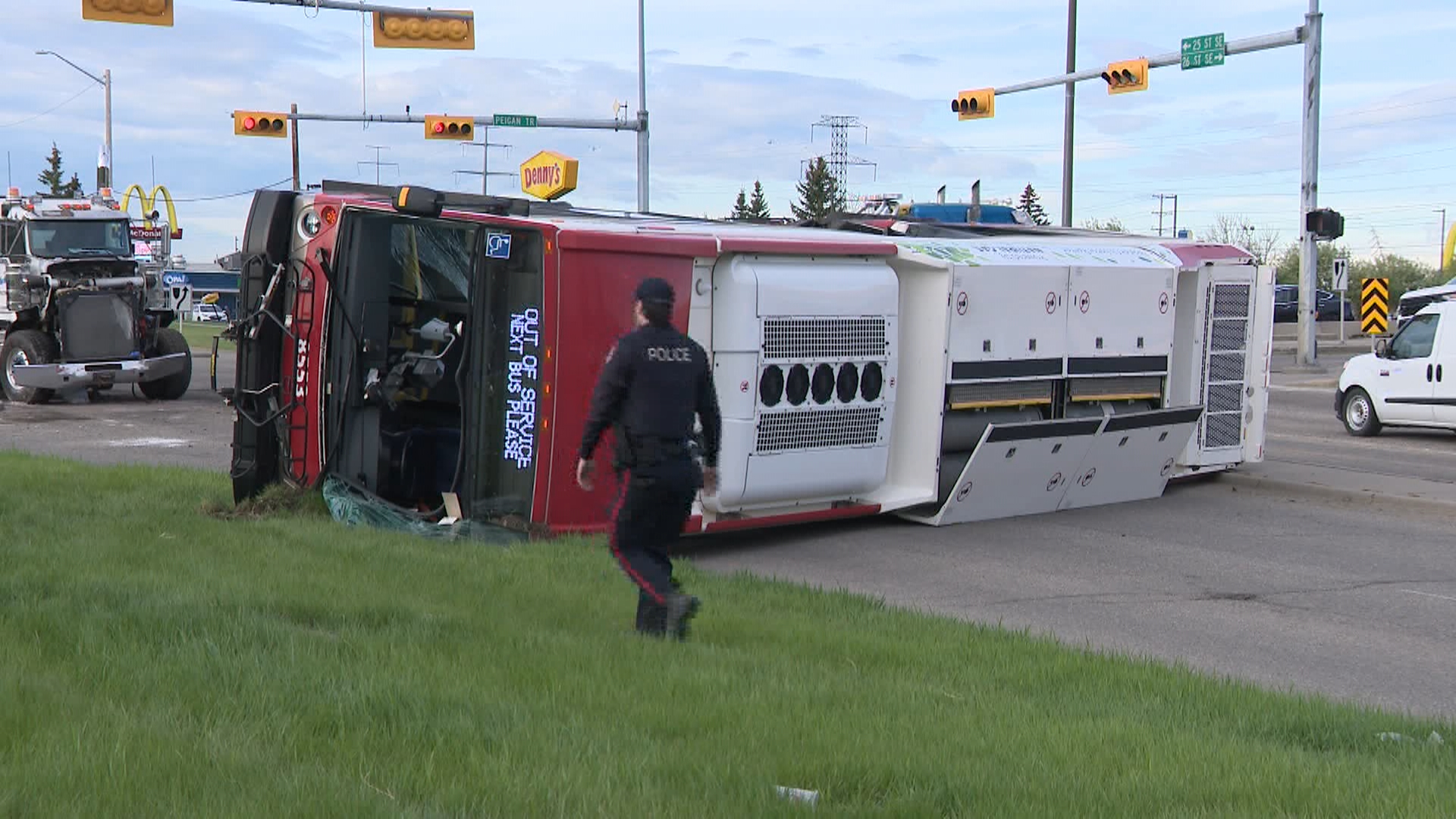
A standard morning commute turned into a chaotic emergency scene in southeast Calgary when a Calgary Transit bus collided with a heavy semi-truck hauling gravel. The violent impact at Peigan Trail and 26 Street SE sent the municipal transit vehicle spinning before it rolled onto its side, trapping passengers inside. Initial emergency responder reports indicated that multiple people required immediate transportation to local hospitals with non-life-threatening injuries, while overall casualty estimates from the scene ranged up to six injured individuals.
Local commuters captured early dashcam footage suggesting the heavy commercial gravel truck failed to stop for a red traffic light, broadsiding the urban transit bus at approximately 7:20 a.m.
While city officials quickly categorized the event as an isolated traffic mishap, industry watchdogs and seasoned transit analysts recognize a deeper problem. This rollover is not merely a statistical anomaly. It exposes the vulnerable structural position of urban mass transit operating alongside heavy industrial shipping corridors, highlighting systemic gaps in city infrastructure and defensive operator training.
The Industrial Intersections Putting Passengers At Risk
Major industrial hubs rely on heavy commercial vehicles to move materials. Calgary has intentionally routed massive commercial shipping corridors through areas shared heavily by everyday municipal transit routes. The intersection of Peigan Trail and 26 Street SE serves as a prime example of this hazardous municipal design.
When a forty-ton gravel truck encounters a standard city transit vehicle, the physics are entirely one-sided. Municipal transit buses are engineered to withstand urban collisions, but they are top-heavy and lack the reinforced roll-cage systems found in long-distance coach lines. The moment a commercial semi-truck delivers a direct side impact, the structural center of gravity shifts, making a catastrophic rollover almost inevitable.
City planners have historically prioritized economic throughput, ensuring that industrial freight moves quickly from major distribution centers to peripheral highways. This economic speed comes at a literal cost to commuter safety. Relying on simple automated traffic lights to manage the high-stakes intersection of heavy industrial hauling and mass passenger transit is an outdated approach that invites human error to cause structural devastation.
The Blind Spot In Transit Defensive Strategy
Driving a city transit vehicle requires a specialized skill set. Navigating tight urban avenues, managing unpredictable passenger dynamics, and maintaining tight schedules forces operators into a high-stress operational environment. However, the unique danger of mixed-use industrial zones requires an entirely different style of defensive driving that current training regimens fail to adequately address.
A standard transit training protocol focuses primarily on pedestrian awareness, low-speed mirror tracking, and smooth braking deceleration. It expects cross-traffic to follow standard rules. When a heavy commercial vehicle ignores a red light, a transit operator possesses very few evasive options because city buses accelerate slowly and handle poorly in sudden maneuvers.
Vehicle Type     Weight Class    Maneuverability    Roll Risk Factor
Standard Sedan   Light           High               Very Low
Transit Bus      Heavy/Urban     Low                High
Gravel Semi      Extreme/Freight Extremely Low      Moderate
The table above illustrates the disparity. A transit bus occupies a dangerous middle ground, carrying the weight of a heavy commercial vehicle but lacking the structural stability or the cabin isolation of a commercial freight truck. When forced to share identical lanes with industrial transport, transit operators are essentially operating at a permanent disadvantage.
Upgrading Infrastructure Beyond Traffic Lights
Hoping that drivers will always obey traffic signals is a flawed safety strategy. To prevent identical rollovers in heavy commercial zones, municipal traffic planners must look toward active intervention infrastructure.
Implementing physical infrastructure upgrades could dramatically lower the frequency of broadside collisions.
- Preemptive Signal Technology: Installing transponders on heavy commercial trucks and city buses that actively communicate with traffic lights to extend red-light buffers when high-speed approaches are detected.
- Dedicated Mass Transit Right-of-Ways: Separating city transit routes completely from heavy industrial haul routes, ensuring that commercial trucks and public commuters do not cross paths at high speeds.
- Reinforced Intersection Geometry: Redesigning industrial roundabouts or altering approach angles to force massive commercial vehicles to decelerate significantly before entering a shared transit zone.
These changes require significant capital investments, an obstacle that municipal governments routinely use to delay structural changes. Yet, continuing to ignore the structural incompatibility of mixing industrial freight with public transit will guarantee that today's rollover on Peigan Trail is repeated on another shared corridor tomorrow.
The Cost Of Operational Inaction
Every municipal transit incident triggers an official internal investigation. Investigators check onboard telemetry, interview the operator, examine mechanical maintenance logs, and review available video footage. In most scenarios, the final report places the blame neatly on an individual driver's negligence or a singular environmental factor, allowing the broader system to escape accountability.
This administrative redirection shields municipal agencies from facing the reality of their outdated routing choices. Labeling a massive broadside collision and subsequent vehicle rollover as a simple traffic infraction ignores the institutional failure to protect vulnerable public ridership. Public transit cannot be considered a viable, trustworthy alternative to personal vehicles if a routine morning route involves sharing high-speed intersections with rule-breaking heavy industrial vehicles.
Fixing this structural flaw requires moving past basic press releases and minor policy adjustments. It demands an immediate, comprehensive review of every square kilometer where public transit lines overlap with heavy industrial freight routes. Until city planners actively separate mass transit from industrial transport corridors, passengers will remain exposed to the unpredictable hazards of heavy freight traffic.