The conviction of a retired member of the clergy for violating an abortion clinic "buffer zone" functions as a critical case study in the friction between localized administrative orders and constitutional expressions of belief. This legal outcome is not an isolated event but the result of a specific intersection between the Public Order Act 2023 and the operational implementation of Safe Access Zones. To understand why a 72-year-old individual can be found guilty of a criminal offense for standing within a specific radius of a healthcare facility, one must deconstruct the statutory definitions of "interference" and the spatial mechanics of exclusion zones.
The core tension lies in the shift from conduct-based policing to location-based prohibitions. In traditional public order law, an offense generally requires an overt act of harassment or obstruction. However, under the current legislative framework governing buffer zones, the mere presence of a person within a designated perimeter—if accompanied by intent to influence—triggers a criminal liability regardless of the volume or visibility of their conduct.
The Tripartite Framework of Safe Access Zone Enforcement
The legal architecture supporting these convictions rests on three distinct pillars:
- Spatial Determinism: The creation of a geofenced area (typically a 150-meter radius) where specific civil liberties are suspended in favor of maintaining "unimpeded access" to services.
- Intentionality vs. Impact: The prosecution does not need to prove that a patient felt intimidated; it only needs to establish that the defendant intended to influence or "interfere" with a person’s decision to access the service.
- The Proportionality Test: The judicial balancing act where the court decides if the restriction on Article 9 (freedom of thought, conscience, and religion) and Article 10 (freedom of expression) rights is "necessary in a democratic society" to protect the Article 8 rights (right to private and family life) of service users.
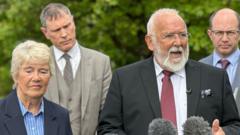
The conviction of Stephen Green in the United Kingdom highlights a specific interpretation of "interference." By holding a sign with a biblical verse within the exclusion zone, the defendant engaged in what the court categorized as a "prohibited act." The legal logic suggests that the content of the sign is secondary to the location of the act. If the sign is intended to be seen by those entering the clinic, and its message pertains to the services offered therein, the act satisfies the criteria for a breach of the zone’s protective mandate.
The Mechanism of Passive Influence
A significant point of contention in these cases is the definition of "protest." Defense strategies often attempt to distinguish between "active" protest (shouting, blocking paths, distributing leaflets) and "passive" presence (silent prayer, holding signs, standing still). The judiciary has increasingly rejected this distinction.
The operational logic used by the courts is that passive presence still constitutes a psychological barrier. In a healthcare context, particularly one involving reproductive services, the presence of an individual known to oppose the procedure creates a "chilling effect." From a data-driven perspective, the efficacy of a buffer zone is measured by the reduction in reported "avoidance behaviors" by patients. If a patient changes their route, delays their appointment, or experiences heightened physiological stress due to a visible presence, the buffer zone is deemed to have been breached in spirit and, by extension, in law.
Analyzing the Statutory Cost-Benefit Ratio
The implementation of Safe Access Zones across the UK and other jurisdictions represents a calculated trade-off between individual expression and collective access.
- The Benefit Variable: The primary objective is the "de-risking" of medical pathways. By removing adversarial actors from the immediate vicinity of a clinic, the state reduces the probability of physical altercations and psychological trauma for a vulnerable demographic.
- The Cost Variable: The "cost" is the curtailment of the right to assembly in public spaces. This creates a precedent where the government can designate "sensitive" locations as exempt from standard protest norms.
The conviction of a retired pastor serves as a stress test for this ratio. The state argues that the cost (the fine and criminal record of one individual) is outweighed by the benefit (the uninterrupted access for hundreds of patients). Critics, however, argue that this creates a "floating" definition of criminality where an act—standing on a sidewalk—is legal on one side of a line and illegal on the other.
The Disconnect Between Individual Agency and State Mandate
One of the structural failures in the discourse surrounding these convictions is the neglect of the "Intent-Impact Gap." A defendant may believe they are acting out of a moral or religious duty to offer help (their internal intent). The state, conversely, views the same action through the lens of institutional efficiency and patient protection (the external impact).
The court’s role is not to adjudicate the morality of the defendant’s belief system, but to determine if the expression of that belief disrupts a state-sanctioned service. In the case of buffer zones, the law has moved toward a Strict Liability model. Under this model, the nuances of the defendant's motivation are irrelevant if the physical act of presence within the 150-meter zone is proven.
Structural Obstacles in Defense Litigation
Defendants in these cases face a bottleneck in legal strategy. The "Reasonable Excuse" defense is the most common avenue, where a defendant argues that their presence was justified by a higher moral or legal obligation. However, this defense is systematically undermined by the wording of the Safe Access Zone legislation.
The legislation is written to be preemptive. It does not wait for a conflict to occur; it assumes that the presence of an opposing party is the conflict. Therefore, a "reasonable excuse" must be unrelated to the protest itself (e.g., waiting for a bus, walking to a shop). If the "excuse" is rooted in the act of being a witness or praying, it is inherently an admission of the intent to influence, which is the very thing the law prohibits.
The Logic of Escalating Penalties
The sentencing in these cases—often involving fines and victim surcharges—is designed to function as a deterrent for a specific demographic: motivated activists who view legal penalties as a form of "cost of doing business."
By securing a guilty verdict against a figure like a retired pastor, the state signals that age, professional background, and the "peaceful" nature of the act do not provide immunity. This is a move toward Homogenized Enforcement, where the law is applied with clinical indifference to the profile of the offender.
The Precedential Impact on Public Space
The broader implication of these convictions is the normalization of "sensitive area" geofencing. If buffer zones are deemed effective and legally sound for abortion clinics, the framework can logically be extended to:
- Animal Research Facilities: To prevent harassment of staff.
- Government Buildings: During periods of high civil unrest.
- Private Residences of Public Officials: To ensure personal safety.
Each expansion of this logic further segments the public square into "zones of permitted speech" and "zones of total silence." The conviction of Stephen Green is not merely a local news item; it is a data point indicating a long-term shift in the management of public dissent.
Strategic Recommendation for Legal and Policy Analysts
Organizations monitoring these developments must move beyond the emotive rhetoric of "religious freedom" versus "reproductive rights" and focus on the Administrative Architecture of the zones. The focus should be on the clarity of signage, the precision of the 150-meter boundaries, and the specific police training regarding "influence" versus "presence."
For those navigating the legal landscape of protest, the strategic play is to challenge the evidentiary basis of "intent." Since these convictions hinge on the defendant’s desire to influence others, the burden of proof rests on the state to demonstrate that prayer or sign-holding is directed at clinic users rather than being a general expression of faith. Without a recorded interaction or specific proximity to a patient, the prosecution's case relies on an inference of intent that is vulnerable to rigorous cross-examination.
The definitive forecast is an increase in the frequency of these convictions as Safe Access Zones become standard across the UK. The judiciary has signaled its commitment to the "impact-first" model of public order. Consequently, the only remaining variable is the extent to which the Supreme Court or international human rights bodies will intervene to recalibrate the balance between localized safety and national constitutional protections. Until such an intervention occurs, the spatial geofence remains the supreme arbiter of legality in the vicinity of healthcare facilities.
- Ensure all potential defendants are aware that "passive presence" is now legally indistinguishable from "active protest" within a 150-meter radius.
- Monitor the rollout of the Public Order Act 2023 to identify if the definition of "interference" expands to include digital or remote communication aimed at clinic users.
- Analyze the sentencing trends to determine if courts are moving from fines toward suspended sentences for repeat offenders, which would indicate a shift from deterrence to incapacitation.
The resolution of these cases will dictate the future of "bubble laws" worldwide, setting the standard for how liberal democracies manage the physical proximity of ideological adversaries.