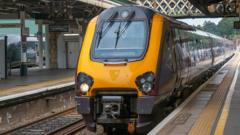
Commuters across Southern England are currently facing a total standstill as a series of infrastructure failures have triggered a complete shutdown of major lines into London. The disruption, which officials admit will last until the end of service tonight, has left thousands stranded at stations from Brighton to Portsmouth. While the immediate cause is being attributed to a combination of signaling failures and track defects near key junctions, the reality is a much grimmer reflection of a Victorian-era network being pushed far beyond its breaking point. This isn’t just a bad day at the office for Great Western Railway and Southern Rail; it is a systemic collapse that has become the new, exhausting normal for the British public.
The Anatomy of a Systemic Failure
When a signal fails in the South East, the ripple effect is almost instantaneous. The geography of the UK rail network means that nearly every major line feeds into a handful of bottlenecks. Today, those bottlenecks tightened into a noose.
The breakdown began in the early hours near East Croydon, a critical nerve center for the Brighton Main Line. A "fault with the signaling system" is the official line, but that sanitized phrase hides a complex mess of aging copper wires and software that struggles to talk to hardware installed decades ago. By 8:00 AM, the delays had metastasized. Because trains cannot simply "pull over" to let others pass, a twenty-minute delay at Croydon translates into a two-hour cancellation in Southampton.
The sheer volume of traffic makes recovery impossible. Unlike a motorway where a cleared accident allows traffic to eventually find its rhythm, the rail schedule is a rigid deck of cards. One card falls, and the whole house follows. Engineers are currently on-site, but they are fighting a battle against time and a lack of redundant systems. If the primary relay fails and the backup is corroded, the only safe option is to halt all movement. Safety is the priority, but it has become the shield behind which a lack of investment hides.
The Financial Fallout Beyond the Ticket Gate
We often talk about the cost of a train ticket, but we rarely quantify the cost of the train not arriving. The economic hit from today's disruption is estimated to run into the millions.
Consider the ripple effects.
- Lost Productivity: Thousands of workers are currently sitting on station floors or in overpriced coffee shops instead of at their desks.
- Supply Chain Friction: While passengers feel the pinch, light freight and mail services that rely on these corridors are also shunted into sidings.
- Retail Decline: Businesses located in major hubs like London Victoria or London Bridge see footfall evaporate when the platforms go silent.
For the private operators, the financial penalty system—often referred to as Schedule 8 payments—means they must compensate Network Rail for delays they cause, and vice versa. However, these payments are a circular flow of money that never seems to find its way back into actual track improvements. It is a closed loop of bureaucratic fines that does nothing to replace a cracked rail or an ancient transformer.
Why Maintenance is a Losing Battle
The central problem is one of "access." Network Rail, the body responsible for the tracks, is caught in a perpetual catch-22. To fix the tracks properly, they need to shut them down. But because the Southern lines are so vital to the economy, the government and the public demand they stay open 24/7.
This results in a "patch-and-mend" culture. Instead of a comprehensive overhaul that would require a week-long closure and provide twenty years of stability, teams are given four-hour windows in the middle of the night to perform "surgical" repairs. It is the equivalent of trying to perform open-heart surgery on a patient while they are running a marathon.
The Problem with the Rolling Stock
Even when the tracks work, the trains themselves are becoming a liability. Much of the fleet operating in the South is aging. Older units are more susceptible to "leaves on the line"—a phrase that has become a national joke but remains a genuine friction problem—and more importantly, they are prone to mechanical failure in the fluctuating British climate. Today’s humidity and sudden temperature shifts can cause older electronics to overheat, leading to the dreaded "short circuit" that can take out a whole carriage's power system.
The Counter Argument The Case for Nationalization
There is a growing chorus of voices claiming that the current franchise or "contract" model is the root of the rot. The argument is simple: private companies are incentivized to maximize dividends rather than long-term infrastructure health. Since the tracks are owned by the state (via Network Rail) but the trains are run by private firms, there is a constant blame-shifting exercise whenever something goes wrong.
The government’s move toward "Great British Railways" is intended to fix this by bringing the two halves back together. However, critics argue this is merely a rebranding of the same underfunded system. Changing the logo on the side of the train does not change the fact that the signals under the ballast were installed when Margaret Thatcher was in power.
The Human Cost of Commuter Fatigue
Beyond the spreadsheets and the engineering reports lies the psychological toll on the passenger. For a worker in Crawley or Brighton, the rail service is not a luxury; it is a vital utility, like water or electricity. When it fails, it disrupts childcare, medical appointments, and mental well-being.
The "delay repay" system is often touted as the solution for disgruntled passengers. Yet, the process of claiming back £15 for a two-hour delay is often so cumbersome that many don't bother. This creates a data gap where the true level of passenger dissatisfaction is never fully captured by the operators. They see a "90% punctuality" rate on paper, but that figure often excludes "planned" cancellations or skips stations to make up time—a tactic known as "stop-skipping" that leaves passengers at smaller stations completely stranded.
A Fragile Future
As we look at the maps today, glowing red with "No Service" icons, we have to ask how long this can continue. The shift toward hybrid work was supposed to ease the pressure on the rail network. Instead, it has made the network more fragile. With fewer people traveling on Mondays and Fridays, the revenue for the operators has dipped, leading to even deeper cuts in maintenance budgets and staffing.
The staff who remain are often the ones facing the brunt of public anger. Station masters and platform guards are currently dealing with thousands of frustrated people, often with very little information themselves. The communication breakdown is usually just as severe as the mechanical one. When the central control room doesn't know when a part will arrive, the person on the platform can only offer a shrug and a "check the app."
The Only Real Fix
The solution isn't a new app or a better refund policy. The solution is a decade of sustained, "boring" investment.
We need to stop looking for a silver bullet. High-speed rail gets all the headlines and the multi-billion-pound budgets, but it is the commuter "donkey work" lines that keep the country running. Replacing every 40-year-old signal box with a modern digital interlocking system would do more for the British economy than any flagship project.
Until that happens, the people of Southern England will continue to be held hostage by a network that is quite literally rusting away. Today’s disruption isn't an anomaly. It is a warning. Every time we ignore a minor signaling fault, we are just counting down the minutes until the next total shutdown.
The current advice for passengers is to avoid travel entirely. It is a damning indictment of a national infrastructure when the official recommendation for using a service is "don't."
Check your routes, find a bus, or stay home. The trains aren't coming.